Biofilm Formation and Doripenem Susceptibility in Clinical Pseudomonas aeruginosa: Anti-Biofilm Effect of Sub-MIC Doripenem
DOI:
https://doi.org/10.65329/wjeb.v14.02.08Keywords:
Biofilm formation;, carbapenem resistance, Pseudomonas aeruginosa, sub-inhibitory concentration.Abstract
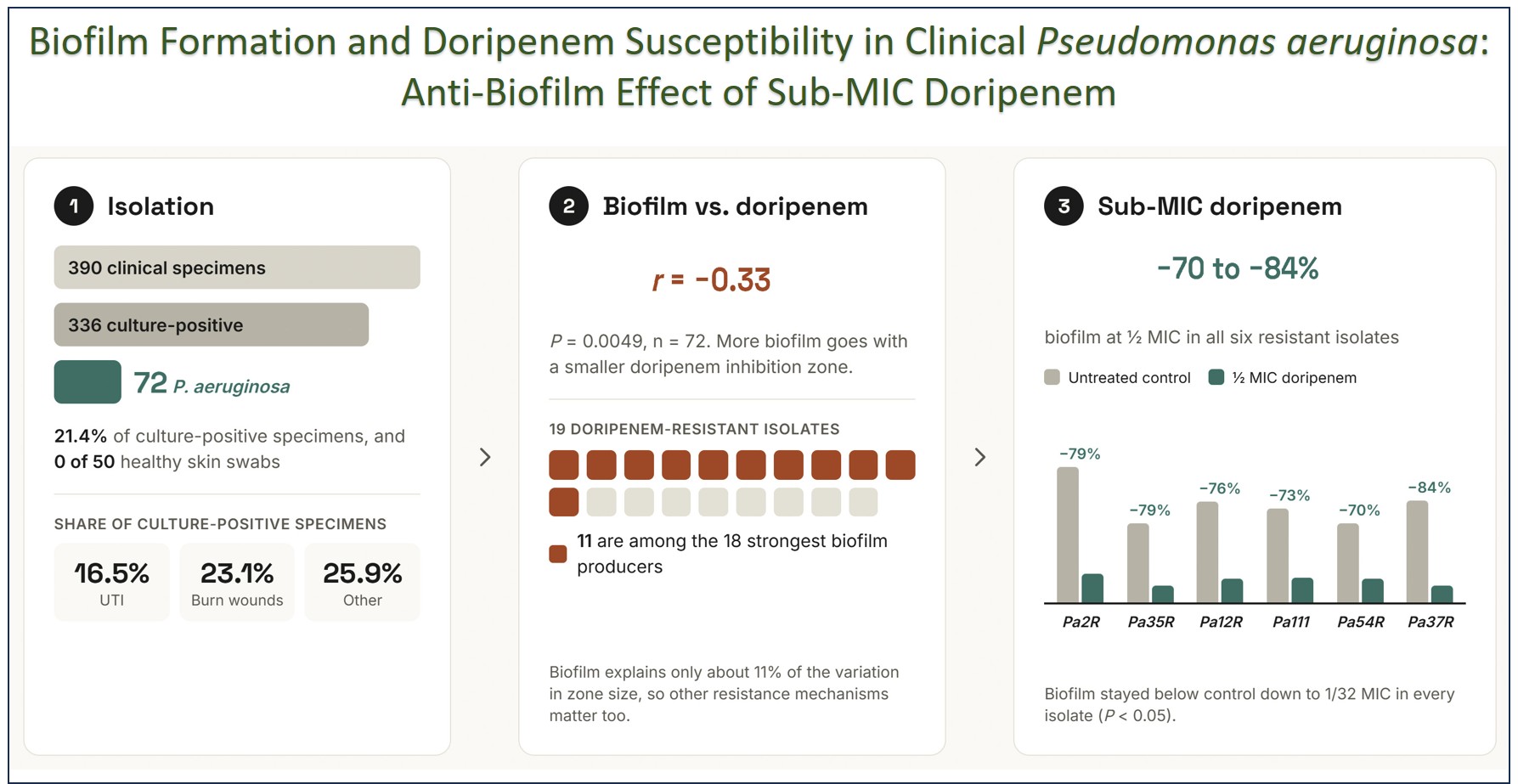
Pseudomonas aeruginosa is a major cause of burn, wound, and urinary tract infections. It poses a serious threat to global public health. Biofilm formation by this pathogen may contribute to its reduced susceptibility to carbapenems. P. aeruginosa was isolated from 390 clinical specimens and 50 healthy skin swabs. The 72 isolates were isolated and tested for susceptibility to six antibiotics by disk diffusion and for biofilm formation by the microtiter plate assay. The Pearson correlation coefficient between biofilm OD590 and doripenem inhibition zone diameter was calculated. Six doripenem-resistant, strong biofilm-producing isolates were exposed to doripenem from 1/2 to 1/2048 MIC. P. aeruginosa was isolated from 72 of 336 culture-positive clinical specimens (21.4%) and from none of the healthy controls. The present study showed that nineteen isolates (26.4%) were resistant to doripenem. Biofilm formation correlated negatively with doripenem zone diameter (r = −0.328, P = 0.0049). At 1/2 MIC, doripenem reduced biofilm in all six isolates by roughly 40–83%, and biofilm remained below the control at 1/32 MIC in all of them. Some isolates produced more biofilm at certain sub-MICs. Stronger biofilm formation was modestly associated with reduced doripenem susceptibility, and sub-MIC doripenem can limit biofilm formation in resistant isolates, although the effect varies between strains.
Article History:
Received: September 01, 2026
Revised: October 28, 2026
Accepted: November 21, 2026
Published: November 28, 2026
Downloads
References
[1] Ali S, Assafi M. (2024) Prevalence and antibiogram of Pseudomonas aeruginosa and Staphylococcus aureus clinical isolates from burns and wounds in Duhok City, Iraq. J Infect Dev Ctries 18(1):82-92. doi: https://doi.org/10.3855/jidc.18193. PMID: 38377094. DOI: https://doi.org/10.3855/jidc.18193
[2] El Husseini N, Carter JA, Lee VT. (2024) Urinary tract infections and catheter-associated urinary tract infections caused by Pseudomonas aeruginosa. Microbiol Mol Biol Rev 88(4):e00066-22. doi: https://doi.org/10.1128/mmbr.00066-22. PMID: 39431861. DOI: https://doi.org/10.1128/mmbr.00066-22
[3] Roy R, Tiwari M, Donelli G, Tiwari V. (2018) Strategies for combating bacterial biofilms: a focus on anti-biofilm agents and their mechanisms of action. Virulence 9:522–554. doi: https://doi.org/10.1080/21505594.2017.1313372. PMID: 28362216. DOI: https://doi.org/10.1080/21505594.2017.1313372
[4] Zhang X, Zhang D, Zhou D, Zheng S, Li S, et al. (2025) A comprehensive review of the pathogenic mechanisms of Pseudomonas aeruginosa: synergistic effects of virulence factors, quorum sensing, and biofilm formation. Front Microbiol 16:16-196-26. doi: https://doi.org/10.3389/fmicb.2025.1619626. PMID: 40761286. DOI: https://doi.org/10.3389/fmicb.2025.1619626
[5] Krūmiņa A, Reinis A, Jeske A, Zeltiņa I, Vīksna L. (2026) Molecular Mechanisms Underlying the Pathogenicity of Pseudomonas aeruginosa. Medicina 62(3):462. doi: https://doi.org/10.3390/medicina62030462. PMID: 41901545. DOI: https://doi.org/10.3390/medicina62030462
[6] Sahu A, Ruhal R. (2025) Immune system dynamics in response to Pseudomonas aeruginosa biofilms. NPJ Biofilms Microbiomes 11(1):104. https://doi.org/10.1038/s41522-025-00738-2. PMID: 40506442. DOI: https://doi.org/10.1038/s41522-025-00738-2
[7] Soltani B, Ahmadrajabi R, Kalantar-Neyestanaki D. (2024) Critical resistance to carbapenem and aminoglycosides in Pseudomonas aeruginosa: spread of blaNDM/16S methylase armA harboring isolates with intrinsic resistance mechanisms in Kerman, Iran. BMC Infect Dis 24:1188. doi: https://doi.org/10.1186/s12879-024-10085-w. PMID: 39434025. DOI: https://doi.org/10.1186/s12879-024-10085-w
[8] Matthews SJ, Lancaster JW. (2009) Doripenem monohydrate, a broad-spectrum carbapenem antibiotic. Clin Ther 31(1):42–63. https://doi.org/10.1016/j.clinthera.2009.01.013. PMID: 19243706. DOI: https://doi.org/10.1016/j.clinthera.2009.01.013
[9] Hemmati J, Nazari M, Abolhasani FS, Ahmadi A, Asghari B. (2024) In vitro investigation of relationship between quorum-sensing system genes, biofilm forming ability, and drug resistance in clinical isolates of Pseudomonas aeruginosa. BMC Microbiol 24(99). doi: https://doi.org/10.1186/s12866-024-03249-w. PMID: 38528442. DOI: https://doi.org/10.1186/s12866-024-03249-w
[10] Mahmood HM, Al-Mohammed T. (2024) Carbapenem resistance related to biofilm formation in clinical Pseudomonas aeruginosa isolates. Iraqi J Pharm Sci 33(1):72-78. doi: https://doi.org/10.31351/vol33iss1pp72-78. DOI: https://doi.org/10.31351/vol33iss1pp72-78
[11] Hu M, Chua SL. (2025) Antibiotic-Resistant Pseudomonas aeruginosa: Current Challenges and Emerging Alternative Therapies. Microorganisms 13(4):913. doi: https://doi.org/10.3390/microorganisms13040913. PMID: 40284749. DOI: https://doi.org/10.3390/microorganisms13040913
[12] Al-mutalib LAA, Zgair AK. (2023) Sub-inhibitory doses of Ofloxacin reduce adhesion and biofilm formation of Pseudomonas aeruginosa to biotic and abiotic surfaces. Pharm Sci Asia 50(3):196–203. doi: https://doi.org/10.29090/psa.2023.03.23.377. DOI: https://doi.org/10.29090/psa.2023.03.23.377
[13] Ficociello B, Giordano D, Incoronato F, Farinella A, Pietrangeli B. (2023) WHO Laboratory Biosafety Manual: A new approach to security. Ann Work Expo Health 67(4):425–429. doi: https://doi.org/10.1093/annweh/wxac086. DOI: https://doi.org/10.1093/annweh/wxac086
[14] Clinical and Laboratory Standards Institute. (2024) Performance Standards for Antimicrobial Susceptibility Testing. 34th ed. CLSI supplement M100. Wayne, PA: Clinical and Laboratory Standards Institute.
[15] A Haidar, A Muazzam, A Nadeem, R Atique, HA Saeed, et al. (2024) Biofilm formation and antibiotic resistance in Pseudomonas aeruginosa. The Microbe 3:100078. doi: https://doi.org/10.1016/j.microb.2024.100078. DOI: https://doi.org/10.1016/j.microb.2024.100078
[16] Brady AJ, Laverty G, Gilpin DF, Kearney P, Tunney M. (2017) Antibiotic susceptibility of planktonic- and biofilm-grown staphylococci isolated from implant-associated infections: should MBEC and nature of biofilm formation replace MIC?. J Med Microbiol 66(4):461–469. doi: https://doi.org/10.1099/jmm.0.000466. PMID: 28463662. DOI: https://doi.org/10.1099/jmm.0.000466
Additional Files
Published
Issue
Section
License

This work is licensed under a Creative Commons Attribution 4.0 International License.
All articles in the World Journal of Experimental Biosciences are published under the terms of the Creative Commons Attribution 4.0 International License (CC BY 4.0) ( (http://creativecommons.org/licenses/by/4.0/), which permits unrestricted use, distribution, and reproduction in any medium, provided the original work is properly cited.