Silver Nanoparticles from Lawsonia inermis against Uropathogenic Escherichia coli: Antimicrobial, Antibiofilm, and Molecular Docking Investigations
Silver Nanoparticles Against Uropathogenic E. coli
DOI:
https://doi.org/10.65329/wjeb.v14.01.06Keywords:
Antibiofilm, DNA gyrase, FimH, Green nanotechnology, Lawsonia inermis, Molecular docking, Silver nanoparticles, Uropathogenic Escherichia coliAbstract
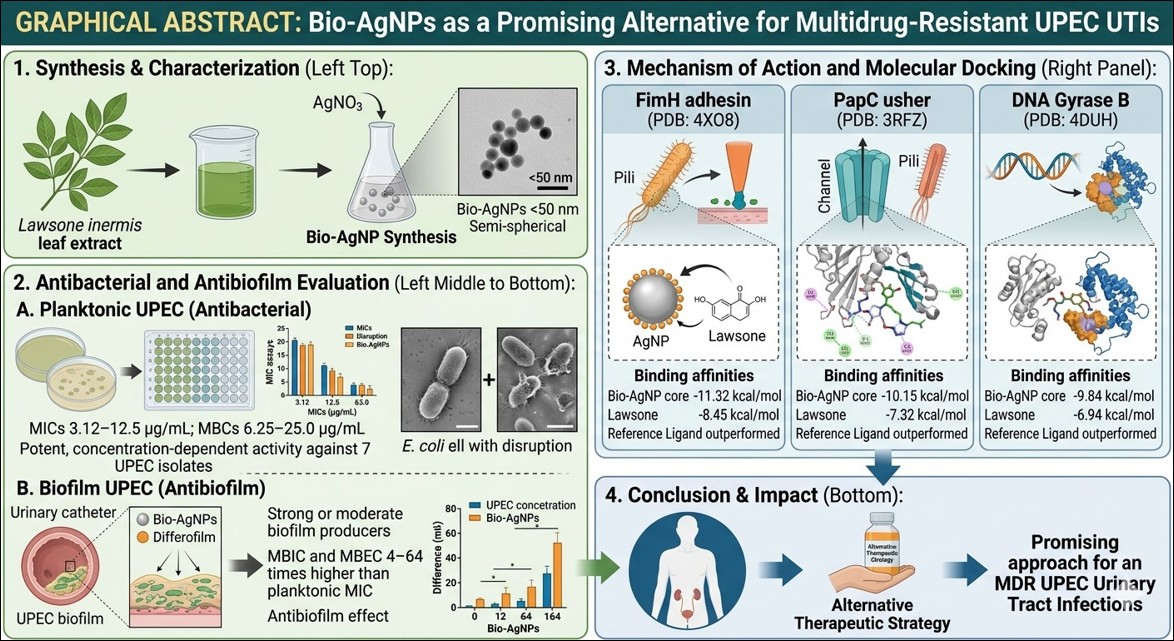
Uropathogenic Escherichia coli (UPEC) is responsible for more than 80% of urinary tract infections (UTIs). These infections are associated with multidrug resistance, especially to extended-spectrum beta-lactamases (ESBL). This study evaluated the antibacterial and antibiofilm potential of biogenic silver nanoparticles (Bio-AgNPs) synthesized using Lawsonia inermis (henna) leaf extract against multidrug-resistant UPEC isolates. The virulence (fimH and papC) and resistance genes (blaCTX-M and blaKPC) in UPEC were amplified using multiplex PCR. The study also explores their mechanism of action and their molecular docking with three key UPEC virulence targets. The fimH gene was found in all isolates, while papC was found only in four isolates. The study showed that blaCTX-M and blaKPC genes were present in 4 and 1 isolate from 7 studies, respectively. Synthesized bio-AgNPs were semi-spherical (less than 50 nm). Bio-AgNPs exhibited potent, concentration-dependent bactericidal activity against all seven UPEC isolates (MICs of 3.12–12.5 µg/mL; MBCs of 6.25–25.0 µg/mL). All UPEC isolates were strong or moderate biofilm producers; minimum biofilm inhibitory concentration (MBIC) and minimum biofilm eradication concentration (MBEC) values were 4–64 times higher than planktonic MIC values. Molecular docking demonstrated strong binding affinities of the bio-AgNP silver core (−9.84 to −11.32 kcal/mol) and lawsone (−6.94 to −8.45 kcal/mol) against FimH adhesin (PDB: 4XO8), PapC usher (PDB: 3RFZ), and DNA Gyrase B (PDB: 4DUH), outperforming reference ligands. These findings support the use of bio-AgNPs synthesized as a promising alternative therapeutic strategy against multidrug-resistant (MDR) UPEC-associated UTIs. This finding needs an in vivo improvement project.
Article History:
Received May 10, 2026
Revised June 17, 2026
Accepted: June 19, 2026
Published: June 25, 2026
Downloads
References
[1] Mancuso G, Midiri A, Gerace E, Marra M, Zummo S, Biondo C. (2023) Urinary Tract Infections: The Current Scenario and Future Prospects. Pathogens (Basel, Switzerland), 12(4), 623. doi: https://doi.org/10.3390/pathogens12040623, PMCID: PMC10145414
[2] Azimzadeh PN, Birchenough GM, Gualbuerto NC, Pinkner JS, Tamadonfar KO, et al. (2025) Mechanisms of uropathogenic E. coli mucosal association in the gastrointestinal tract. Sci Adv 11(5), eadp7066. doi: https://doi.org/10.1126/sciadv.adp7066 . PMCID: PMC11784811
[3] Li X, Li Q, He A, Dang M, Zhang Y, et al. (2025) Disrupting Biofilm Tolerance by Ionic Microbubble-Mediated Copper Ion Surge for Infection Clearance. ACS nano 19(31), 28624–28643. doi: https://doi.org/10.1021/acsnano.5c08035. PMID: 40743484.
[4] Sroithongkham P, Nittayasut N, Yindee J, Nimsamer P, Payungporn S, et al. (2024) Multidrug-resistant Escherichia coli causing canine pyometra and urinary tract infections are genetically related but distinct from those causing prostatic abscesses. Sci Rep 14(1):11848.doi: doi: https://doi.org/10.1038/s41598-024-62028-9. PMCID: PMC11116460.
[5] Rodrigues AS, Batista JGS, Rodrigues MÁV, Thipe VC, Minarini LAR, et al. (2024) Advances in silver nanoparticles: a comprehensive review on their potential as antimicrobial agents and their mechanisms of action elucidated by proteomics. Front Microbiol 15:1440065. doi: https://doi.org/10.3389/fmicb.2024.1440065. PMCID: PMC11325591.
[6] Ijaz I, Gilani E, Nazir A, Bukhari A. (2020) Detail review on chemical, physical and green synthesis, classification, characterizations and applications of nanoparticles. Green Chem Lett Rev 13(3), 223-245. doi: https://doi.org/10.1080/17518253.2020.1802517.
[7] Said A, Abu-Elghait M, Atta HM, Salem SS. (2024) Antibacterial Activity of Green Synthesized Silver Nanoparticles Using Lawsonia inermis Against Common Pathogens from Urinary Tract Infection. Appl Biochem Biotechnol 196(1): 85–98. doi: https://doi.org/10.1007/s12010-023-04482-1. PMCID: PMC10794286.
[8] Malaikozhundan B, Mohandoss S, Krishnamoorthi R, Bharathi PV, Palanisamy S, Vinodhini J. (2024) Enhanced bactericidal, antibiofilm and antioxidative response of Lawsonia inermis leaf extract synthesized ZnO NPs loaded with commercial antibiotic. Bioprocess Biosyst Eng 47(8), 1241–1257. doi: https://doi.org/10.1007/s00449-024-03000-9. PMID: 38607416.
[9] Danaei M, Motaghi MM, Naghmachi M, Amirmahani F, Moravej R. (2021) Green synthesis of silver nanoparticles (AgNPs) by filamentous algae extract: comprehensive evaluation of antimicrobial and anti-biofilm effects against nosocomial pathogens. Biologia 76, 3057–3069. doi: https://doi.org/10.1007/s11756-021-00808-8 .
[10] Al-Mutalib LAA, Zgair AK. (2023) Effect of subinhibitory doses of rifaximin on in vitro Pseudomonas aeruginosa adherence and biofilm formation to biotic and abiotic surface models. Polim Med 53(2), 97–103. doi: https://doi.org/10.17219/pim/166584, PMID: 37470308
[11] Mogessie H, Legesse M, Feleke Haile A, Tesfaye Beyene G, T/Haimanot T, et al. (2025) Genetic analysis of virulence, extended spectrum beta lactamase, and carbapenem resistance in Escherichia coli O157:H7 isolates from drinking water and wastewater in Addis Ababa, Ethiopia. J Environ Sci Health A Tox Hazard Subst Environ Eng 60(7), 342–350. doi: https://doi.org/10.1080/10934529.2025.2596531. PMID: 41352762
[12] Shnyoor HA, Zgair AK. (2025) Effect of combination of sub-inhibitory concentrations of cefepime and Thymus vulgaris essential oil in modulating biofilm formation of Enterococcus faecalis in vitro. Pharm Sci Asia 52(3). doi: https://doi.org/10.29090/psa.2025.03.25.3835 .
[13] Stec J, Kosikowska U, Mendrycka M, Stępień-Pyśniak D, Niedźwiedzka-Rystwej P, et al. (2022) Opportunistic Pathogens of Recreational Waters with Emphasis on Antimicrobial Resistance-A Possible Subject of Human Health Concern. Int J Environ Res Public Health 19(12):7308. doi: https://doi.org/10.3390/ijerph19127308. PMCID: PMC9224392.
[14] Thacharodi A, Ahmed T, Hassan S, Singh PAS, Pugazhendhi A. (2026) Carbapenem resistance and hypervirulence in Klebsiella pneumoniae are raising global public health concerns in the 21st century. iScience, 29(3), 114782. doi: https://doi.org/10.1016/j.isci.2026.114782.
[15] Mohammed MT, Zgair AK. (2025) Polymer matrix of biofilm in Klebsiella pneumoniae reduced by sub-MIC hydrogen peroxide enhances cefotaxime efficacy. Polim Med 55(2), 113–122. doi: https://doi.org/10.17219/pim/207885. PMID: 41396039.
[16] Sadiq SI, Ghafil JA. (2025) Polyhydroxybutyrate nanoparticle improving the sensitivity of Pseudomonas aeruginosa to ceftriaxone and reducing the biofilm formation in vitro. Polim Med 55(1): 31–37. doi: https://doi.org/10.17219/pim/203765 , PMID: 40599100.
[17] Wang H, Shi T, Ma J, Meng S, Wei Z, et al. (2025) Chitosan-based nanocomposite films incorporated with AgNPs/porphyrinic MOFs for killing pathogenic bacteria. Int J Biol Macromol 295:139584. doi: https://doi.org/10.1016/j.ijbiomac.2025.139584. PMID: 39788251
[18] Rai M, Ingle AP, Trzcińska-Wencel J, Wypij M, Bonde S, et al. (2021) Biogenic Silver Nanoparticles: What We Know and What Do We Need to Know?. Nanomaterials (Basel, Switzerland) 11(11), 2901. doi: https://doi.org/10.3390/nano11112901. PMCID: PMC8624974
[19] Mahale RP, Anuradha K, Princy A, Maheshwarappa YD, Sumana MN. (2025) Comparative evaluation of biofilm-forming capacity in uropathogenic and commensal Escherichia coli. Front cell Infect Microbiol 15:1570422. doi: https://doi.org/10.3389/fcimb.2025.1570422. PMCID: PMC12350247
[20] Millar BC, Cates MJ, Torrisi MS, Round AJ, Warde A, et al. (2026) Antimicrobial Resistance: The Answers. Br J Biomed Sci 83:15559. Doi: https://doi.org/10.3389/bjbs.2026.15559 . PMCID: PMC12922517.
[21] Lee SH, Jun BH. (2019) Silver Nanoparticles: Synthesis and Application for Nanomedicine. Int J Mol Sci 20(4): 865. Doi: https://doi.org/10.3390/ijms20040865. PMCID: PMC6412188.
[22] Rodríguez-Serrano C, Guzmán-Moreno J, Ángeles-Chávez C, Rodríguez-González V, Ortega-Sigala JJ, et al. (2020) Biosynthesis of silver nanoparticles by Fusarium scirpi and its potential as antimicrobial agent against uropathogenic Escherichia coli biofilms. PloS one 15(3): e0230275. Doi: https://doi.org/10.1371/journal.pone.0230275. PMCID: PMC7067426.
[23] Sharma D, Misba L, Khan AU. (2019) Antibiotics versus biofilm: an emerging battleground in microbial communities. Antimicrob Resist Infect Control 8:76. Doi: https://doi.org/10.1186/s13756-019-0533-3. PMCID: PMC6524306
[24] Sahli C, Moya SE, Lomas JS, Gravier-Pelletier C, Briandet R, Hémadi M. (2022) Recent advances in nanotechnology for eradicating bacterial biofilm. Theranostics 12(5): 2383–2405. doi: https://doi.org/10.7150/thno.67296. PMCID: PMC8899562.
[25] Kumar L, Bisen M, Harjai K, Chhibber S, Azizov S, et al. (2023) Advances in Nanotechnology for Biofilm Inhibition. ACS omega 8(24): 21391–21409. doi: https://doi.org/10.1021/acsomega.3c02239. PMCID: PMC10286099
[26] Dakal TC, Kumar A, Majumdar RS, Yadav V. (2016) Mechanistic Basis of Antimicrobial Actions of Silver Nanoparticles. Front Microbiol 7: 1831. Doi: https://doi.org/10.3389/fmicb.2016.01831. PMCID: PMC5110546.
[27] Morones JR, Elechiguerra JL, Camacho A, Holt K, Kouri JB, et al. (2005) The bactericidal effect of silver nanoparticles. Nanotechnology 16(10): 2346–2353. doi: https://doi.org/10.1088/0957-4484/16/10/059.
[28] Pettersen EF, Goddard TD, Huang CC, Meng EC, Couch GS, et al. (2021) UCSF ChimeraX: Structure visualization for researchers, educators, and developers. Protein Sci 30(1): 70–82. doi: https://doi.org/10.1002/pro.3943. PMCID: PMC7737788.
[29] Trott O, Olson AJ. (2010) AutoDock Vina: improving the speed and accuracy of docking with a new scoring function, efficient optimization, and multithreading. J Comput Chem 31(2): 455–461. doi: https://doi.org/10.1002/jcc.21334. PMCID: PMC3041641.
[30] Moxon CA, Paulus S. (2016) Beta-lactamases in Enterobacteriaceae infections in children. J Infect 72 Suppl: S41–S49. https://doi.org/10.1016/j.jinf.2016.04.021. PMID: 27180312.
[31] Mohanta YK, Chakrabartty I, Mishra AK, Chopra H, Mahanta S, et al. (2023) Nanotechnology in combating biofilm: A smart and promising therapeutic strategy. Front Microbiol 13: 1028086. doi: https://doi.org/10.3389/fmicb.2022.1028086. PMCID: PMC10020670.
Additional Files
Published
Issue
Section
License
Copyright (c) 2026 Jenan Atiyha Ghafil, Dr. Dongmei Li, Deyar Jassim Shawi, Nabaa Amer Jaber (Author)

This work is licensed under a Creative Commons Attribution 4.0 International License.
All articles in the World Journal of Experimental Biosciences are published under the terms of the Creative Commons Attribution 4.0 International License (CC BY 4.0) ( (http://creativecommons.org/licenses/by/4.0/), which permits unrestricted use, distribution, and reproduction in any medium, provided the original work is properly cited.