Molecular Detection of Abortifacient Zoonotic Bacteria and Placental Gene-Expression Alterations in Ruminants
DOI:
https://doi.org/10.65329/wjeb.v14.02.03Keywords:
Abortifacient pathogens, Gene expression, Placenta, RT-PCR.Abstract
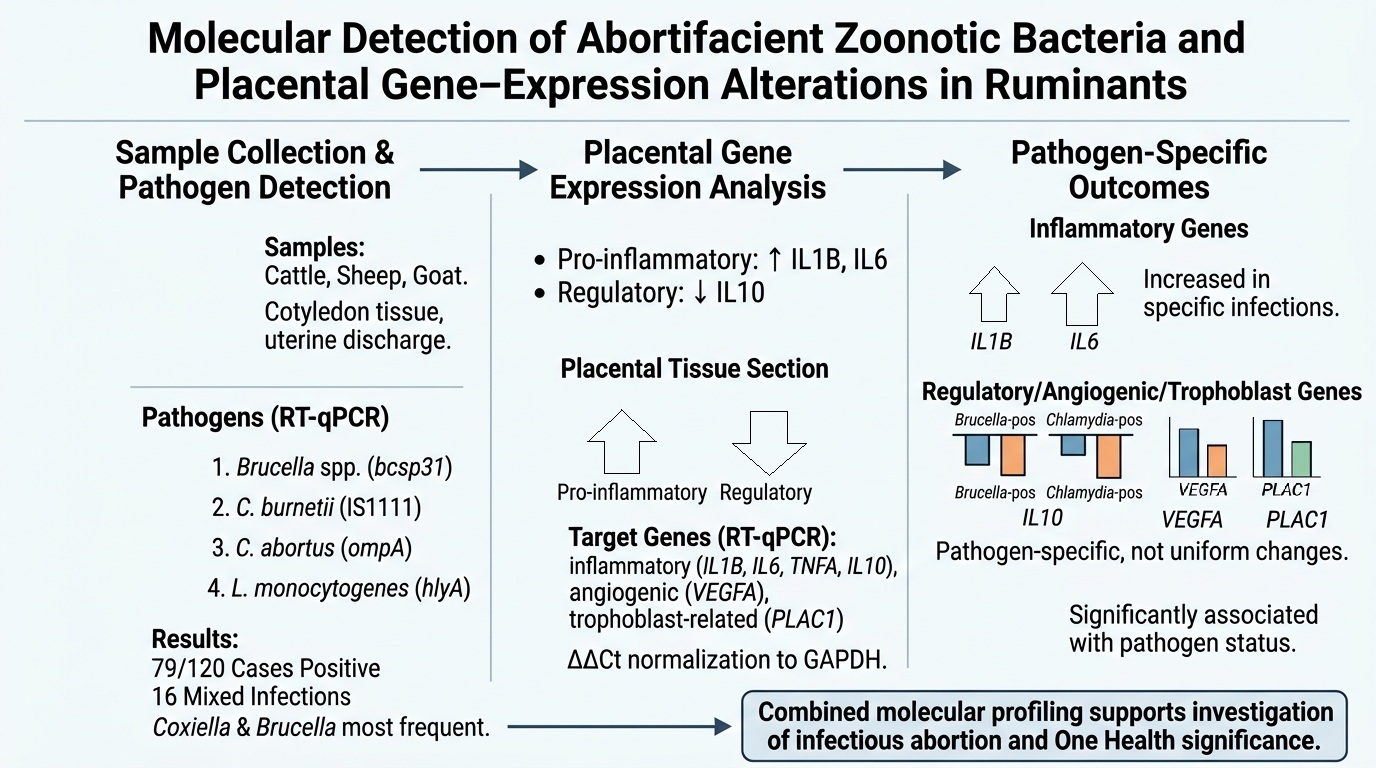
Background: Abortions occurring in cattle, sheep, and goats cause substantial reproductive loss in veterinary obstetrics and pose a significant zoonotic threat to public health. Placental pathogens, such as Brucella spp., Chlamydia abortus, Coxiella burnetii, and Listeria monocytogenes, target placental tissue during infection and trigger inflammatory pathways that impair trophoblast function. Although the infection-associated modulation of placental gene expression is known, the precise mechanisms responsible for the infection-associated loss of pregnancy are unknown. Aim: This study sought to determine the presence of key abortifacient zoonotic pathogens using real-time polymerase chain reaction (RT-PCR) and evaluate the association between pathogen presence and placental gene-expression changes of selected pro-inflammatory, anti-inflammatory, and trophoblast-integrity genes in ruminant species that were aborted. Methods: Placental cotyledon and uterine discharge samples were collected from cattle, sheep, and goats with a recent history of abortion. Pathogen detection was performed using RT-PCR targeting bcsp31, ompA, IS1111, and hlyA, while placental gene expression (IL1B, IL6, ILTNF-α, IL10, VEGFA, and PLAC1) was quantified using SYBR Green RT-qPCR normalized to GAPDH. Gene expression results were calculated using the Δ Δ Ct method and correlated with the positive samples for the pathogens. Results: Infection was confirmed in a high proportion of the cases of abortion by RT-PCR, and Brucella spp. and C. abortus were the most commonly seen. Significant upregulation of IL1B, IL6, and ILTNF- -α in the infected placentas, and IL10 was downregulated, indicating a strong inflammatory shift. There was considerable suppression of VEGFA and PLAC1, which means that there was placental vascularization and impairment of trophoblast stability. These changes in molecules were strongly connected with the presence of the pathogens, which showed their involvement in the abortion. Conclusion: Certain disruptions in placental gene expression caused by abortifacient zoonotic pathogens are responsible for the loss of pregnancies. Profiling these molecules with RT-PCR provides a useful means for identifying infectious abortion and evaluating its public health significance.
Article History:
Received June 20, 2026
Revised August 02, 2026
Accepted: August 10, 2026
Published: September 05, 2026
Downloads
References
[1] Amagliani G, La Guardia ME, Dominici S, Brandi G, Omiccioli E. (2021) Salmonella Abortusovis: An epidemiologically relevant pathogen. Curr Microbiol 79:3. doi: https://doi.org/10.1007/s00284-021-02689-1. PMID: 34878615.
[2] Rossetti CA, Maurizio E, Rossi UA. (2022) Comparative Review of Brucellosis in Small Domestic Ruminants. Front Vet Sci 9:887671. doi: https://doi.org/10.3389/fvets.2022.887671. PMID: 35647101.
[3] Semango GP, Buza J. (2024) Review of the Current Status on Ruminant Abortigenic Pathogen Surveillance in Africa and Asia. Vet Sci 11: 425. doi: https://doi.org/10.3390/vetsci11090425. PMID: 39330804.
[4] Rossi F, Giaccone V, Colavita G, Amadoro C, Pomilio F, Catellani P. (2022) Virulence Characteristics and Distribution of the Pathogen Listeria ivanovii in the Environment and in Food. Microorganisms 10: 1679. doi: https://doi.org/10.3390/microorganisms10081679. PMID: 36014096.
[5] Končurat A, Sukalić T. (2024) Listeriosis: Characteristics, Occurrence in Domestic Animals, Public Health Significance, Surveillance and Control. Microorganisms 12:2055. doi: https://doi.org/10.3390/microorganisms12102055. PMID: 39458364.
[6] Ebani VV. (2023) Coxiella burnetii Infection in Cats. Pathogens (Basel, Switzerland) 12:1415. doi: https://doi.org/10.3390/pathogens12121415. PMID: 38133298.
[7] Plummer PJ, McClure JT, Menzies P, Morley PS, Van den Brom R, Van Metre DC. (2018) Management of Coxiella burnetii infection in livestock populations and the associated zoonotic risk: A consensus statement. J Vet Intern Med 32:1481–1494. doi: https://doi.org/10.1111/jvim.15229 . PMID: 30084178.
[8] Loy JD, Clawson ML, Adkins PRF, Middleton JR. (2023) Current and emerging diagnostic approaches to bacterial diseases of ruminants. Vet Clin North Am Food Anim Pract 39: 93–114. doi: https://doi.org/10.1016/j.cvfa.2022.10.006 . PMID: 36732002.
[9] Orjuela AG, Parra-Arango JL, Sarmiento-Rubiano LA. (2022) Bovine leptospirosis: effects on reproduction and an approach to research in Colombia. Trop Anim Health Prod 54:251. doi: https://doi.org/10.1007/s11250-022-03235-2. PMID: 35943610.
[10] Faul F, Erdfelder E, Buchner A, Lang AG. (2009) Statistical power analyses using G*Power 3.1: tests for correlation and regression analyses. Behav Res Methods 41: 1149–1160. doi: https://doi.org/10.3758/BRM.41.4.1149. PMID: 19897823.
[11] Shell WS, Abdullah FFJ, Zamri-Saad M, Haron AW, Saad N, Bejo SK. (2017) Using real-time polymerase chain reaction as an alternative for colony counting of living Brucella vaccines. Vet World 10: 630–637. doi: https://doi.org/10.14202/vetworld.2017.610-615. PMID: 28717311.
[12] Gwida MM, El-Gohary AH, Melzer F, Tomaso H, Rösler U, et al. (2011). Comparison of diagnostic tests for the detection of Brucella spp. in camel sera. BMC Res Notes 4:525. doi: https://doi.org/10.1186/1756-0500-4-525. PMID: 22145943.
[13] Kumari R, Singh S, Behera B, Singh D, Kaur P, Kumar R. (2023) Human brucellosis: An observational study from a tertiary-care centre in North India. Cureus, 15:e42980. doi: https://doi.org/10.7759/cureus.42980. PMID: 37671228.
[14] Pantchev A, Sting R, Bauerfeind R, Tyczka J, Sachse K. (2009) New real-time PCR tests for species-specific detection of Chlamydophila psittaci and Chlamydophila abortus from tissue samples. Vet J 181:145–150. doi: https://doi.org/10.1016/j.tvjl.2008.02.025. PMID: 18413292.
[15] Esmaeili H, Hamedi M, Madani SA, Barin A, Haji Agha Khiyabani F. (2024). Diagnosis of Chlamydia abortus using real-time PCR and cell culture in small ruminants with abortion. J Med Bacteriol 12:9–16. doi: https://doi.org/10.18502/jmb.v12i4.17003.
[16] Klee SR, Tyczka J, Ellerbrok H, Franz T, Linke S, et al. (2006) Highly sensitive real-time PCR for specific detection and quantification of Coxiella burnetii. BMC Microbiol 6:2. doi: https://doi.org/10.1186/1471-2180-6-2. PMID: 16423303.
[17] Mendonça M, Conrad NL, Conceição FR, Moreira ÂN, da Silva WP, et al. (2012) Highly specific fiber optic immunosensor coupled with immunomagnetic separation for detection of low levels of Listeria monocytogenes and L. ivanovii. BMC Microbiol 12:275. doi: https://doi.org/10.1186/1471-2180-12-275. PMID: 23176167
[18] Yamada S, Yoshioka K, Mizuguchi H, Ohta M, Mikami T. (2009) Quantitative analysis of cytokine mRNA expression in calves experimentally infected with Theileria parva. J Vet Med Sci 71: 49–55. doi: https://doi.org/10.1292/jvms.71.49. PMID: 19194076.
[19] Lopera-Vásquez R, Uribe-García F, Rondón-Barragán I. (2022) Effect of estrous cycle phases on gene expression in bovine oviduct epithelial cells. Vet World 15:1665–1675. doi: https://doi.org/10.14202/vetworld.2022.1665-1675. PMID: 36185535.
[20] Gholami P, Asgarian-Omran H, Yaghmaei M, Mahmoudian J, Kianersi S, et al. (2023) Investigation of expression profile of placenta-specific 1 (PLAC1) in acute myeloid and lymphoid leukemias. Avicenna J Med Biotechnol 15:167–172. doi: https://doi.org/10.18502/ajmb.v15i3.12926. PMID: 37538244.
[21] Lesseur C, Jessel RH, Ohrn S, Ma Y, Li Q, et al. (2022) Gestational SARS-CoV-2 infection is associated with placental expression of immune and trophoblast genes. Placenta 126:125–132. doi: https://doi.org/10.1016/j.placenta.2022.06.017. PMID: 35797939.
[22] Cappelletti M, Presicce P, Kallapur SG. (2020) Immunobiology of Acute Chorioamnionitis. Front Immunol 11:649. doi: https://doi.org/10.3389/fimmu.2020.00649. PMID: 32373122.
[23] do Imperio GE, Bloise E, Javam M, Lye P, Constantinof A, et al. (2018) Chorioamnionitis Induces a Specific Signature of Placental ABC Transporters Associated with an Increase of miR-331-5p in the Human Preterm Placenta. Cell Physiol Biochem 45:591–604. doi: https://doi.org/10.1159/000487100. PMID: 29402780.
[24] Bonhomme D, Werts C. (2022) Host and Species-Specificities of Pattern Recognition Receptors Upon Infection With Leptospira interrogans. Front Cell Infect Microbiol 12:932137. doi: https://doi.org/10.3389/fcimb.2022.932137. PMID: 35937697.
[25] Dubey JP, Rosenthal BM. (2023) Bovine sarcocystosis: Sarcocystis species, diagnosis, prevalence, economic and public health considerations, and association of Sarcocystis species with eosinophilic myositis in cattle. Int J Parasitol 53:463–475. doi: https://doi.org/10.1016/j.ijpara.2022.09.009 . PMID: 36462560.
[26] Tirosh-Levy S, Savitsky I, Blinder E, Mazuz ML. (2022) The involvement of protozoan parasites in sheep abortions - A ten-year review of diagnostic results. Vet Parasitol 303:109664. doi: https://doi.org/10.1016/j.vetpar.2022.109664. PMID: 35131575 .
[27] Devaux CA, Osman IO, Million M, Raoult D. (2020) Coxiella burnetii in Dromedary Camels (Camelus dromedarius): A Possible Threat for Humans and Livestock in North Africa and the Near and Middle East?. Front Vet Sci 7:558481. doi: https://doi.org/10.3389/fvets.2020.558481. PMID: 33251255.
[28] Bayne JE, Waters KM. (2025) Biosecurity for Reproductive Disease Prevention in Sheep and Goats. Vet Clin North Am Food Anim Pract 41:71–82. doi: https://doi.org/10.1016/j.cvfa.2024.11.009. PMID: 39741070.
[29] Rojas JM, Martín V, Sevilla N. (2021) Vaccination as a Strategy to Prevent Bluetongue Virus Vertical Transmission. Pathogens (Basel, Switzerland) 10:1528. doi: https://doi.org/10.3390/pathogens10111528 . PMID: 34832683.
[30] Wang, N., Zhou, C., Basang, W., Zhu, Y., Wang, X., Li, C., Chen, L., & Zhou, X. (2021) Mechanisms by which mastitis affects reproduction in dairy cow: A review. Reprod Domest Anim 56:1165–1175. doi: https://doi.org/10.1111/rda.13953. PMID: 34008236.
Additional Files
Published
Issue
Section
License
Copyright (c) 2026 Kamal Ghazi Ghanim, Ali Ismail Jassim, Qasim Zamel Bneed, Mohammed Mahdi Yaseen (Author)

This work is licensed under a Creative Commons Attribution 4.0 International License.
All articles in the World Journal of Experimental Biosciences are published under the terms of the Creative Commons Attribution 4.0 International License (CC BY 4.0) ( (http://creativecommons.org/licenses/by/4.0/), which permits unrestricted use, distribution, and reproduction in any medium, provided the original work is properly cited.