Bile-Salt Stress Activation of cadF and flaA Virulence Gene Expression in Zoonotic Campylobacter jejuni from Poultry with HPLC-Based Organic Acid Profiling in Al-Diwaniyah City, Iraq
DOI:
https://doi.org/10.65329/wjeb.v14.02.04Keywords:
Campylobacter jejuni, bile salts, foodborne pathogens, organic acids, poultry, RT-qPCR, virulence gene expression, zoonotic bacteriaAbstract
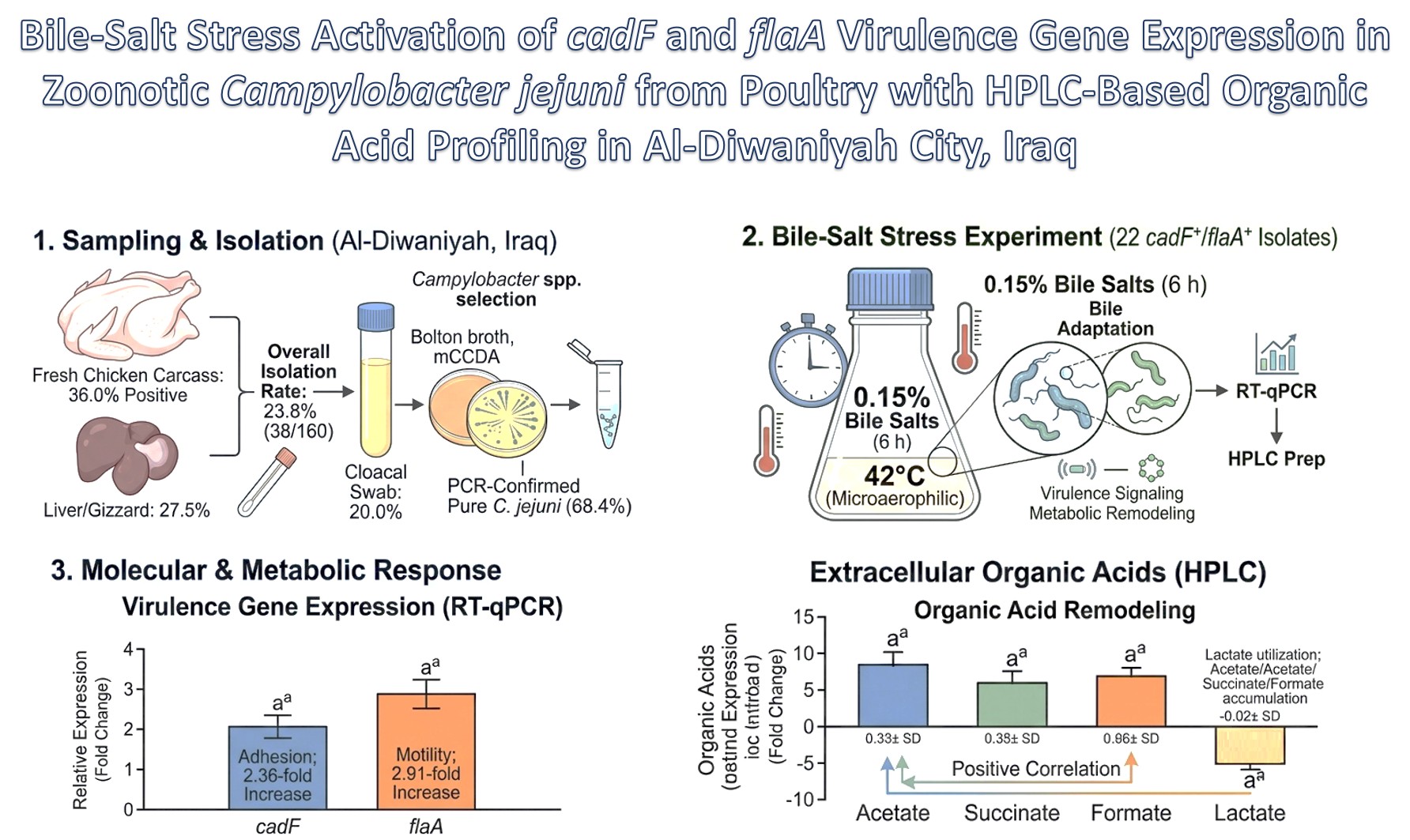
Campylobacter jejuni is a major zoonotic foodborne pathogen associated with poultry and poultry-derived products. This study evaluated whether bile-salt stress alters the expression of cadF and flaA in poultry-origin C. jejuni isolates and whether these changes correlate with HPLC-detected extracellular organic acid remodeling. A total of 160 poultry samples were tested for Campylobacter using selective culture, biochemical, and molecular methods. Twenty-two isolates of C. jejuni positive for cadF and flaA were exposed to 42 oC and bile-salt stress (0.15%, 6 h). Gene expression was quantified by RT-qPCR using rrs as the reference gene, while organic acids were measured by HPLC. Campylobacter spp. were recovered from 38/160 samples, giving an overall isolation rate of 23.8%. C. jejuni represented 26/38 isolates, or 68.4%. Among C. jejuni isolates, 22/26 (84.6%) were positive for both cadF and flaA. Bile-salt stress significantly increased cadF expression by 2.36-fold and flaA expression by 2.91-fold compared with the control condition. HPLC showed increased acetate from 34.5 ± 11.8 to 64.8 ± 18.6 mg/L, succinate from 8.9 ± 3.7 to 19.6 ± 7.4 mg/L, and format from 12.7 ± 5.1 to 24.3 ± 8.9 mg/L, while lactate decreased from 55.2 ± 17.4 to 31.7 ± 12.8 mg/L. flaA expression correlated positively with format accumulation, while cadF expression correlated positively with acetate concentration. Bile salts did not act only as an inhibitory intestinal barrier for poultry-origin C. jejuni; instead, bile exposure promoted coordinated virulence and metabolic adaptation that may support intestinal colonization and zoonotic transmission.
Article History:
Received August 17, 2026
Revised September 23, 2026
Accepted: September 27, 2026
Published: October 12, 2026
Downloads
References
[1] Fischer GH, Hashmi MF, Paterek E. (2024) Campylobacter Infection. In StatPearls. StatPearls Publishing. PMID: 30725718. Bookshelf ID: NBK537033
[2] Tikhomirova A, McNabb ER, Petterlin L, Bellamy GL, Lin KH, et al. (2024) Campylobacter jejuni virulence factors: update on emerging issues and trends. J Biomed Sci 31(1):45. doi: https://doi.org/10.1186/s12929-024-01033-6. PMID: 38693534.
[3] Mohamed MI, Khalifa HO, Habib I. (2025) The role of virulence genes in Campylobacter pathogenicity: a perspective from the Gulf Cooperation Council countries. Front Cell Infect Microbiol 15:1584835. doi: https://doi.org/10.3389/fcimb.2025.1584835. PMID: 40353223.
[4] Kuang S, Hao H, Dai M, Wang Y, Chen D, Yuan Z. (2025) Prevalence and genetic characteristics of Campylobacter jejuni isolated from poultry sources. BMC Vet Res 21:92. doi: https://doi.org/10.1186/s12917-025-04600-7
[5] Omole Z, Dorrell N, Elmi A, Nasher F, Gundogdu O, Wren BW. (2024) Pathogenicity and virulence of Campylobacter jejuni: What do we really know?. Virulence 15(1):2436060. doi: https://doi.org/10.1080/21505594.2024.2436060. PMID: 39648291.
[6] Reuter M, Ultee E, Toseafa Y, Tan A, van Vliet AHM. (2020) Inactivation of the core cheVAWY chemotaxis genes disrupts chemotactic motility and organised biofilm formation in Campylobacter jejuni. FEMS Microbiol Lett 367(24). doi: https://doi.org/10.1093/femsle/fnaa198. PMID: 33264398.
[7] Talukdar PK, Negretti NM, Turner KL, Konkel ME. (2020) Molecular Dissection of the Campylobacter jejuni CadF and FlpA Virulence Proteins in Binding to Host Cell Fibronectin. Microorganisms 8(3): 389. doi: https://doi.org/10.3390/microorganisms8030389. PMID: 32168837.
[8] Talukdar PK, Crockett TM, Gloss LM, Huynh S, Roberts SA. (2022) The bile salt deoxycholate induces Campylobacter jejuni adaptation and enhances bacterial fitness. Front Microbiol 13:1062464. doi: https://doi.org/10.3389/fmicb.2022.1062464. PMID: 36619995.
[9] Cao X, van Putten JPM, Wösten MMSM. (2023) Campylobacter jejuni benefits from the bile salt deoxycholate under low-oxygen condition in a PldA dependent manner. Gut Microbes 15(2):2262592. doi: https://doi.org/10.1080/19490976.2023.2262592. PMID: 37768138.
[10] Sinha R, LeVeque RM, Callahan SM, Chatterjee S, Stopnisek N, et al. (2024) Gut metabolite L-lactate supports Campylobacter jejuni population expansion during acute infection. Proc Natl Acad Sci U S A 121(2):e2316540120. doi: https://doi.org/10.1073/pnas.2316540120. PMID: 38170751.
[11] Price EP, Huygens F, Giffard PM. (2006) Fingerprinting of Campylobacter jejuni by using resolution-optimized binary gene targets derived from comparative genome hybridization studies. Appl Environ Microbiol 72(12):7793-7803. doi: https://doi.org/10.1128/AEM.01338-06. PMID: 16997982.
[12] Chaisowwong W, Kusumoto A, Hashimoto M, Harada T, Maklon K, Kawamoto, K. (2012) Physiological characterization of Campylobacter jejuni under cold stresses conditions: its potential for public threat. J Vet Med Sci 74(1):43-50. doi: https://doi.org/10.1292/jvms.11-0305. PMID: 21891974.
[13] Abbas SGE, Abd El-Aziz NK, El-Jakee JK, Abd El-Hamid MI. (2022) Prevalence and virulence genes profile of zoonotic Campylobacter jejuni and Campylobacter coli from chickens and humans. SVU Int J Vet Sci 5(4):15-32. doi: https://doi.org/10.21608/svu.2022.143454.1204.
[14] Poudel S, Pokhrel D, Zhang X, Sukumaran AT, Adhikari P, et al. (2024) Campylobacter jejuni from no antibiotics ever (NAE) broilers: prevalence, antibiotic resistance, and virulence genes analysis. Poult Sci 103(12):104380. doi: https://doi.org/10.1016/j.psj.2024.104380. PMID: 39418794.
[15] Reis LP, Menezes LD, Gomes CN, Silva IM, Figueiredo TC. (20218) Detection of Campylobacter spp. in chilled and frozen poultry products. Cienc Rural 48(6). doi: https://doi.org/10.1590/0103-8478cr20161034.
[16] Yang M, Zhang Y, Chen Y, Zhang X, Li Y, Wang X. (2025) Genomic analysis and antimicrobial resistance in human and poultry Campylobacter jejuni isolates. Front Microbiol 16:1599555. doi: https://doi.org/10.3389/fmicb.2025.1599555. PMID: 40625622.
[17] Gharbi M, Bejaoui A, Ben Hamda C, Alaya N, Ghedira K, Maaroufi A. (2022) Distribution of virulence and antibiotic resistance genes in Campylobacter isolates from layer hens and eggs. Foods 11(22):3554. doi: https://doi.org/10.3390/foods11223554.
[18] Takeuchi MG, Bracarense APFRL, Langoni H. (2022) Agents of campylobacteriosis in different meat matrices in Brazil: prevalence, virulence and antimicrobial resistance. Int J Environ Res Public Health 19(10):6087. doi: https://doi.org/10.3390/ijerph19106087. PMID: 35627626.
[19] Wanja DW, Mbuthia PG, Waruiru RM, Bebora LC, Ngowi HA, Mulei CM. (2024) Molecular detection of virulence-associated markers in Campylobacter species from chicken sources. Vet Med Int 2024:4631351. doi: https://doi.org/10.1155/2024/4631351.
[20] Sierra-Arguello YM, Perdoncini G, Rodrigues LB, Dos Santos LR, Gomes MJP, et al. (2021) Identification of pathogenic genes in Campylobacter jejuni isolated from broiler chickens and broiler carcasses. Sci Rep 11:4588. doi: https://doi.org/10.1038/s41598-021-84149-1. PMID: 33633256.
Additional Files
Published
Issue
Section
License
Copyright (c) 2026 Hussein Kareem, Amaar Nabeel Al-Jubouri, Mustafa Sabbar Mhr, Mohammed Mahdi Yaseen (Author)

This work is licensed under a Creative Commons Attribution 4.0 International License.
All articles in the World Journal of Experimental Biosciences are published under the terms of the Creative Commons Attribution 4.0 International License (CC BY 4.0) ( (http://creativecommons.org/licenses/by/4.0/), which permits unrestricted use, distribution, and reproduction in any medium, provided the original work is properly cited.