GC–MS-Based Chemical Profiling and Antibacterial Activity of Thymus vulgaris L. Essential Oil Against Carbapenem-Resistant Pseudomonas aeruginosa
DOI:
https://doi.org/10.65329/wjeb.v14.02.06Keywords:
Biofilm formation, Carbapenem-resistant Pseudomonas aeruginosa, GC-MS, Thymus vulgaris L. essential oil.Abstract
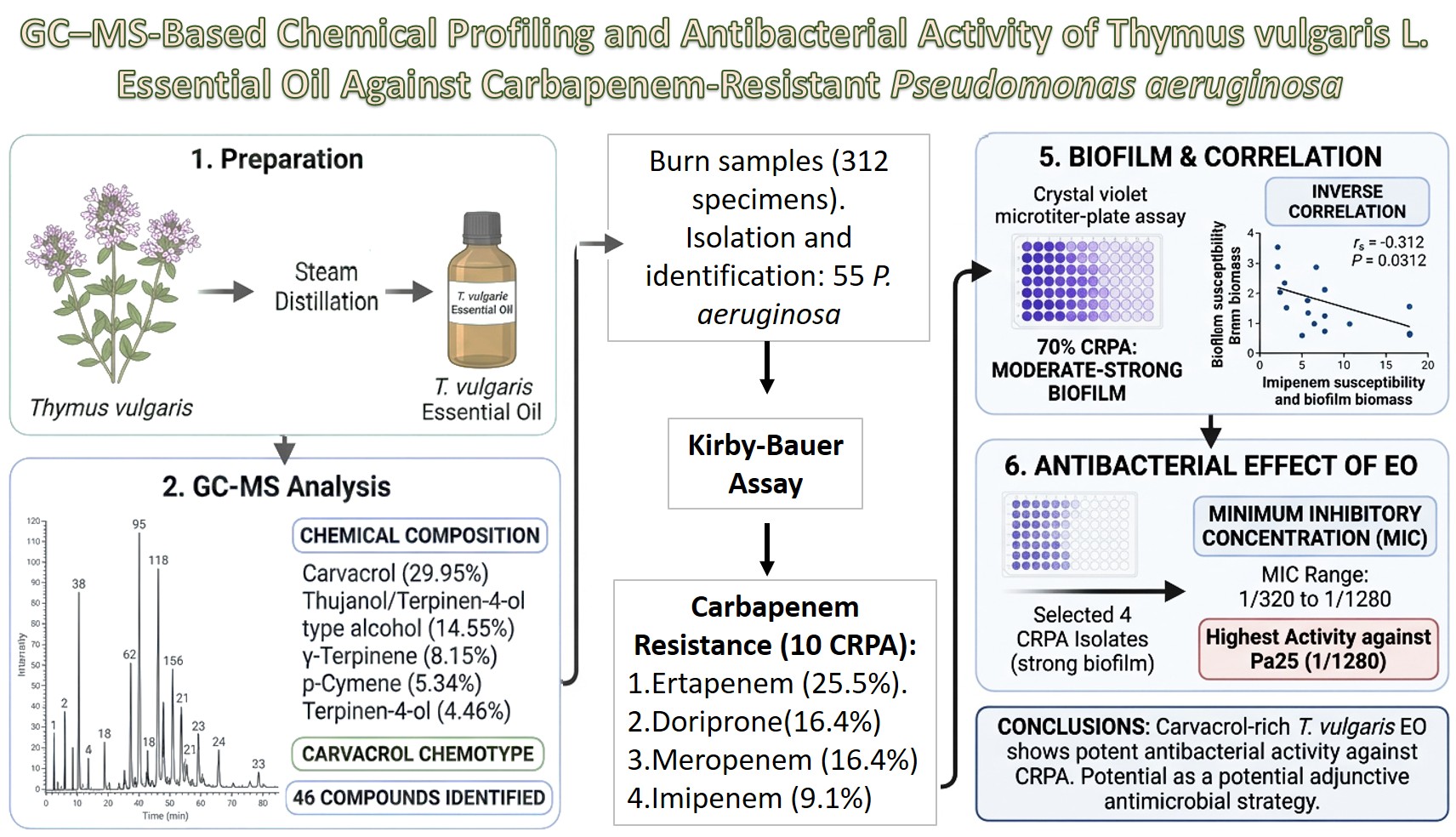
Carbapenem-resistant Pseudomonas aeruginosa (CRPA) is a major therapeutic challenge because its biofilm contributes to antimicrobial tolerance. This study aims to determine the chemical composition and antibacterial effect of Thymus vulgaris L. essential oil against CRPA and to evaluate the relationship between bacterial response to carbapenem and biofilm formation. The essential oil was prepared from dried T. vulgaris flowers by steam distillation and characterized using gas chromatography-mass spectrometry (GC-MS). The isolates of P. aeruginosa were isolated from 312 burn-wound specimens and identified using biochemical methods and VITEK 2 technology. Kirby-Bauer method was used to test carbapenem susceptibility of bacterial isolates. Crystal violet microtiter-plate (polystyrene) assay was used to quantify biofilm formation. The microdilution assay was used to measure the minimum inhibitory concentration (MIC) of T. vulgaris essential oil against four CRPA isolates that produced the highest biofilm biomass. Forty-six compounds were identified by GC-MS. The main compounds were carvacrol (29.95%), thujanol/terpinen-4-ol-type alcohol (14.55%), γ-terpinene (8.15%), p-cymene (5.34%), and terpinen-4-ol (4.46%), indicating a carvacrol chemotype. Out of 55 isolates of P. aeruginosa, resistance rates were 25.5% for ertapenem, 16.4% for doripenem and meropenem, and 9.1% for imipenem. Ten isolates were CRPA, of which 70% exhibited moderate-to-strong biofilm formation. Imipenem susceptibility showed a significant inverse correlation with biofilm biomass (rs = −0.312, P = 0.0312). T. vulgaris essential oil inhibited all four selected multidrug-resistant isolates, and the MICs ranged from 1/320 to 1/1280; the highest activity was observed against Pa25 (1/1280). T. vulgaris essential oil, which is rich in carvacrol, demonstrated antibacterial activity against all CRPA isolates and may warrant further investigation as a potential adjunctive antimicrobial strategy.
Article History:
Received September 07, 2026
Revised November 02, 2026
Accepted: November 08, 2026
Published: November 14, 2026
Downloads
References
[1] Macesic N, Uhlemann AC, Peleg AY. (2025) Multidrug-resistant Gram-negative bacterial infections. Lancet (London, England) 405(10474):257–272. doi: https://doi.org/10.1016/S0140-6736(24)02081-6. PMID: 39826970. DOI: https://doi.org/10.1016/S0140-6736(24)02081-6
[2] Elfadadny A, Ragab RF, AlHarbi M, Badshah F, Ibáñez-Arancibia E, et al. (2024) Antimicrobial resistance of Pseudomonas aeruginosa: navigating clinical impacts, current resistance trends, and innovations in breaking therapies. Front Microbiol 15:1374466. doi: https://doi.org/10.3389/fmicb.2024.1374466. PMID: 38646632. DOI: https://doi.org/10.3389/fmicb.2024.1374466
[3] Qin S, Xiao W, Zhou C, Pu Q, Deng X, et al. (2022) Pseudomonas aeruginosa: pathogenesis, virulence factors, antibiotic resistance, interaction with host, technology advances and emerging therapeutics. Signal Transduct Target Ther 7:199. doi: https://doi.org/10.1038/s41392-022-01056-1. PMID: 35752612. DOI: https://doi.org/10.1038/s41392-022-01056-1
[4] Elshimy R, El-Shiekh RA, Okba MM, Ashour RMS, Ibrahim MA, et al. (2025) Unveiling the antimicrobial, antivirulence, and wound-healing accelerating potentials of resveratrol against carbapenem-resistant Pseudomonas aeruginosa (CRPA)-septic wound in a murine model. Inflammopharmacology 33:401–416. doi: https://doi.org/10.1007/s10787-024-01591-z. PMID: 39508957. DOI: https://doi.org/10.1007/s10787-024-01591-z
[5] Chouhan S, Sharma K, Guleria S. (2017) Antimicrobial Activity of Some Essential Oils-Present Status and Future Perspectives. Medicines (Basel) 4(3):58. doi: https://doi.org/10.3390/medicines4030058. PMID: 28930272. DOI: https://doi.org/10.3390/medicines4030058
[6] Patil SM, Ramu R, Shirahatti PS, Shivamallu C, Amachawadi RG. (2021) A systematic review on ethnopharmacology, phytochemistry and pharmacological aspects of Thymus vulgaris Linn. Heliyon 7:e07054. doi: https://doi.org/10.1016/j.heliyon.2021.e07054. PMID: 34041399. DOI: https://doi.org/10.1016/j.heliyon.2021.e07054
[7] da Costa-Oliveira C, Gouvêa-Silva JG, Dos Santos Fernandes Muniz R, Felisberto JS, Mazzola PG, et al. (2026) Cannabis: from crop to shop-some insights about stability to access quality control. J Cannabis Res 8:45. doi: https://doi.org/10.1186/s42238-026-00409-9. PMID: 41724995. DOI: https://doi.org/10.1186/s42238-026-00409-9
[8] Khalaf AN, Abed IJ. (2021) Evaluating the in vitro Cytotoxicity of Thymus vulgaris Essential Oil on MCF-7 and HeLa Cancer Cell Lines, Iraqi J Sci 62: 2862-2871. doi: https://doi.org/10.24996/ijs.2021.62.9.3. DOI: https://doi.org/10.24996/ijs.2021.62.9.3
[9] Borugă O, Jianu C, Mişcă C, Goleţ I, Gruia AT, Horhat FG. (2014) Thymus vulgaris essential oil: chemical composition and antimicrobial activity. J Med Life Spec No. 3:56-60. PMID: 25870697.
[10] Talib MM, Ghafil JA. (2024) Comparative Adhesion of Pseudomonas aeruginosa to Human Oral Mucosal Epithelial Cells and Polystyrene Surfaces. J Fac Med Baghdad 66:344-349. doi: https://doi.org/10.32007/jfacmedbaghdad.6632328 DOI: https://doi.org/10.32007/jfacmedbaghdad.6632328
[11] Clinical and Laboratory Standards Institute. (2024). Performance standards for antimicrobial susceptibility testing; 34th edition. CLSI supplement M100. Clinical and Laboratory Standards Institute. https://clsi.org/shop/standards/m100/.
[12] Shnyoor HA, Zgair AK. (2025) Effect of combination of sub-inhibitory concentrations of cefepime and Thymus vulgaris essential oil in modulating biofilm formation of Enterococcus faecalis in vitro. Pharm Sci Asia 52:376. doi: https://doi.org/10.29090/psa.2025.03.25.3835 DOI: https://doi.org/10.29090/psa.2025.03.25.3835
[13] Mancuso G, De Gaetano S, Midiri A, Zummo S, Biondo C. (2023) The Challenge of Overcoming Antibiotic Resistance in Carbapenem-Resistant Gram-Negative Bacteria: "Attack on Titan". Microorganisms 11:1912. doi: https://doi.org/10.3390/microorganisms11081912. PMID: 37630472. DOI: https://doi.org/10.3390/microorganisms11081912
[14] Jilani S, Ferjeni M, Al-Shammery K, Rashid Mohammed AlTamimi H, Besbes M, et al. (2025) The synergistic effect of Thymus vulgaris essential oil and carvacrol with imipenem against carbapenem-resistant Acinetobacter baumannii: in vitro, molecular docking, and molecular dynamics studies. Front Pharmacol 16:1582102. doi: https://doi.org/10.3389/fphar.2025.1582102. PMID: 40474976. DOI: https://doi.org/10.3389/fphar.2025.1582102
[15] Akermi S, Smaoui S, Fourati M, Elhadef K, Chaari M, et al. (2022) In-Depth Study of Thymus vulgaris Essential Oil: Towards Understanding the Antibacterial Target Mechanism and Toxicological and Pharmacological Aspects. BioMed Res Int 3368883. doi: https://doi.org/10.1155/2022/3368883. PMID: 35909468. DOI: https://doi.org/10.1155/2022/3368883
[16] Naenna P, Noisumdaeng P, Pongpech P, Tribuddharat C. (2010) Detection of outer membrane porin protein, an imipenem influx channel, in Pseudomonas aeruginosa clinical isolates. Southeast Asian J Trop Med Public Health 41:614–624. PMID: 20578550.
[17] Ocampo-Sosa AA, Cabot G, Rodríguez C, Roman E, Tubau F, et al. (2012) Alterations of OprD in carbapenem-intermediate and -susceptible strains of Pseudomonas aeruginosa isolated from patients with bacteremia in a Spanish multicenter study. Antimicrob Agents Chemother 56:1703–1713. doi: https://doi.org/10.1128/AAC.05451-11. PMID: 22290967. DOI: https://doi.org/10.1128/AAC.05451-11
[18] El Amin N, Giske CG, Jalal S, Keijser B, Kronvall G, Wretlind B. (2005) Carbapenem resistance mechanisms in Pseudomonas aeruginosa: alterations of porin OprD and efflux proteins do not fully explain resistance patterns observed in clinical isolates. APMIS 113:187–196. doi: https://doi.org/10.1111/j.1600-0463.2005.apm1130306.x. PMID: 15799762. DOI: https://doi.org/10.1111/j.1600-0463.2005.apm1130306.x
[19] Zhanel GG, Wiebe R, Dilay L, Thomson K, Rubinstein E, et al. (2007) Comparative review of the carbapenems. Drugs 67:1027–1052. doi: https://doi.org/10.2165/00003495-200767070-00006. PMID: 17488146. DOI: https://doi.org/10.2165/00003495-200767070-00006
[20] Mahmoud SF, Fayez M, Swelum AA, Alswat AS, Alkafafy M, et al. (2022) Genetic Diversity, Biofilm Formation, and Antibiotic Resistance of Pseudomonas aeruginosa Isolated from Cow, Camel, and Mare with Clinical Endometritis. Vet Sci 9:239. doi: https://doi.org/10.3390/vetsci9050239. PMID: 35622767. DOI: https://doi.org/10.3390/vetsci9050239
[21] El-sayed H, Fahmy Y. (2021) Correlation between biofilm formation and multidrug resistance in clinical isolates of Pseudomonas aeruginosa. Microbes Infect Dis 2:541-549. doi: https://doi.org/10.21608/mid.2021.81284.1164. DOI: https://doi.org/10.21608/mid.2021.81284.1164
[22] Datta S, Singh V, Nag S, Roy DN. (2025) Carvacrol, a monoterpenoid, binds quorum sensing proteins (LasI and LasR) and swarming motility protein BswR of Pseudomonas aeruginosa, resulting in loss of pathogenicity: an in silico approach. Can J Microbiol 71:1–15. doi: https://doi.org/10.1139/cjm-2024-0155. PMID: 39566032. DOI: https://doi.org/10.1139/cjm-2024-0155
[23] González-Pinto L, Alonso-García I, Blanco-Martín T, Camacho-Zamora P, Fraile-Ribot PA, et al. (2024) Impact of chromosomally encoded resistance mechanisms and transferable β-lactamases on the activity of cefiderocol and innovative β-lactam/β-lactamase inhibitor combinations against Pseudomonas aeruginosa. J Antimicrob Chemother 79(10):2591–2597. doi: https://doi.org/10.1093/jac/dkae263. PMID: 39073766. DOI: https://doi.org/10.1093/jac/dkae263
[24] Burt SA, Ojo-Fakunle VT, Woertman J, Veldhuizen EJ. (2014) The natural antimicrobial carvacrol inhibits quorum sensing in Chromobacterium violaceum and reduces bacterial biofilm formation at sub-lethal concentrations. PloS one 9:e93414. doi: https://doi.org/10.1371/journal.pone.0093414. PMID: 24691035. DOI: https://doi.org/10.1371/journal.pone.0093414
Additional Files
Published
Issue
Section
License
Copyright (c) 2026 Farah Mohommed Saleh Al-qurashi, Barkat Ali Khan, Mu’men Alrwashde (Author)

This work is licensed under a Creative Commons Attribution 4.0 International License.
All articles in the World Journal of Experimental Biosciences are published under the terms of the Creative Commons Attribution 4.0 International License (CC BY 4.0) ( (http://creativecommons.org/licenses/by/4.0/), which permits unrestricted use, distribution, and reproduction in any medium, provided the original work is properly cited.