Sample Pretreatment, Extraction, and Analysis of Organic Contaminants in Surface-Water Sediments: Green Approaches and Public Health Relevance-A Review
DOI:
https://doi.org/10.65329/wjeb.v14.02.05Keywords:
Chromatographic analysis, Organic pollutants, Public health, Sample pretreatment, Surface water, Sustainable extraction methods.Abstract
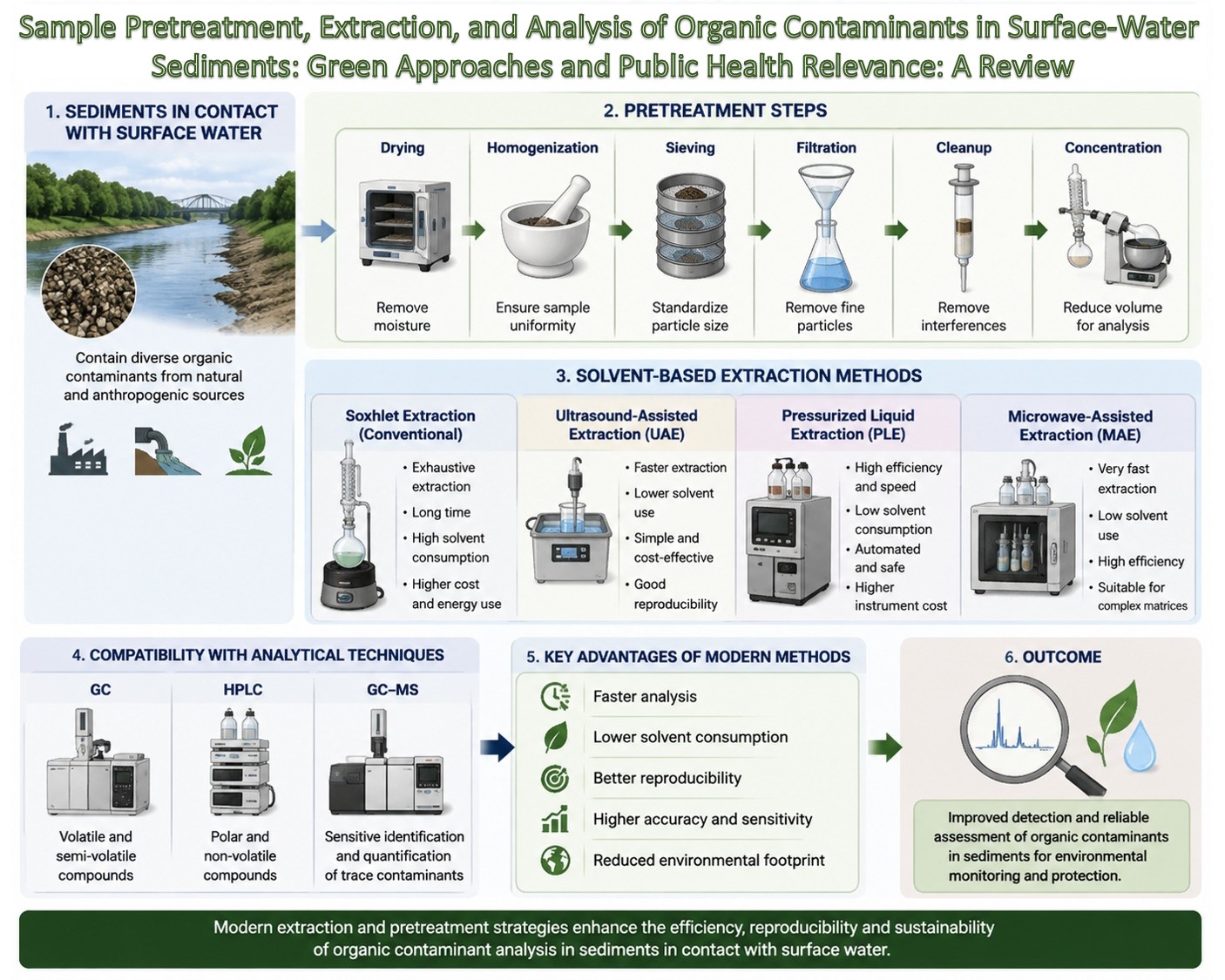
Sediments that are exposed to surface water might take up organic contaminants from natural sources and humans, thus bringing about environmental pollution and creating a risk to human health. Hence, this gives enough reason to indicate the need for conducting proper analysis of pollutants. The literature on sediment pre-treatment, extraction of contaminants, cleaning, concentration, and instrumental analysis is covered in the review. Conventional and advanced methods include Soxhlet extraction, ultrasonic extraction, pressurized extraction, microwave extraction, and supercritical fluid extraction. These methods may differ in terms of efficiency, solvent requirements, duration, and analytical capabilities. Chromatographic and mass-spectrometric techniques, such as gas chromatography, high-performance liquid chromatography, and mass-spectrometric methods, are most commonly used today to determine and identify a range of environmental contaminants. Special emphasis has been placed on solvent-free and green methods, as well as sustainable analytical criteria for monitoring ecological performance. This study provides an in-depth look into sediment pretreatment, extraction procedures used, and analytical methods as well as environmentally friendly analytical methods and potential implications for public health, thereby providing a broader overview than reviews that focus on a specific method of extraction or category of contaminants. Effective sample preparation and recognized analytical methods are key for reliable assessment of organic pollutants contained in sediments.
Article History:
Received August 28, 2026
Revised October 10, 2026
Accepted: October 26, 2026
Published: November 7, 2026
Downloads
References
[1] Lee H, Kim S, Sin A, Kim G, Khan S, et al. (2023) Pretreatment methods for monitoring microplastics in soil and freshwater sediment samples: A comprehensive review. Sci Total Environ 871:161718. doi: https://doi.org/10.1016/j.scitotenv.2023.161718. PMID: 36709896.
[2] Nguyen TTN, Baduel C. (2023) Optimization and validation of an extraction method for the analysis of multi-class emerging contaminants in soil and sediment. Journal of Chromatography A.1710:464287. doi: https://doi.org/10.1016/j.chroma.2023.464287. PMID: 37797419.
[3] Lozano-Castellón J, Laveriano-Santos EP, Abuhabib MM, Pozzoli C, Pérez M, Vallverdú-Queralt A, et al. (2024) Proven traceability strategies using chemometrics for organic food authenticity. Trends Food Sci Technol 147:104430. doi: https://doi.org/10.1016/j.tifs.2024.104430.
[4] Ducrocq T, Merel S, Miège C. (2024) Review on analytical methods and occurrence of organic contaminants in continental water sediments. Chemosphere 365:143275. doi: https://doi.org/10.1016/j.chemosphere.2024.143275. PMID: 39277038.
[5] Simpson S, Batley G, Chariton A, Stauber J, King C, et al. (2005) Handbook for Sediment Quality Assessment.
[6] Dimpe M, Nomngongo P (2016) Current sample preparation methodologies for analysis of emerging pollutants in different environmental matrices. TrAC Trends Anal Chem 82. doi: https://doi.org/10.1016/j.trac.2016.05.023.
[7] Savic R, Stajic M, Kostesic E, Antic S, Horvatinec J, et al. (2025) Heavy metal contamination and ecological risk assessment in drainage channel sediments from urban and agricultural areas. J Environ Manage 389:126221. doi: https://doi.org/10.1016/j.jenvman.2025.126221.
[8] Sunny AR, Sazzad SA, Islam MA, Mithun MH, Hussain M, et al. (2025) Microplastics in aquatic ecosystems: A global review of distribution, ecotoxicological impacts, and human health risks. Water 17(12):1741. doi: https://doi.org/10.3390/w17121741.
[9] Tanoiri H, Barrientos EE, Nakano H, Arakawa H, Yokota M (2023) The pretreatment method in marine organisms and sediment for microplastics analysis by FTIR using “Cylindrical microplastics fractionator”. MethodsX 11:102396. doi: https://doi.org/10.1016/j.mex.2023.102396.
[10] Kazapoe RW, Kwayisi D, Alidu S, Sagoe SD, Umaru AO, et al. (2025) Advanced analysis of soil pollution in southwestern Ghana using variational autoencoders (VAE) and positive matrix factorization (PMF). Environ Sustain Indic 26:100627. doi: https://doi.org/10.1016/j.indic.2025.100627.
[11] Smenderovac E, Emilson C, Rheault K, Brazeau É, Morency MJ, et al. (2024) Drying as an effective method to store soil samples for DNA-based microbial community analyses: a comparative study. Sci Rep 14(1):1725. doi: https://doi.org/10.1038/s41598-023-50541-2. PMID: 38242898.
[12] Deli M, Ndjantou EB, Ngatchic Metsagang JT, Petit J, Njintang Yanou N, et al. (2019) Successive grinding and sieving as a new tool to fractionate polyphenols and antioxidants of plants powders: Application to Boscia senegalensis seeds, Dichrostachys glomerata fruits, and Hibiscus sabdariffa calyx powders. Food Sci Nutr 7(5):1795-1806. doi: https://doi.org/10.1002/fsn3.1022. PMID: 31139393.
[13] Lloyd CEM, Johnes PJ, Pemberton JA, Yates CA, Jones D, et al. (2022) Sampling, storage and laboratory approaches for dissolved organic matter characterisation in freshwaters: Moving from nutrient fraction to molecular-scale characterisation. Sci Total Environ 827:154105. doi: https://doi.org/10.1016/j.scitotenv.2022.154105. PMID: 35219656
[14] Song N, Tian Y, Luo Z, Dai J, Liu Y, et al. (2022) Advances in pretreatment and analysis methods of aromatic hydrocarbons in soil. RSC Adv 12(10):6099-6113. doi: https://doi.org/10.1039/d1ra08633b. PMID: 35424557.
[15] Torres Rodriguez A, Darvishzadeh R, Skidmore A, Fränzel-Luiten E, Knaken B, et al. (2024) High-throughput Soxhlet extraction method applied for analysis of leaf lignocellulose and non-structural substances. MethodsX 12:102644. doi: https://doi.org/10.1016/j.mex.2024.102644. PMID: 38660031.
[16] Sharma P, Chaudhary H, Desai K, Modi N. (2023) Techniques Used in Isolation of Secondary Metabolites. In: (INDIA) PSMMsA, editor.: M/s AGROBIOS (INDIA); pp:179-204.
[17] Shen L, Pang S, Zhong M, Sun Y, Qayum A, et al. (2023) A comprehensive review of ultrasonic assisted extraction (UAE) for bioactive components: Principles, advantages, equipment, and combined technologies. Ultrason Sonochem 101:106646. doi: https://doi.org/10.1016/j.ultsonch.2023.106646. PMID: 37862945.
[18] Porevsky P, Gomez-Ruiz H, Hernandez Garciadiego L (2013) Comparison of Soxhlet extraction, ultrasonic bath and focused microwave extraction techniques for the simultaneous extraction of PAH’s and pesticides from sediment samples. Sci Chromatogr 6:124. doi: https://doi.org/10.4322/SC.2014.026.
[19] Yamaguchi C, Lee WY (2010) A cost effective, sensitive, and environmentally friendly sample preparation method for determination of polycyclic aromatic hydrocarbons in solid samples. J Chromatogr A 1217(44):6816-6823. doi: https://doi.org/10.1016/j.chroma.2010.08.055. PMID: 20851399.
[20] Núñez S, Valero MS, Mustafa AM, Caprioli G, Maggi F, et al. (2025) Ultrasound-assisted extraction versus traditional Soxhlet apparatus for the obtention of polyphenols, carotenoids and tocopherols from Tagetes erecta L. flowers. J Sci Food Agric 105(6):3453-3462. doi: https://doi.org/10.1002/jsfa.14105. PMID: 39716808.
[21] Wang X, Wu J, Liu B (2016) Pressurized liquid extraction of chlorinated polycyclic aromatic hydrocarbons from soil samples using aqueous solutions. RSC Adv 6(83):80017-80023. doi: https://doi.org/10.1039/C6RA13973F.
[22] Burkhardt MR, ReVello RC, Smith SG, Zaugg SD (2005) Pressurized liquid extraction using water/isopropanol coupled with solid-phase extraction cleanup for industrial and anthropogenic waste-indicator compounds in sediment. Anal Chim Acta 534(1):89-100. doi: https://doi.org/10.1016/j.aca.2004.11.023.
[23] Cao S, Liang J, Chen M, Xu C, Wang X, et al. (2025) Comparative analysis of extraction technologies for plant extracts and absolutes. Front Chem 13. doi: https://doi.org/10.3389/fchem.2025.1536590. PMID: 40099208.
[24] Samanta D, Chatterjee A, Kumar A, Mishra R, Sahoo S, et al. (2025) Comparative analysis of microwave-assisted extraction (MAE) and traditional extraction techniques for phytochemicals from plants. Int J Environ Sci 3390-3404. doi: https://doi.org/10.64252/r5hzc522.
[25] Richter B, Jones BA, Ezzell JL, Porter NL, Avdalovic N, et al. (1996) Accelerated solvent extraction: A technique for sample preparation. Anal Chem 68:1033-1039. doi: https://doi.org/10.1021/ac9508199
[26] Bangkedphol S, Sakultantimetha A, Keenan HE, Songsasen A (2007) Optimization of microwave-assisted extraction of polycyclic aromatic hydrocarbons from sediments. J Environ Sci Health A Tox Hazard Subst Environ Eng 41(6):1105-1116. doi: https://doi.org/10.1080/10934520600620394. PMID: 16760088.
[27] Castro-Alves V, Nguyen A, Marcos J, Oresic M, Hyotylainen T (2025) Liquid and gas-chromatography-mass spectrometry methods for exposome analysis. J Chromatogr A 1744:465728. doi: https://doi.org/10.1016/j.chroma.2025.465728. PMID: 39893915.
[28] Dubocq F, Bæringsdóttir BB, Wang T, Kärrman A. (2022) Comparison of extraction and clean-up methods for comprehensive screening of organic micropollutants in fish using gas chromatography coupled to high-resolution mass spectrometry. Chemosphere 286:131743. doi: https://doi.org/10.1016/j.chemosphere.2021.131743. PMID: 34388434.
[29] Aouant AD, Hela D. (2025) Extraction and analytical techniques for pharmaceuticals and personal care products in sediments: A critical review towards environmental sustainability. Sustainability 17(22):10025. doi: https://doi.org/10.3390/su172210025
[30] Camel V. (2001) Recent extraction techniques for solid matrices: supercritical fluid extraction, pressurized fluid extraction and microwave-assisted extraction: their potential and pitfalls. Analyst 126(7):1182-1193. doi: https://doi.org/10.1039/b008243k. PMID: 11478658.
[31] ISO 18287:2006. (2006) Soil quality — Determination of polycyclic aromatic hydrocarbons (PAH) — Gas chromatographic method with mass spectrometric detection (GC-MS). Geneva: International Organization for Standardization.
[32] ISO 10382:2002. (2002) Soil quality — Determination of organochlorine pesticides and polychlorinated biphenyls — Gas-chromatographic method with electron capture detection. Geneva: International Organization for Standardization.
[33] Chester TL, Pinkston JD, Raynie DE (1996) Supercritical fluid chromatography and extraction. Anal Chem 68(12):487-514. doi: https://doi.org/10.1021/a1960017i.
[34] Alam MA, Sarker MZI, Ghafoor K, Happy RA, Ferdosh S. (2017) Bioactive compounds and extraction techniques. In: Nguyen VT (ed) Recovering bioactive compounds from agricultural wastes. John Wiley & Sons, pp 33-53.
[35] Patel K, Panchal N, Ingle PK (2019) Extraction methods: Microwave, ultrasonic, pressurized fluid, Soxhlet extraction, etc. Int J Adv Res Chem Sci 6(3):6-21. doi: https://doi.org/10.20431/2349-0403.0603002.
[36] Karst U (2007) Wilfried M.A. Niessen: Liquid chromatography-mass spectrometry (third edition). Anal Bioanal Chem 389. Taylor & Francis Group doi: https://doi.org/10.1007/s00216-007-1580-9.
[37] Ayala-Cabrera JF, Santos FJ, Moyano E (2021) Recent advances in analytical methodologies based on mass spectrometry for the environmental analysis of halogenated organic contaminants. Trends Environ Anal Chem 30:e00122. doi: https://doi.org/10.1016/j.teac.2021.e00122.
[38] Li X, Dorman FL, Helm PA, Kleywegt S, Simpson A, et al. (2021) Nontargeted screening using gas chromatography-atmospheric pressure ionization mass spectrometry: Recent trends and emerging potential. Molecules 26(22):6911. doi: https://doi.org/10.3390/molecules26226911. PMID: 34834002.
[39] Casey JS, Jackson SR, Ryan J, Newton SR (2023) The use of gas chromatography-high resolution mass spectrometry for suspect screening and non-targeted analysis of per- and polyfluoroalkyl substances. J Chromatogr A 1693:463884. doi: https://doi.org/10.1016/j.chroma.2023.463884. PMID: 36863195.
[40] Hndeya AG, Sbhatu DB, Gebreyohannes G (2026) Advances in eco-friendly extraction of fruit bioactive compounds: Technologies, challenges and future directions. Anal Sci Adv 7(1):e70071. doi: https://doi.org/10.1002/ansa.70071. PMID: 41737951.
[41] Rani M, Ducoli S, Depero LE, Prica M, Tubić A, et al. (2023) A complete guide to extraction methods of microplastics from complex environmental matrices. Molecules 28(15):5710. doi: https://doi.org/10.3390/molecules28155710. PMID: 37570680
[42] Fatoki OS, Awofolu RO (2003) Methods for selective determination of persistent organochlorine pesticide residues in water and sediments by capillary gas chromatography and electron-capture detection. J Chromatogr A 983(1):225-236. doi: https://doi.org/10.1016/S0021-9673(02)01730-2. PMID: 12568385.
[43] Silgoner I, Krska R, Lombas E, Gans O, Rosenberg E (1998) Microwave assisted extraction of organochlorine pesticides from sediments and its application to contaminated sediment samples. Fresenius J Anal Chem 362:120-124. doi: https://doi.org/10.1007/s002160051043.
[44] Alzahrani M, Perera C (2019) Ultrasound-assisted extraction of bioactive compounds from microalgae. In Handbook of Algal Technologies and Phytochemicals (pp. 81-88). CRC Press.
[45] Pino V, Ayala JH, Afonso AM, González V (2001) Ultrasonic micellar extraction of polycyclic aromatic hydrocarbons from marine sediments. Talanta 54(1):15-23. doi: https://doi.org/10.1016/S0039-9140(00)00622-6.
[46] Moniz T, Sarraguça M (2026) Green solvents in analytical chemistry: From sustainable innovation to education for a greener future. Green Anal Chem 17:100340. doi: https://doi.org/10.1016/j.greeac.2026.100340.
[47] Banger A, Srivastava A, Yadav A, Sharma R, Srivastava M (2023) Application of green solvent in green chemistry: An overview. Green Chem Technol Lett 9:01-14. doi: https://doi.org/10.18510/gctl.2023.911.
[48] Carpentieri S, Soltanipour F, Ferrari G, Pataro G, Donsì F (2021) Emerging green techniques for the extraction of antioxidants from agri-food by-products as promising ingredients for the food industry. Antioxidants (Basel) 10(9). doi: https://doi.org/10.3390/antiox10091417. PMID: 34573049.
[49] Chemat F, Abert Vian M, Ravi HK, Khadhraoui B, Hilali S, et al. (2019) Review of alternative solvents for green extraction of food and natural products: Panorama, principles, applications and prospects. Molecules 24(16):3007. doi: https://doi.org/10.3390/molecules24163007. PMID: 31430982.
[50] Chemat F, Vian MA, Cravotto G (2012) Green extraction of natural products: concept and principles. Int J Mol Sci 13(7):8615-8627. doi: https://doi.org/10.3390/ijms13078615. PMID: 22942724.
[51] Usman M, Nakagawa M, Cheng S (2023) Emerging trends in green extraction techniques for bioactive natural products. Processes 11(12):3444. doi: https://doi.org/10.3390/pr11123444
[52] Cheriyan BV, Karunakar KK, Anandakumar R, Murugathirumal A, Kumar AS (2025) Eco-friendly extraction technologies: A comprehensive review of modern green analytical methods. Sustain Chem Clim Action 6:100054. doi: https://doi.org/10.1016/j.scca.2024.100054.
[53] Kumar M, Dahuja A, Tiwari S, Punia S, Tak Y, et al. (2021) Recent trends in extraction of plant bioactives using green technologies: A review. Food Chem 353:129431. doi: https://doi.org/10.1016/j.foodchem.2021.129431. PMID: 33714109.
[54] Tiwari A, Dharsandia I, Tiwari S, Vishwakarma GS, Tiwari BS, et al. (2026) Multifunctional nanomaterials coupled with AI-based optimization for advanced wastewater treatment. Chem Eng J Adv 27:101400. doi: https://doi.org/10.1016/j.ceja.2026.101400.
[55] Dharsandia I, Kumar N, Tiwari A, Tiwari BS, Nagar MR, et al. (2026) Next generation materials for environmental remediation through advanced mechanisms and future perspectives. Discover Nano 21(1):408. doi: https://doi.org/10.1186/s11671-026-04781-6. PMID: 42627598.
[56] Wada O, McKay G, Al-Ansari T, Mahmoud K (2026) AI-driven biochar engineering for emerging pollutants removal from water: performance, mechanisms, and environmental perspectives. Biochar 8:61. doi: https://doi.org/10.1007/s42773-025-00565-w.
[57] Yilmaz CN, Yilmaz O, Mitan NMM, Brebu M, Stoleru E, et al. (2026) Advanced and tailored nanocomposites for removing pollutants from contaminated water or soil using the simultaneous “sense-and-remove” strategy: A review. Polymers 18(15):1892. doi: https://doi.org/10.3390/polym18151892. PMID: 42589821.
[58] US EPA. (2007) Test methods for evaluating solid waste, physical/chemical methods (SW-846). US Environmental Protection Agency, Washington, DC.
Published
Issue
Section
License
Copyright (c) 2026 Bahaa Altahir, Keith Edward Taylor (Author)

This work is licensed under a Creative Commons Attribution 4.0 International License.
All articles in the World Journal of Experimental Biosciences are published under the terms of the Creative Commons Attribution 4.0 International License (CC BY 4.0) ( (http://creativecommons.org/licenses/by/4.0/), which permits unrestricted use, distribution, and reproduction in any medium, provided the original work is properly cited.