Nanoparticles in Biomedicine and Biosciences: Design, Mechanism, and Their Applications
DOI:
https://doi.org/10.65329/wjeb.v14.01.10Keywords:
Biomedicine & Biosciences; Drug delivery; Lipid Nanoparticles; Nanoparticles, Nanomedicine, Nanotoxicology.Abstract
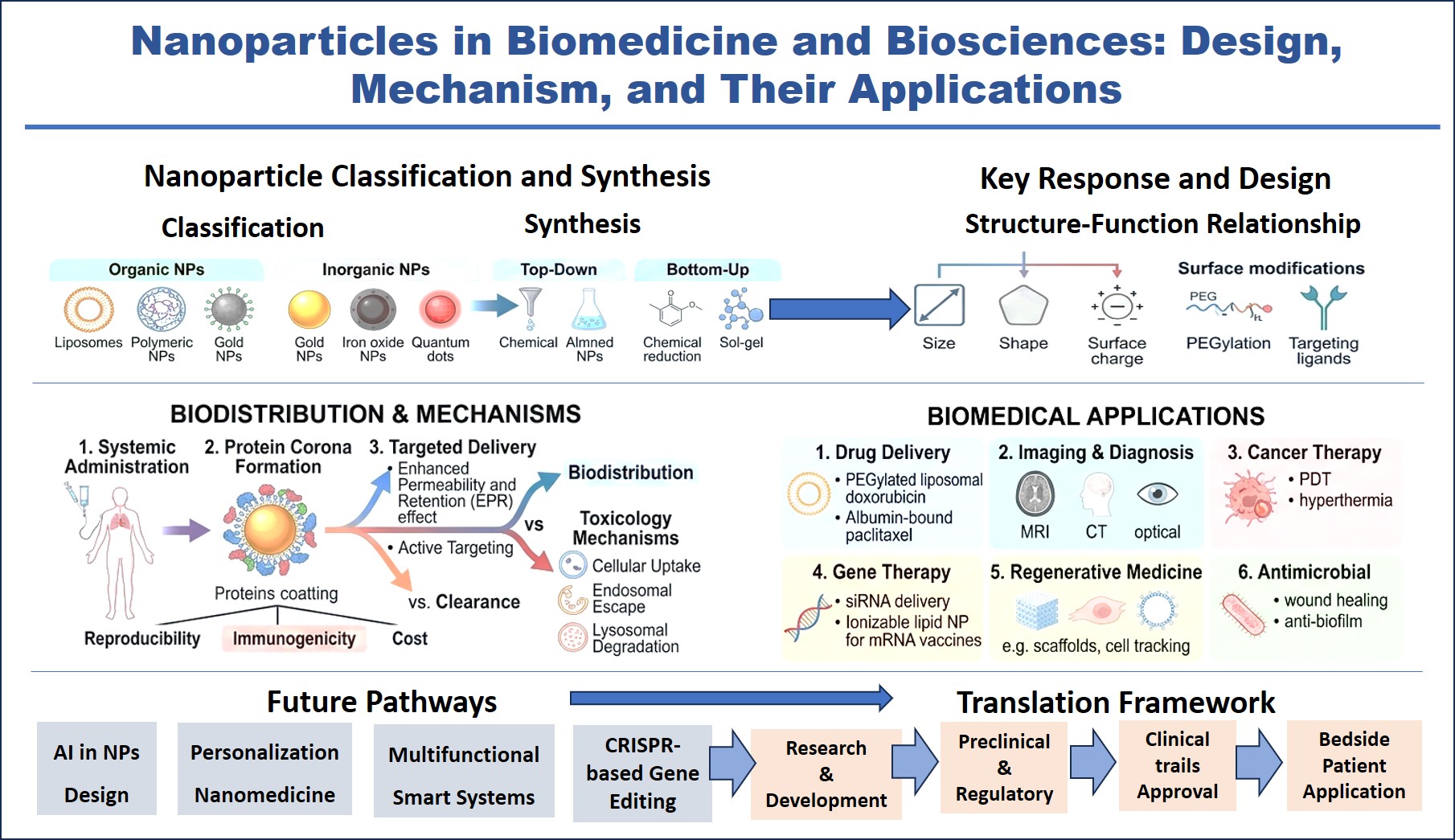
Nanotechnology is one of the promising sciences that has progressed rapidly in the last fifty years. It is used in many biomedical fields, including drug delivery, disease diagnosis, and vaccination. There are many examples of nanoparticles (NPs), PEGylated liposomal doxorubicin, albumin-bound paclitaxel and ionizable lipid NP mRNA Covid-19 vaccines. This article focuses on NP classification, synthesis, and properties and tests their translation into drug delivery, imaging, cancer therapy, gene therapy, regenerative medicine, and antimicrobial applications. This review article also highlighted the relationship between structure and function of NPs, leading to the study of biodistribution, protein corona formation and targeting, all of which shed light on toxicology mechanisms, the regulatory framework and its persistent barriers, including reproducibility, immunogenicity and cost impact on the application and synthesis of NPs. This article also investigated the publications that deal with the role of AI in NP design, personalized nanomedicine, multifunctional smart systems, and in conjunction with CRISPR-based gene editing. All these are also discussed as pathways to overcome the limitations. This article tries to reach the aims by consolidating materials design, bioscientific interaction, and clinical translation within a single framework. The aim of the manuscript is to provide researchers and clinicians with information for advancing nanoparticle-based technologies from the bench to the bedside of patients.
Article History:
Received: May 07, 2026
Revised: June 18, 2026
Accepted: June 22, 2026
Published: June 30, 2026
Downloads
References
[1] Feynman RP. (1960) There's Plenty of Room at the Bottom. Engineering and Science, 23 (5). pp. 22-36. ISSN 0013-7812 https://resolver.caltech.edu/CaltechES:23.5.1960Bottom.
[2] Drexler, KE. (1987) Engines of creation: The coming era of nanotechnology. Anchor. (Anchor Books, New York, 1986).
[3] Langer R, Folkman J. (1976) Polymers for the sustained release of proteins and other macromolecules. Nature 263(5580):797–800. doi: https://doi.org/10.1038/263797a0. PMID: 995197
[4] Porche DJ. (1996) Liposomal doxorubicin (Doxil). The Journal of the Association of Nurses in AIDS Care: JANAC 7(2):55–59. doi: https://doi.org/10.1016/S1055-3290(96)80016-1. PMID: 8679968.
[5] Gradishar WJ, Tjulandin S, Davidson N, Shaw H, Desai N, et al. (2005) Phase III trial of nanoparticle albumin-bound paclitaxel compared with polyethylated castor oil-based paclitaxel in women with breast cancer. J Clin Oncol 23(31):7794–7803. doi: https://doi.org/10.1200/JCO.2005.04.937. PMID: 16172456.
[6] Yoon HY, Jeon S, You DG, Park JH, Kwon IC, et al. (2017) Inorganic Nanoparticles for Image-Guided Therapy. Bioconjug Chem 28(1): 124–134. doi: https://doi.org/10.1021/acs.bioconjchem.6b00512. PMID: 27788580.
[7] Polack FP, Thomas SJ, Kitchin N, Absalon J, Gurtman A, et al. (2020) Safety and Efficacy of the BNT162b2 mRNA Covid-19 Vaccine. N Engl J Med 383(27): 2603–2615. doi: https://doi.org/10.1056/NEJMoa2034577. PMCID: PMC7745181.
[8] Lee N, Yoo D, Ling D, Cho MH, Hyeon T, Cheon J. (2015) Iron Oxide Based Nanoparticles for Multimodal Imaging and Magnetoresponsive Therapy. Chem Rev 115(19):10637–10689. doi: https://doi.org/10.1021/acs.chemrev.5b00112. PMID: 26250431.
[9] Xu S, Xu Y, Solek NC, Chen J, Gong F, et al. (2024) Tumor-Tailored Ionizable Lipid Nanoparticles Facilitate IL-12 Circular RNA Delivery for Enhanced Lung Cancer Immunotherapy. Adv Mater 36(29):e2400307. doi: https://doi.org/10.1002/adma.202400307. PMID: 38657273.
[10] Shi J, Kantoff PW, Wooster R, Farokhzad OC. (2017) Cancer nanomedicine: progress, challenges and opportunities. Nature reviews. Cancer 17(1):20–37. doi: https://doi.org/10.1038/nrc.2016.108. PMCID: PMC5575742
[11] Jain RK, Stylianopoulos T. (2010) Delivering nanomedicine to solid tumors. Nat Rev Clin Oncol 7(11):653–664. doi: https://doi.org/10.1038/nrclinonc.2010.139. PMCID: PMC3065247.
[12] Mamidi N, Franco De Silva F, Orash Mahmoudsalehi A. (2025) Advanced disease therapeutics using engineered living drug delivery systems. Nanoscale 17(13):7673–7696. doi: https://doi.org/10.1039/d4nr05298f. PMID: 40040419.
[13] Anjali K, Raghav A, Saxena U. (2026) Polymeric biomaterials in translational nanomedicine: a review on drug delivery, gene therapy, and tissue engineering. Int J Polym Mater Polym Biomater 75(10):1069-1086. doi: https://doi.org/10.1080/00914037.2026.2661646.
[14] Hang Y, Wang A, Wu N. (2024) Plasmonic silver and gold nanoparticles: shape- and structure-modulated plasmonic functionality for point-of-caring sensing, bio-imaging and medical therapy. Chem Soc Rev 53(6):2932–2971. doi: https://doi.org/10.1039/d3cs00793f. PMCID: PMC11849058.
[15] Pucci C, Degl'Innocenti A, Belenli Gümüş M, Ciofani G. (2022) Superparamagnetic iron oxide nanoparticles for magnetic hyperthermia: recent advancements, molecular effects, and future directions in the omics era. Biomater Sci 10(9):2103–2121. doi: https://doi.org/10.1039/d1bm01963e. PMID: 35316317.
[16] Min C, Zhang Q, Shen C, Liu D, Shen X, et al. (2017) Graphene oxide/carboxyl-functionalized multi-walled carbon nanotube hybrids: Powerful additives for water-based lubrication. RSC Adv 7(52):32574-32580. doi: https://doi.org/10.1039/c7ra04730d
[17] Jacob S, Rao R, Gorain B, Boddu SHS, Nair AB. (2025) Solid Lipid Nanoparticles and Nanostructured Lipid Carriers for Anticancer Phytochemical Delivery: Advances, Challenges, and Future Prospects. Pharmaceutics 17(8):1079. doi: https://doi.org/10.3390/pharmaceutics17081079. PMCID: PMC12389418
[18] Zhao D, Han A, Qiu M. (2019) Ice lithography for 3D nanofabrication. Sci Bull (Beijing) 64(12):865–871. doi: https://doi.org/10.1016/j.scib.2019.06.001. PMID: 36659676.
[19] Bassyouni M, Zahid MS, Alabdullah FA. (2026) Sustainable Approaches to Nanomaterial synthesis Using Mechanical Grinding Methods. Int J Ind Sustain Dev 7(1):1-28. doi: https://doi.org/10.21608/ijisd.2026.446142.1094.
[20] Rahman IA, Padavettan V. (2012) Synthesis of silica nanoparticles by sol‐gel: size‐dependent properties, surface modification, and applications in silica‐polymer nanocomposites—a review. J Nanomater 2012(1):132424. doi: https://doi.org/10.1155/2012/132424
[21] Mittal AK, Chisti Y, Banerjee UC. (2013) Synthesis of metallic nanoparticles using plant extracts. Biotechnol Adv 31(2):346–356. doi: https://doi.org/10.1016/j.biotechadv.2013.01.003.
[22] Suk JS, Xu Q, Kim N, Hanes J, Ensign LM. (2016) PEGylation as a strategy for improving nanoparticle-based drug and gene delivery. Adv Drug Deliv Rev 99(Pt A):28–51. doi: https://doi.org/10.1016/j.addr.2015.09.012. PMCID: PMC4798869.
[23] Samieipour F, Dianat-Moghadam H, Khanahmad H. (2025) Recent developments in bioconjugation: From strategies to design and clinical applications. Biomed Pharmacother 192:118593. doi: https://doi.org/10.1016/j.biopha.2025.118593. PMID: 40991990.
[24] Albanese A, Tang PS, Chan WC. (2012) The effect of nanoparticle size, shape, and surface chemistry on biological systems. Annu Rev Biomed Eng 14:1–16. doi: https://doi.org/10.1146/annurev-bioeng-071811-150124. PMID: 22524388.
[25] Champion JA, Mitragotri S. (2006) Role of target geometry in phagocytosis. Proc Natl Acad Sci U S A 103(13):4930–4934. doi: https://doi.org/10.1073/pnas.0600997103. PMCID: PMC1458772
[26] Blanco E, Shen H, Ferrari M. (2015) Principles of nanoparticle design for overcoming biological barriers to drug delivery. Nat Biotechnol 33(9):941–951. doi: https://doi.org/10.1038/nbt.3330. PMCID: PMC4978509.
[27] Shafaei N, Khorshidi S, Karkhaneh A. (2023) The immune-stealth polymeric coating on drug delivery nanocarriers: In vitro engineering and in vivo fate. J Biomater Appl 38(2):159–178. doi: https://doi.org/10.1177/08853282231185352. PMID: 37480331.
[28] Jokerst JV, Lobovkina T, Zare RN, Gambhir SS. (2011) Nanoparticle PEGylation for imaging and therapy. Nanomedicine (Lond) 6(4):715–728. doi: https://doi.org/10.2217/nnm.11.19. PMCID: PMC3217316.
[29] Anselmo AC, Mitragotri S. (2016) Nanoparticles in the clinic. Bioeng Transl Med 1(1):10–29. doi: https://doi.org/10.1002/btm2.10003. PMCID: PMC5689513.
[30] Pustulka SM, Ling K, Pish SL, Champion JA. (2020) Protein Nanoparticle Charge and Hydrophobicity Govern Protein Corona and Macrophage Uptake. ACS Appl Mater Interfaces 12(43):48284–48295. doi: https://doi.org/10.1021/acsami.0c12341. PMID: 33054178.
[31] Monopoli MP, Aberg C, Salvati A, Dawson KA. (2012) Biomolecular coronas provide the biological identity of nanosized materials. Nat Nanotechnol 7(12):779–786. doi: https://doi.org/10.1038/nnano.2012.207. PMID: 23212421
[32] Kamaly N, Yameen B, Wu J, Farokhzad OC. (2016) Degradable Controlled-Release Polymers and Polymeric Nanoparticles: Mechanisms of Controlling Drug Release. Chem Rev 116(4):2602–2663. doi: https://doi.org/10.1021/acs.chemrev.5b00346. PMCID: PMC5509216.
[33] Hashida M. (2022) Advocation and advancements of EPR effect theory in drug delivery science: A commentary. J Control Release 346:355–357. doi: https://doi.org/10.1016/j.jconrel.2022.04.031. PMID: 35483640.
[34] Bertrand N, Wu J, Xu X, Kamaly N, Farokhzad OC. (2014) Cancer nanotechnology: the impact of passive and active targeting in the era of modern cancer biology. Adv Drug Deliv Rev 66:2–25. doi: https://doi.org/10.1016/j.addr.2013.11.009. PMCID: PMC4219254.
[35] Mura S, Nicolas J, Couvreur P. (2013) Stimuli-responsive nanocarriers for drug delivery. Nat Mater 12(11): 991–1003. doi: https://doi.org/10.1038/nmat3776. PMID: 24150417.
[36] Akinc A, Maier MA, Manoharan M, Fitzgerald K, Jayaraman M, et al. (2019) The Onpattro story and the clinical translation of nanomedicines containing nucleic acid-based drugs. Nat Nanotechnol 14(12):1084–1087. doi: https://doi.org/10.1038/s41565-019-0591-y. PMID: 31802031.
[37] Cormode DP, Naha PC, Fayad ZA. (2014) Nanoparticle contrast agents for computed tomography: a focus on micelles. Contrast Media Mol Imaging 9(1):37–52. doi: https://doi.org/10.1002/cmmi.1551. PMCID: PMC3905628.
[38] Kiessling F, Fokong S, Bzyl J, Lederle W, Palmowski M, Lammers T. (2014) Recent advances in molecular, multimodal and theranostic ultrasound imaging. Adv Drug Deliv Rev 72:15–27. doi: https://doi.org/10.1016/j.addr.2013.11.013. PMCID: PMC4043517.
[39] Mohkam M, Sadraeian M, Lauto A, Gholami A, Nabavizadeh SH, Esmaeilzadeh H, Alyasin S. (2023) Exploring the potential and safety of quantum dots in allergy diagnostics. Microsyst Nanoeng 9:145. doi: https://doi.org/10.1038/s41378-023-00608-x. PMCID: PMC10656439.
[40] Doria G, Conde J, Veigas B, Giestas L, Almeida C, et al. (2012) Noble metal nanoparticles for biosensing applications. Sensors (Basel) 12(2):1657–1687. doi: https://doi.org/10.3390/s120201657. PMCID: PMC3304133.
[41] Parkhe VS, Tiwari AP. (2024) Gold nanoparticles-based biosensors: pioneering solutions for bacterial and viral pathogen detection-a comprehensive review. World J Microbiol Biotechnol 40(9):269. doi: https://doi.org/10.1007/s11274-024-04072-1. PMID: 39009934.
[42] Lammers T, Aime S, Hennink WE, Storm G, Kiessling F. (2011) Theranostic nanomedicine. Acc Chem Res 44(10):1029–1038. doi: https://doi.org/10.1021/ar200019c. PMID: 21545096.
[43] Rehan F, Zhang M, Fang J, Greish K. (2024) Therapeutic Applications of Nanomedicine: Recent Developments and Future Perspectives. Molecules 29(9):2073. doi: https://doi.org/10.3390/molecules29092073. PMCID: PMC11085487.
[44] Khan MS, Alqahtani T, Al Shmrany H, Gupta G, Goh KW, et al. (2026) Enhanced permeability and retention (EPR) effect: Advances in nanomedicine for improved tumor targeting. Biomater Adv 181:214636. doi: https://doi.org/10.1016/j.bioadv.2025.214636. PMID: 41365275.
[45] Lancet JE, Uy GL, Cortes JE, Newell LF, Lin TL, et al. (2018) CPX-351 (cytarabine and daunorubicin) Liposome for Injection Versus Conventional Cytarabine Plus Daunorubicin in Older Patients With Newly Diagnosed Secondary Acute Myeloid Leukemia. J Clin Oncol 36(26):2684–2692. doi: https://doi.org/10.1200/JCO.2017.77.6112. PMCID: PMC6127025.
[46] Hirsch LR, Stafford RJ, Bankson JA, Sershen SR, Rivera B, et al. (2003) Nanoshell-mediated near-infrared thermal therapy of tumors under magnetic resonance guidance. Proc Natl Acad Sci U S A 100(23):13549–13554. doi: https://doi.org/10.1073/pnas.2232479100. PMCID: PMC263851.
[47] Yang Z, Huang M, Yang R, Sun J, Zhang X, et al. (2023) Near-Infrared Trapping by Surface Plasmons in Randomized Platinum-Ceramic Metamaterial for Thermal Barrier Coatings. Small methods 7(6):e2201691. doi: https://doi.org/10.1002/smtd.202201691. PMID: 36932890.
[48] Lovell JF, Jin CS, Huynh E, Jin H, Kim C, et al. (2011). Porphysome nanovesicles generated by porphyrin bilayers for use as multimodal biophotonic contrast agents. Nat Mater 10(4):324–332. doi: https://doi.org/10.1038/nmat2986. PMID: 21423187.
[49] Kranz LM, Diken M, Haas H, Kreiter S, Loquai C, et al. (2016) Systemic RNA delivery to dendritic cells exploits antiviral defence for cancer immunotherapy. Nature 534(7607):396–401. doi: https://doi.org/10.1038/nature18300. PMID: 27281205.
[50] Riley RS, June CH, Langer R, Mitchell MJ. (2019) Delivery technologies for cancer immunotherapy. Nat Rev Drug Discov 18(3):175–196. doi: https://doi.org/10.1038/s41573-018-0006-z. PMCID: PMC6410566.
[51] Mukalel AJ, Riley RS, Zhang R, Mitchell MJ. (2019) Nanoparticles for nucleic acid delivery: Applications in cancer immunotherapy. Cancer Lett 458:102–112. doi: https://doi.org/10.1016/j.canlet.2019.04.040. PMCID: PMC6613653.
[52] Qi S, Zhang X, Yu X, Jin L, Yang K, et al. (2024) Supramolecular Lipid Nanoparticles Based on Host-Guest Recognition: A New Generation Delivery System of mRNA Vaccines For Cancer Immunotherapy. Adv Mater 36(23):e2311574. doi: https://doi.org/10.1002/adma.202311574. PMID: 38433564.
[53] Hou X, Zaks T, Langer R, Dong Y. (2021) Lipid nanoparticles for mRNA delivery. Nat Rev Mater 6(12):1078–1094. doi: https://doi.org/10.1038/s41578-021-00358-0. PMCID: PMC8353930
[54] Cullis PR, Hope MJ. (2017) Lipid Nanoparticle Systems for Enabling Gene Therapies. Mol Ther 25(7):1467–1475. doi: https://doi.org/10.1016/j.ymthe.2017.03.013. PMCID: PMC5498813.
[55] Hall A, Bartek J, Wagner E, Lächelt U, Moghimi SM. (2023) High-resolution bioenergetics correlates the length of continuous protonatable diaminoethane motif of four-armed oligo(ethanamino)amide transfectants to cytotoxicity. J Control Release 361:115–129. doi: https://doi.org/10.1016/j.jconrel.2023.07.051. PMID: 37532151.
[56] Steinhauff D, Ghandehari H. (2019) Matrix Mediated Viral Gene Delivery: A Review. Bioconjug Chem 30(2):384–399. doi: https://doi.org/10.1021/acs.bioconjchem.8b00853. PMID: 30707573.
[57] Schoenmaker L, Witzigmann D, Kulkarni JA, Verbeke R, Kersten G, et al. (2021) mRNA-lipid nanoparticle COVID-19 vaccines: Structure and stability. Int J Pharm 601:120586. doi: https://doi.org/10.1016/j.ijpharm.2021.120586. PMCID: PMC8032477.
[58] Saikia N. (2024) Inorganic-Based Nanoparticles and Biomaterials as Biocompatible Scaffolds for Regenerative Medicine and Tissue Engineering: Current Advances and Trends of Development. Inorganics 12(11):292. doi: https://doi.org/10.3390/inorganics12110292.
[59] Dvir T, Timko BP, Kohane DS, Langer R. (2011) Nanotechnological strategies for engineering complex tissues. Nat Nanotechnol 6(1):13–22. doi: https://doi.org/10.1038/nnano.2010.246. PMCID: PMC4059057.
[60] Yi C, Liu D, Fong CC, Zhang J, Yang M. (2010) Gold nanoparticles promote osteogenic differentiation of mesenchymal stem cells through p38 MAPK pathway. ACS Nano 4(11):6439–6448. doi: https://doi.org/10.1021/nn101373r. PMID: 21028783.
[61] Tończyk A, Niedziałkowska K, Nowak-Lange M, Bernat P, Lisowska K. (2025) Mycogenic Silver Nanoparticles: Promising Antimicrobials with Fungistatic Properties. Int J Mol Sci 26(14): 6639. doi: https://doi.org/10.3390/ijms26146639. PMCID: PMC12294507.
[62] Naskar A, Kim KS. (2020) Recent Advances in Nanomaterial-Based Wound-Healing Therapeutics. Pharmaceutics 12(6):499. doi: https://doi.org/10.3390/pharmaceutics12060499. PMCID: PMC7356512.
[63] Huang Z, Zhang X, Yao Z, Han Y, Ye J, et al. (2023) Thymol-Decorated Gold Nanoparticles for Curing Clinical Infections Caused by Bacteria Resistant to Last-Resort Antibiotics. mSphere, 8(3):e0054922. doi: https://doi.org/10.1128/msphere.00549-22. PMCID: PMC10286717.
[64] Slavin YN, Asnis J, Häfeli UO, Bach H. (2017) Metal nanoparticles: understanding the mechanisms behind antibacterial activity. J Nanobiotechnology 15(1):65. doi: https://doi.org/10.1186/s12951-017-0308-z. PMCID: PMC5627441.
[65] Okaiyeto K, Gigliobianco MR, Di Martino P. (2024) Biogenic Zinc Oxide Nanoparticles as a Promising Antibacterial Agent: Synthesis and Characterization. Int J Mol Sci 25(17):9500. doi: https://doi.org/10.3390/ijms25179500. PMCID: PMC11395547.
[66] Mba IE, Nweze EI. (2021) Nanoparticles as therapeutic options for treating multidrug-resistant bacteria: research progress, challenges, and prospects. World J Microbiol Biotechnol 37(6):108. doi: https://doi.org/10.1007/s11274-021-03070-x. PMCID: PMC8159659.
[67] Barbari A. (2024) A Different Perspective on the COVID-19 Pandemic: Validity of COVID-19 Testing and Protective Nonpharmaceutical Interventions (Part 2). Exp Clin Transplant 22(Suppl 2):15–32. doi: https://doi.org/10.6002/ect.2023.0130. PMID: 38385594.
[68] Nel A, Xia T, Mädler L, Li N. (2006) Toxic potential of materials at the nanolevel. Science 311(5761):622–627. doi: https://doi.org/10.1126/science.1114397. PMID: 16456071.
[69] Fu PP, Xia Q, Hwang HM, Ray PC, Yu H. (2014) Mechanisms of nanotoxicity: generation of reactive oxygen species. J Food Drug Anal 22(1):64–75. doi: https://doi.org/10.1016/j.jfda.2014.01.005. PMCID: PMC9359151.
[70] Chen Q, Riviere JE, Lin Z. (2022) Toxicokinetics, dose-response, and risk assessment of nanomaterials: Methodology, challenges, and future perspectives. Wiley Interdiscip Rev Nanomed Nanobiotechnol 14(6):e1808. doi: https://doi.org/10.1002/wnan.1808. PMCID: PMC9699155.
[71] Peng L, Gao Z, Liang Y, Guo X, Zhang Q, Cui D. (2025) Nanoparticle-based drug delivery systems: opportunities and challenges in the treatment of esophageal squamous cell carcinoma (ESCC). Nanoscale 17(14):8270–8288. doi: https://doi.org/10.1039/d4nr05114a. PMID: 40052671.
[72] Tinkle S, McNeil SE, Mühlebach S, Bawa R, Borchard G, et al. (2014) Nanomedicines: addressing the scientific and regulatory gap. Ann N Y Acad Sci 1313:35–56. doi: https://doi.org/10.1111/nyas.12403. PMID: 24673240.
[73] Hua S, de Matos MBC, Metselaar JM, Storm G. (2018) Current Trends and Challenges in the Clinical Translation of Nanoparticulate Nanomedicines: Pathways for Translational Development and Commercialization. Front Pharmacol 9:790. doi: https://doi.org/10.3389/fphar.2018.00790. PMCID: PMC6056679.
[74] Kim Y, Park J, Choi J, Kim M, Seo G, et al. (2025) Physiological Barriers to Nucleic Acid Therapeutics and Engineering Strategies for Lipid Nanoparticle Design, Optimization, and Clinical Translation. Pharmaceutics 17(10):1309. doi: https://doi.org/10.3390/pharmaceutics17101309. PMCID: PMC12566709.
[75] Mishra PK, Sharma J. (2021) Navigating the ethics of nanomedicine: are we lost in translation?. Nanomedicine (Lond) 16(13):1075–1080. doi: https://doi.org/10.2217/nnm-2021-0054. PMID: 33900107.
[76] Metselaar JM, Lammers T. (2020) Challenges in nanomedicine clinical translation. Drug Deliv Transl Res 10(3):721–725. doi: https://doi.org/10.1007/s13346-020-00740-5. PMCID: PMC7228980.
[77] Adir O, Poley M, Chen G, Froim S, Krinsky N, et al. (2020) Integrating Artificial Intelligence and Nanotechnology for Precision Cancer Medicine. Adv Mater 32(13):e1901989. doi: https://doi.org/10.1002/adma.201901989. PMCID: PMC7124889.
[78] Mitchell MJ, Billingsley MM, Haley RM, Wechsler ME, Peppas NA, Langer R. (2021) Engineering precision nanoparticles for drug delivery. Nat Rev Drug Discov 20(2):101–124. doi: https://doi.org/10.1038/s41573-020-0090-8. PMCID: PMC7717100.
[79] Saadh MJ, Mustafa MA, Kumar A, Alamir HTA, Kumar A, et al. (2024) Stealth Nanocarriers in Cancer Therapy: a Comprehensive Review of Design, Functionality, and Clinical Applications. AAPS PharmSciTech 25(6):140. doi: https://doi.org/10.1208/s12249-024-02843-5. PMID: 38890191.
[80] Yin H, Kauffman KJ, Anderson DG. (2017) Delivery technologies for genome editing. Nat Rev Drug Discov 16(6):387–399. doi: https://doi.org/10.1038/nrd.2016.280. PMID: 28337020.
[81] Wu F, Li N, Xiao Y, Palanki R, Yamagata H, et al. (2026) Lipid Nanoparticles for Delivery of CRISPR Gene Editing Components. Small Methods 10(2):e2401632. doi: https://doi.org/10.1002/smtd.202401632. PMCID: PMC12825352 .
Additional Files
Published
Issue
Section
License
Copyright (c) 2026 Lubna Al-Mutalib (Author)

This work is licensed under a Creative Commons Attribution 4.0 International License.
All articles in the World Journal of Experimental Biosciences are published under the terms of the Creative Commons Attribution 4.0 International License (CC BY 4.0) ( (http://creativecommons.org/licenses/by/4.0/), which permits unrestricted use, distribution, and reproduction in any medium, provided the original work is properly cited.