Carbapenem Resistance is Associated with Biofilm formation in Clinical isolates of Klebsiella pneumoniae
DOI:
https://doi.org/10.65329/wjeb.v14.02.02Keywords:
Antibacterial susceptibility, Biofilm formation, Carbapenem resistance, Kirby-Bauer disk diffusion, Klebsiella pneumoniae, multidrug resistanceAbstract
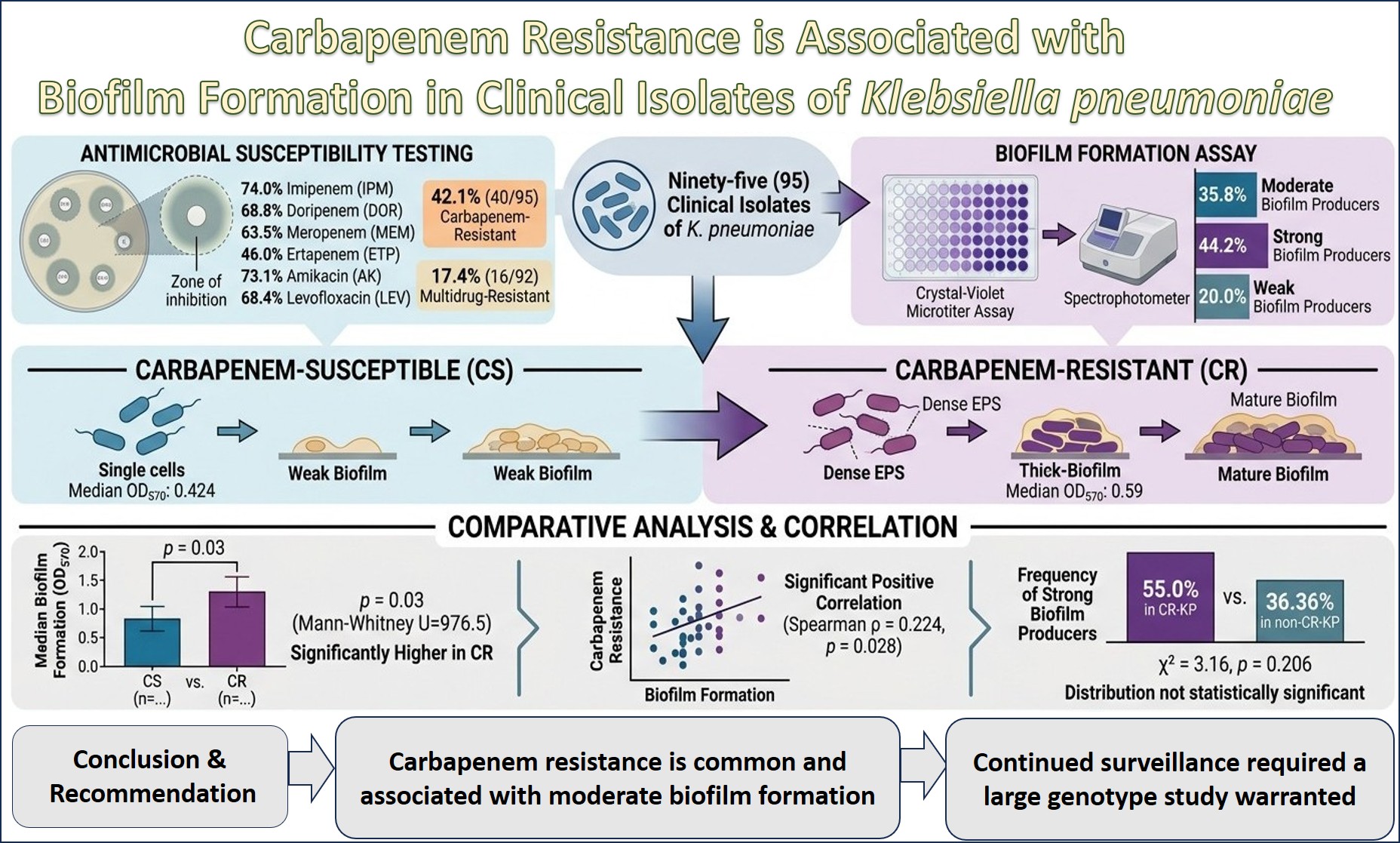
Carbapenem-resistant Klebsiella pneumoniae (CRKP) and biofilm-producing nosocomial pathogenic bacteria may complicate treatment and infection control. The relationship between carbapenem resistance and biofilm formation remains poorly characterized. Susceptibility to imipenem, doripenem, ertapenem, amikacin, and levofloxacin was assessed using the Kirby-Bauer disk diffusion assay and CLSI M100 breakpoints for ninety-five non-duplicate clinical isolates of K. pneumoniae. The crystal-violet microtiter assay, which measured the optical density at 570 nm and was categorised based on Stepanovic criteria, was used to measure the ability of the isolates to produce biofilm in vitro. Based on the isolates' carbapenem resistance results, the isolates were classified as carbapenem-resistant (CR), carbapenem-intermediate (CIN), and carbapenem-susceptible (CS). The susceptibility rates were 74.0%, 68.8%, 63.5%, 46.0%, 73.1%, and 68.4% for imipenem, doripenem, meropenem, ertapenem, amikacin, and levofloxacin, respectively. The results showed that 43.2% (41/95) were resistant to a carbapenem antibiotic, while 16.8% (16/95) were multidrug-resistant. When the biofilm product was assessed, 35.4% of the isolates were moderate biofilm producers, 43.8% were strong biofilm producers, and 20.8% were weak biofilm producers. The OD570 of biofilm formation was significantly higher in CR isolates than in CS isolates (0.59 vs. 0.424; Mann-Whitney U=976.5, p= 0.03). Resistance to carbapenems was significantly correlated with biofilm formation (Spearman ρ = 0.224, p = 0.028). Isolates with strong biofilm formation were more frequent in CR-KP than in CR-KP (53.7% vs. 36.4%), but the distribution was not significant (χ² =3.16, p =0.206). It can be concluded that carbapenem resistance was common and associated with a moderate increase in biofilm production. This study recommends continued surveillance, and large genotypic studies are warranted.
Article History:
Received June 10, 2026
Revised July 22, 2026
Accepted: August 15, 2026
Published: September 05, 2026
Downloads
References
[1] Guerra MES, Destro G, Vieira B, Lima AS, Ferraz LFC, et al. (2022) Klebsiella pneumoniae Biofilms and Their Role in Disease Pathogenesis. Front Cell Infect Microbiol 12:877995. doi: https://doi.org/10.3389/fcimb.2022.877995. PMID: 35646720.
[2] Sati H, Carrara E, Savoldi A, Hansen P, Garlasco J, et al. (2025) WHO Bacterial Priority Pathogens List Advisory Group. The WHO Bacterial Priority Pathogens List 2024: a prioritisation study to guide research, development, and public health strategies against antimicrobial resistance. Lancet Infect Dis 25(9):1033-1043. doi: https://doi.org/10.1016/S1473-3099(25)00118-5 . PMID: 40245910.
[3] Wang D, Wang M, He T, Li D, Zhang L, et al. (2022) Molecular epidemiology and mechanism of Klebsiella pneumoniae resistance to ertapenem but not to other carbapenems in China. Front Microbiol 13:974990.
doi: https://doi.org/10.3389/fmicb.2022.974990. PMID: 36425030.
[4] Rahdar HA, Malekabad ES, Dadashi AR, Takei E, Keikha M, et al. (2019) Correlation between biofilm formation and carbapenem resistance among clinical isolates of Klebsiella pneumoniae. Ethiop J Health Sci 29(6):745–750.
doi: https://doi.org/10.4314/ejhs.v29i6.11. PMID: 31741645.
[5] Cusumano JA, Caffrey AR, Daffinee KE, Luther MK, Lopes V, LaPlante KL. (2019) Weak biofilm formation among carbapenem-resistant Klebsiella pneumoniae. Diagn Microbiol Infect Dis 95(4):114877 doi: https://doi.org/10.1016/j.diagmicrobio.2019.114877. PMID: 31484626.
[6] Fang R, Liu H, Zhang X, Dong G, Li J, et al. (2021) Difference in biofilm formation between carbapenem-resistant and carbapenem-sensitive Klebsiella pneumoniae based on analysis of mrkH distribution. Microb Pathog 152:104743.
doi: https://doi.org/10.1016/j.micpath.2021.104743. PMID: 33484812.
[7] Dan B, Dai H, Zhou D, Tong H, Zhu M. (2023) Relationship Between Drug Resistance Characteristics and Biofilm Formation in Klebsiella Pneumoniae Strains. Infect Drug Resist 16:985–998. doi: https://doi.org/10.2147/IDR.S396609. PMID: 36824066.
[8] Marzouk E, Abalkhail A, ALqahtani J, Alsowat K, Alanazi M, et al. (2024) Proteome analysis, genetic characterization, and antibiotic resistance patterns of Klebsiella pneumoniae clinical isolates. AMB Express 14(1):54. doi: https://doi.org/10.1186/s13568-024-01710-7. PMID: 38722429.
[9] Mohammed MT, Zgair AK. (2025) Polymer matrix of biofilm in Klebsiella pneumoniae reduced by sub-MIC hydrogen peroxide enhances cefotaxime efficacy. Polimery w medycynie 55(2):113–122. doi: https://doi.org/10.17219/pim/207885 . PMID: 41396039.
[10] Kimbrough JH, Maher JM, Sader HS, Castanheira M, Mendes RE. (2024) In vitro activity assessment of cefiderocol against Enterobacterales, Pseudomonas aeruginosa, and Acinetobacter spp., including β-lactam nonsusceptible molecularly characterized isolates, collected from 2020 to 2021 in the United States and European hospitals. Microbiol Spectr 12(11):e0147424. doi: https://doi.org/10.1128/spectrum.01474-24. PMCID: PMC11537082.
[11] Yin D, Guo Y, Han R, Yang Y, Zhu D, Hu F. (2023) A modified Kirby-Bauer disc diffusion (mKB) method for accurately testing tigecycline susceptibility: a nation-wide multicenter comparative study. J Med Microbiol 72(8): doi: https://doi.org/10.1099/jmm.0.001671. PMID: 37552058
[12] Ibrahim B, Ghafil JA, Abdullah ZA, Kınaytürk NK, Alshahrani SM, et al. (2026). Molecular insights into the oxidative perturbation of VIM-2 metallo-β-lactamase: Active site remodeling restores imipenem susceptibility in Pseudomonas aeruginosa. Microbial pathogenesis 214:108411. doi: https://doi.org/10.1016/j.micpath.2026.108411. PMID: 41771381
[13] Stepanović S, Cirković I, Ranin L, Svabić-Vlahović M. (2004) Biofilm formation by Salmonella spp. and Listeria monocytogenes on plastic surface. Lett Appl Microbiol 38(5):428–432. doi: https://doi.org/10.1111/j.1472-765X.2004.01513.x . PMID: 15059216.
[14] Ding Q, Jin L, Wang R, Wang Q, Wang H. (2016) Evolution of antibiotic resistance and virulence in ST11-KL64 carbapenem-resistant Klebsiella pneumoniae under last-resort antibiotic pressure. J Glob Antimicrob Resist 48:24-34. doi: https://doi.org/10.1016/j.jgar.2026.02.008 . PMID: 41724355.
[15] Li L, Gao X, Li M, Liu Y, Ma J, et al. (2024) Relationship between biofilm formation and antibiotic resistance of Klebsiella pneumoniae and updates on antibiofilm therapeutic strategies. Front Cell Infect Microbiol 14:1324895. doi: https://doi.org/10.3389/fcimb.2024.1324895. PMID: 38465230.
[16] Dionisio F, Domingues CPF, Rebelo JS, Monteiro F, Nogueira T. (2023) The Impact of Non-Pathogenic Bacteria on the Spread of Virulence and Resistance Genes. Int J Mol Sci 24(3):1967. doi: https://doi.org/10.3390/ijms24031967. PMID: 36768286.
[17] Beceiro A, Tomás M, Bou G. (2013) Antimicrobial resistance and virulence: a successful or deleterious association in the bacterial world? Clin Microbiol Rev 26(2):185-230. doi: https://doi.org/10.1128/CMR.00059-12. PMID: 23554414.
[18] Taha MS, Hagras MM, Shalaby MM, Zamzam YA, Elkolaly RM, et al. (2023) Genotypic characterization of carbapenem-resistant Klebsiella pneumoniae isolated from an Egyptian university hospital. Pathogens 12(1):121. doi: https://doi.org/10.3390/pathogens12010121. PMID: 36678469.
[19] Li J, Shi Y, Song X, Yin X, Liu H. (2025) Mechanisms of Antimicrobial Resistance in Klebsiella: Advances in Detection Methods and Clinical Implications. Infect Drug Resist 18:1339-1354. doi: https://doi.org/10.2147/IDR.S509016. PMID: 40092844.
[20] Fakir AA, Patil SR, Mane PM. (2026) Medical Device-Associated Infections in Intensive Care Settings: Biofilms, Multidrug-Resistant Pathogens, and Prevention Strategies. Cureus 18(7):e111893. doi: https://doi.org/10.7759/cureus.111893. PMID: 42540543.
[21] Salvado de Morais M, Gonçalves A, Cristóvão G, Lucena J, Reis AC, et al. (2025) Managing Bacteremia: Insights Into Pathogen-Specific Treatment. Cureus 17(2):e78674. doi: https://doi.org/10.7759/cureus.78674. PMID: 40062114.
Additional Files
Published
Issue
Section
License
Copyright (c) 2026 Sura Jabuk, Mehdi Meskini Heydarlou, Muhammad Shawal, Ata Ur Rehman (Author)

This work is licensed under a Creative Commons Attribution 4.0 International License.
All articles in the World Journal of Experimental Biosciences are published under the terms of the Creative Commons Attribution 4.0 International License (CC BY 4.0) ( (http://creativecommons.org/licenses/by/4.0/), which permits unrestricted use, distribution, and reproduction in any medium, provided the original work is properly cited.