A Comprehensive Review of Plastic Pollution: Public Health and Environmental Impacts, Sources, and Mitigation Strategies
DOI:
https://doi.org/10.65329/wjeb.v14.01.02Keywords:
Environmental impacts, microplastics, plastic pollution, public health.Abstract
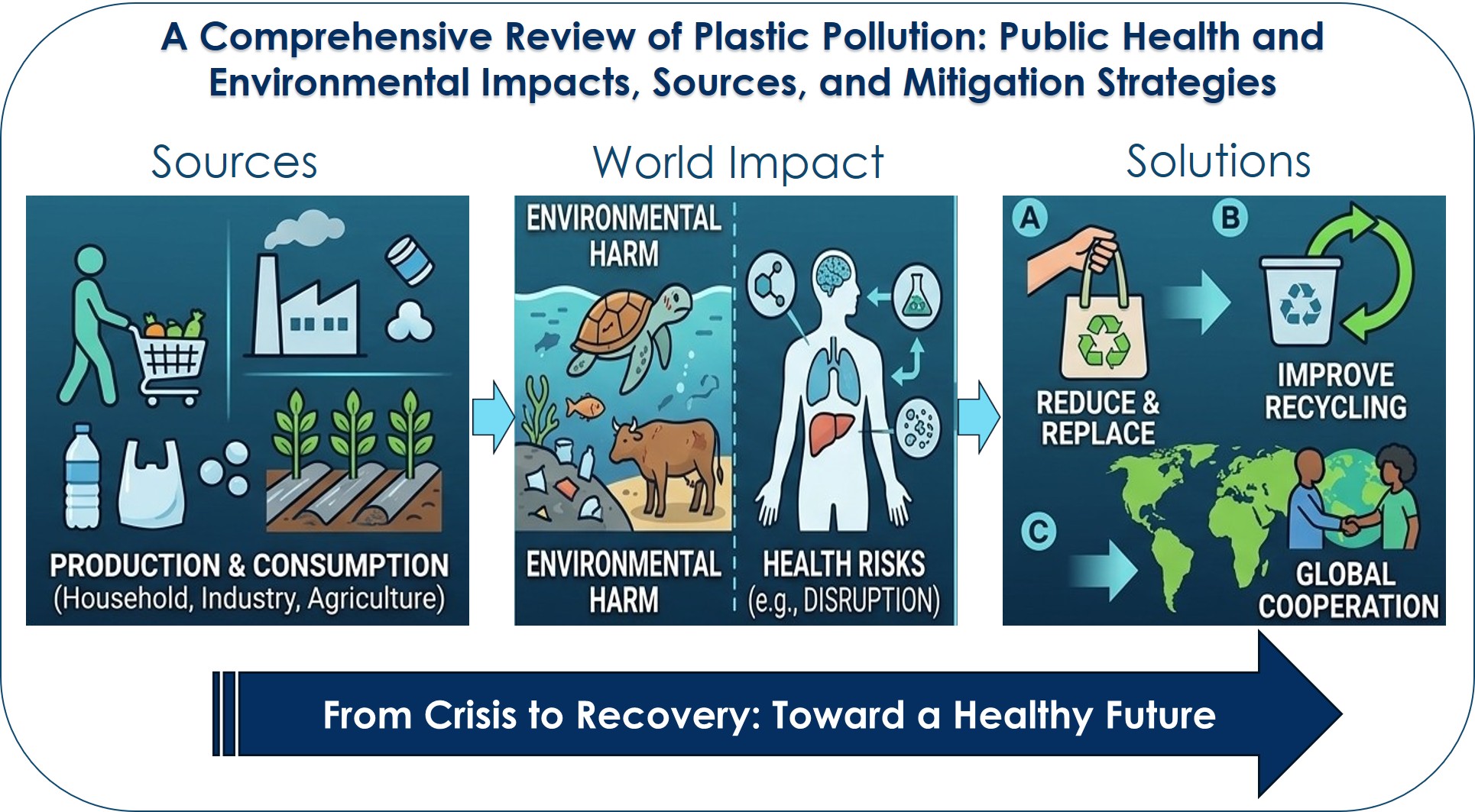
Plastic is a basic material widely used in various consumer and industrial sectors, from construction and vehicles to electronics and agriculture. In recent years, plastic pollution has put pressure on the environment and threatens human safety worldwide due to massive global plastic production, which has led to waste generation that exceeds society's ability to manage it efficiently. This review discusses the types of plastic pollution, as plastic chemical composition consists of long polymers that are resistant to degradation by decomposing organisms. Natural processes break down plastic materials into small particles, forming microplastics and nanoplastics that can easily disperse throughout the environment. Consequently, plastic pollution affects terrestrial and marine ecosystems, causing serious effects on the environment, the economy, and the health of organisms. In addition, the article reviews the main sources of plastic waste, including household, industrial, agricultural, and medical waste. It also reveals the major problems caused by plastic waste, especially its environmental and human health impacts, as chemical materials in plastic cause several health issues like reproductive disorders, hormonal disruption, and neurological disease. It also highlights the importance of control measures and coordinated global efforts to reduce single-use plastic, improve recycling systems, and create international partnerships to mitigate the effects of plastic pollution on the planet and public health.
References
[1] Ziani K, Ionita-Mindrican CB, Mititelu M, Neacsu SM, Negrei C, et al. (2023) Microplastics: a real global threat for environment and food safety: a state of the art review. Nutrients 15(3):617. DOI: https://doi.org/10.3390/nu15030617. PMID: 36771324, PMCID: PMC9920460 DOI: https://doi.org/10.3390/nu15030617
[2] Geyer R, Jambeck J, Law KL. (2017) Production, use, and fate of all plastics ever made. Sci Adv 3(7):e1700782. DOI: https://doi.org/10.1126/sciadv.1700782. PMCID: PMC5517107 DOI: https://doi.org/10.1126/sciadv.1700782
[3] Gao L, Su Y, Mehmood T, Wang Z, Peng L, Zhang N. (2025) UVA-induced weathering of microplastics in seawater: surface property transformations and kinetics. Front Mar Sci 12:1519668. DOI: https://doi.org/10.3389/fmars.2025.1519668 . DOI: https://doi.org/10.3389/fmars.2025.1519668
[4] Yu RS, Yang YF, Singh S. (2023) Global analysis of marine plastics and implications of control measure strategies. Front Mar Sci 10:1305091. DOI: https://doi.org/10.3389/fmars.2023.1305091. DOI: https://doi.org/10.3389/fmars.2023.1305091
[5] Peeken I, Primpke S, Beyer B, Gütermann J, Katlein C, et al. (2018) Arctic sea ice is an important temporal sink and means of transport for microplastic. Nat Commun 9(1):1505. DOI: https://doi.org/10.1038/s41467-018-03825-5 . PMCID: PMC5915590 DOI: https://doi.org/10.1038/s41467-018-03825-5
[6] EPA. (2021) EPA helps states reduce trash, including plastic, in U.S. waterways but needs to identify obstacles and develop strategies for further progress (Report No. 21-P-0130). Office of Inspector General, U.S. EPA.
[7] Lebreton L, Andrady A (2019) Future scenarios of global plastic waste generation and disposal Palgrave. Commun 5:6. DOI: https://doi.org/10.1057/s41599-018-0212-7 . DOI: https://doi.org/10.1057/s41599-018-0212-7
[8] Tanaviyutpakdee PH. Karnpanit W. (2023) Exposure Assessment of Heavy Metals and Microplastic-like Particles from Consumption of Bivalves. Foods 12(16):3018. DOI: https://doi.org/10.3390/foods12163018. PMCID: PMC10453466 DOI: https://doi.org/10.3390/foods12163018
[9] Cox KD, Covernton GA, Davies HL, Dower JF, Juanes F, Dudas SE. (2019) Human consumption of microplastics. Environ Sci Technol 53: 70687074. DOI: https://doi.org/10.1021/acs.est.9b01517 . PMID: 31184127. DOI: https://doi.org/10.1021/acs.est.9b01517
[10] Rillig MC, Lehmann A. (2020) Microplastic in terrestrial ecosystems. Science 368(6498): 1430–1431. DOI: https://doi.org/10.1126/science.abb5979. PMCID: PMC7115994. DOI: https://doi.org/10.1126/science.abb5979
[11] Schwabl P, Koppal S, Konigshofer P, Bbucsics T, Trauner M, et al. (2019) Detection of various microplastics in human stool: a prospective case series. Ann Intern Med 171(7):453-457. DOI: https://doi.org/10.7326/M19-0618 . PMID: 31476765. DOI: https://doi.org/10.7326/M19-0618
[12] Najahi H, Banni M, Nakad M, Abboud R, Assaf JC, et al. (2025) Plastic pollution in food packaging systems: impact on human health, socioeconomic considerations and regulatory framework. J Hazard Mater Adv 18:100667. DOI: https://doi.org/10.1016/j.hazadv.2025.100667. PMCID: PMC12535839 DOI: https://doi.org/10.1016/j.hazadv.2025.100667
[13] Winiarska E, Jutel M, Zemelka-Wiacek M. (2024) The potential impact of nano- and microplastics on human health: understanding human health risks. Environ Res 251:118535. DOI: https://doi.org/10.1016/j.envres.2024.118535. PMID: 38460665. DOI: https://doi.org/10.1016/j.envres.2024.118535
[14] Zhang X, Yu C, Wang P, Yang C. (2025) Microplastics and human health: unraveling the toxicological pathways and implications for public health. Front Public Health 13:1567200. DOI: https://doi.org/10.3389/fpubh.2025.1567200. PMCID: PMC12213550. DOI: https://doi.org/10.3389/fpubh.2025.1567200
[15] Clayton CA, Walker TR, Bezerra JC, Adam I. (2020) Policy responses to reduce single-use plastic marine pollution in the Caribbean. Marine Pollution Bulletin 162:111833. DOI: https://doi.org/10.1016/j.marpolbul.2020.111833. PMID: 33213855. DOI: https://doi.org/10.1016/j.marpolbul.2020.111833
[16] Avio CG, Gorbi S, Regoli F. (2017) Plastics and microplastics in the oceans: From emerging pollutants to emerged threat. Mar Environ Res 128:2-11. DOI: https://doi.org/10.1016/j.marenvres.2016.05.012 . PMID: 27233985. DOI: https://doi.org/10.1016/j.marenvres.2016.05.012
[17] Auta H S, Emenike CU, Fauziah SH. (2017) Distribution and importance of microplastics in the marine environment: a review of the sources, fate, effects, and potential solutions. Environment international. 102:165-176. DOI: https://doi.org/10.1016/j.envint.2017.02.013. PMID: 28284818. DOI: https://doi.org/10.1016/j.envint.2017.02.013
[18] Athey SN, Erdle LM. (2022) Are we underestimating anthropogenic microfiber pollution? A critical review of occurrence, methods, and reporting. Environ Toxicol Chem 41:822–37. DOI: https://doi.org/10.1002/etc.5173 . PMID: 34289522. DOI: https://doi.org/10.1002/etc.5173
[19] Emenike EC, Okorie CJ, Ojeyemi T, Egbemhenghe A, Iwuozor KO, et al. (2023) From oceans to dinner plates: the impact of microplastics on human health. Heliyon 9:e20440. DOI: https://doi.org/10.1016/j.heliyon.2023.e20440. PMCID: PMC10543225 DOI: https://doi.org/10.1016/j.heliyon.2023.e20440
[20] Ivar do Sul JA. (2021) Why it is important to analyze the chemical composition of microplastics in environmental samples. Mar Pollut Bull 165:112086. DOI: https://doi.org/10.1016/j.marpolbul.2021.112086. PMID: 33578189. DOI: https://doi.org/10.1016/j.marpolbul.2021.112086
[21] Alimba CG, Faggio C. (2019) Microplastics in the marine environment: current trends in environmental pollution and mechanisms of toxicological profile. Environ Toxicol Pharm 68:61-74. DOI: https://doi.org/10.1016/j.etap.2019.03.001. PMID: 30877952. DOI: https://doi.org/10.1016/j.etap.2019.03.001
[22] Singh P, Sharma P. (2023) Household Plastic Waste Mis-Management Effect On Environmental Plastic Pollution. International Journal of Creative Research Thoughts (IJCRT) 11(5):2320-2882. DOI: https://doi.org/10.13140/RG.2.2.17912.01285 .
[23] Dris R, Gasperi J, Mirande C, Mandain C, Guerrouache M, et. al. (2017) A first overview of textile fibers, including microplastics, in indoor and outdoor environments. Environ Pollut 221:453-458. DOI: https://doi.org/10.1016/j.envpol.2016.12.013 . PMID: 27989388. DOI: https://doi.org/10.1016/j.envpol.2016.12.013
[24] Erni-Cassola G, Zadjelovic V, Gibson MI, Christieoleza JA. (2019) Distribution of plastic polymer types in the marine environment; A meta-analysis. J Hazard Mater 369:691-698. DOI: https://doi.org/10.1016/j.jhazmat.2019.02.067. PMID: 30826562. DOI: https://doi.org/10.1016/j.jhazmat.2019.02.067
[25] Guo Z. (2022) Environmental Pollution of Medical Waste and New Medical Plastic Waste Treatment Technology. Highlights Sci Eng Technol 26:72-79. DOI: https://doi.org/10.54097/hset.v26i.3647 DOI: https://doi.org/10.54097/hset.v26i.3647
[26] Pratelli A, Cinelli P, Seggiani M, Strangis G. (2023) Agricultural Plastic Waste Management. Highlights Sci Eng Technol 1:198-205. DOI: https://doi.org/10.37394/232033.2023.1.20 DOI: https://doi.org/10.37394/232033.2023.1.20
[27] Foschi E, Barbir J, Mersico L, Stasiškienė. (2025) Tourism intensity and plastic waste management: insights from European capital cities. Discover Sustain 6:419. DOI: https://doi.org/10.1007/s43621-025-00977-5 . DOI: https://doi.org/10.1007/s43621-025-00977-5
[28] Mao X, Xu Y, Cheng Z, Yang Y, Guan Z, et al. (2022) The impact of microplastic pollution on ecological environment: a review. Front Biosci (Landmark Ed) 26;27(2):46. DOI: https://doi.org/10.31083/j.fbl2702046. PMID: 35226989. DOI: https://doi.org/10.31083/j.fbl2702046
[29] Hoffmann L, Eggers SL, Allhusen E, Katlein C, Peeken I. (2020) Interactions between the ice algae Fragillariopsis cylindrus and microplastics in sea ice. Environment International 139:105697. DOI: https://doi.org/10.1016/j.envint.2020.105697 . PMID: 32334123 DOI: https://doi.org/10.1016/j.envint.2020.105697
[30] Halsband C, Herzke D. (2019) Plastic litter in the European Arctic: what do we know? Emerg Contam 5:308-318. DOI: https://doi.org/10.1016/j.emcon.2019.11.001 . DOI: https://doi.org/10.1016/j.emcon.2019.11.001
[31] Zhang Y, Gao T, Kang S, Allen S, Luo X, et. al. (2021) Microplastics in glaciers of the Tibetan Plateau: Evidence for the long-range transport of microplastics. Sci Total Environ 758:143634. DOI: https://doi.org/10.1016/j.scitotenv.2020.143634 . PMID: 33243498 DOI: https://doi.org/10.1016/j.scitotenv.2020.143634
[32] Embrandiri A, Quaik S, Emmanuel MI, Rahma M, Rupani PF, et. al. (2020) Microplastics: the next threat to mankind? Handbook of research on resource management for pollution and waste treatment. IGI Global Scientific Publishing 106-122. DOI: https://doi.org/10.4018/978-1-7998-0369-0.ch006 . DOI: https://doi.org/10.4018/978-1-7998-0369-0.ch006
[33] Smith M, Love DC, Rochman CM, Neff RA. (2018) Microplastics in seafood and the implications for human health. Current environmental health reports 5:375-386. DOI: https://doi.org/10.1007/s40572-018-0206-z . PMCID: PMC6132564. DOI: https://doi.org/10.1007/s40572-018-0206-z
[34] Kwon JH, Kim JW, Pham TD, Tarafdar A, Hong S, et. al. (2020) Microplastics in food: a review on analytical methods and challenges. Int J Environ Res Public Health 17(18):6710. https://doi.org/10.3390/ijerph17186710 . PMCID: PMC7559051 DOI: https://doi.org/10.3390/ijerph17186710
[35] Huerta L, Wanga E, Mendoza Vega J, Quej KV, Chi JD, et. al. (2017) Field evidence for transfer of plastic debris along a terrestrial food chain. Scientific reports 7:14071. DOI: https://doi.org/10.1038/s41598-017-14588-2. PMCID: PMC5658418 DOI: https://doi.org/10.1038/s41598-017-14588-2
[36] Wang YL, Lee YH, Hsu YH, Chiu IJ, Huang CY, et. al. (2021) The kidney-related effects of polystyrene microplastics on human kidney proximal tubular epithelial cells HK-2 and male C57BL/6 mice. Environmental health perspectives 129(5):57003. DOI: https://doi.org/10.1289/EHP7612. PMCID: PMC8101928. DOI: https://doi.org/10.1289/EHP7612
[37] Shengchen W, Jing L, Yujie Y, Yue W. Shiwen X. (2021) Polystyrene microplastics-induced ROS overproduction disrupts the skeletal muscle regeneration by converting myoblasts into adipocytes. J Hazard Mater 5(417):125962. DOI: https://doi.org/10.1016/j.jhazmat.2021.125962. PMID: 33979708. DOI: https://doi.org/10.1016/j.jhazmat.2021.125962
[38] Sun R, Xu K, Yu L, Pu Y, Xiong F, et. al. (2021b) Preliminary study on impacts of polystyrene microplastics on the hematological system and gene expression in bone marrow cells of mice. Ecotoxicology and Environmental Safety 218:112296. DOI: https://doi.org/10.1016/j.ecoenv.2021.112296. PMID: 33962271 DOI: https://doi.org/10.1016/j.ecoenv.2021.112296
[39] Estrela FN, Guimarães ATB, Araújo APDC, Silva FG, Luz TMD, et. al. (2021) Toxicity of polystyrene nanoplastics and zinc oxide to mice. Chemosphere 271:129476. DOI: https://doi.org/10.1016/j.chemosphere.2020.129476. PMID: 33434826. DOI: https://doi.org/10.1016/j.chemosphere.2020.129476
[40] Li S, Wang Q, Yu H, Yang L, Sun Y, et. al. (2021) Polystyrene microplastics induce blood-testis barrier disruption regulated by the MAPK-Nrf2 signaling pathway in rats. Environ Sci Pollut Res Int 28(35):47921-47931. DOI: https://doi.org/10.1007/s11356-021-13911-9. PMID: 33895957. DOI: https://doi.org/10.1007/s11356-021-13911-9
[41] An R, Wang X, Yang L, Zhang J, Wang N, et. al. (2020) Polystyrene microplastics cause granulosa cells apoptosis and fibrosis in ovary through oxidative stress in rats. Toxicology 15(449):152665. DOI: https://doi.org/10.1016/j.tox.2020.152665. PMID: 33359712. DOI: https://doi.org/10.1016/j.tox.2020.152665
[42] Zolotova N, Kosyreva A, Dzhalilova D, Fokichv N, Makarova O. (2022). Harmful effects of the microplastic pollution on animal health: a literature review. Peer J 10:e13503. DOI: https://doi.org/10.7717/peerj.13503. PMCID: PMC9205308. DOI: https://doi.org/10.7717/peerj.13503
[43] Yang Z, DeLoid GM, Zarbl H, Baw J, Demokritou P. (2023) Micro- and nanoplastics (MNPs) and their potential toxicological outcomes: State of science, knowledge gaps and research needs. NanoImpact 32:100481. DOI: https://doi.org/10.1016/j.impact.2023.100481. PMCID: PMC10841092 . DOI: https://doi.org/10.1016/j.impact.2023.100481
[44] Bayattork M, Rahman M, Hossain MI, Zhang Y, Haque ANMA, et. al. (2026) Impact of Textile-Derived Micro- and Nanoplastics on Brain Health: An Emerging Environmental Risk. Environ Sci Technol 60(4):2863-2895. DOI: https://doi.org/10.1021/acs.est.5c10338. PMID: 41560652. DOI: https://doi.org/10.1021/acs.est.5c10338
[45] Moresco V, Oliver D M, Weidmann M, Matallana-Surget S, Quilliam RS. (2021) Survival of humanenteric and respiratory viruses on plastics in soil, freshwater, and marine environments. Environ Res 199: 111367. DOI: https://doi.org/10.1016/j.envres.2021.111367. PMID: 34029551. DOI: https://doi.org/10.1016/j.envres.2021.111367
[46] Schnurr RE, Alboiu V, Chaudhary M, Corbett RA, Quanz ME, et. al. (2018) Reducing marine pollution from single-use plastics (SUPs): A review. Mar Pollut Bull 137:157-171. DOI: https://doi.org/10.1016/j.marpolbul.2018.10.001 . PMID: 30503422. DOI: https://doi.org/10.1016/j.marpolbul.2018.10.001
[47] UNEP. (2018). Single-use plastics: A roadmap for sustainability. Retrieved from: https://www.unenvironment.org/resources/report/single-use-plastics-roadmap-sustainability.
[48] UNEP. (2023). Turning off the tap: How the world can end plastic pollution and create a circular economy. Nairobi: UNEP.
[49] Austin HP, Allen M, Donohoe BS, Rorrer NA, Kearns FL, et. al. (2018) Characterization and engineering of a plastic-degrading aromatic polyesterase. Proc Natl Acad Sci U S A 115(19):E4350-E4357. DOI: https://doi.org/10.1073/pnas.1718804115 . PMCID: PMC5948967 . DOI: https://doi.org/10.1073/pnas.1718804115
[50] Alaghemandi M. (2024) Sustainable Solutions Through Innovative Plastic Waste Recycling Technologies, Sustainability. 16(23): 10401. DOI: https://doi.org/10.3390/su162310401 . DOI: https://doi.org/10.3390/su162310401
[51] Shukla S, Khan R, Roccaro P. (2025) Plastic Waste Recycling is Insufficient to Mitigate Plastic Pollution: the Need for a Paradigm Shift. Curr Pollution Rep 11:62. DOI: https://doi.org/10.1007/s40726-025-00392-4 DOI: https://doi.org/10.1007/s40726-025-00392-4
[52] Nwafor N, Walker TR. (2020) Plastic Bags Prohibition Bill: A developing story of crass legalism aiming to reduce plastic marine pollution in Nigeria. Marine Policy 120:104160. DOI: https://doi.org/10.1016/j.marpol.2020.104160. DOI: https://doi.org/10.1016/j.marpol.2020.104160
Downloads
Additional Files
Published
Issue
Section
License
Copyright (c) 2026 Miyada Khazaal Hassan, Shaimaa Abdul-Kareem (Author)

This work is licensed under a Creative Commons Attribution 4.0 International License.
All articles in the World Journal of Experimental Biosciences are published under the terms of the Creative Commons Attribution 4.0 International License (CC BY 4.0) ( (http://creativecommons.org/licenses/by/4.0/), which permits unrestricted use, distribution, and reproduction in any medium, provided the original work is properly cited.