Association of Imipenem Resistance with LasR/RhIR Quorum Sensing, Biofilm Formation, and Adhesion to Human Epithelial Cells in Pseudomonas aeruginosa
DOI:
https://doi.org/10.65329/wjeb.v14.01.09Keywords:
Biofilm formation; Imipenem resistance; Burn wound infection; Epithelial cell adhesion; Pseudomonas aeruginosa; Quorum sensing (lasR/rhlR).Abstract
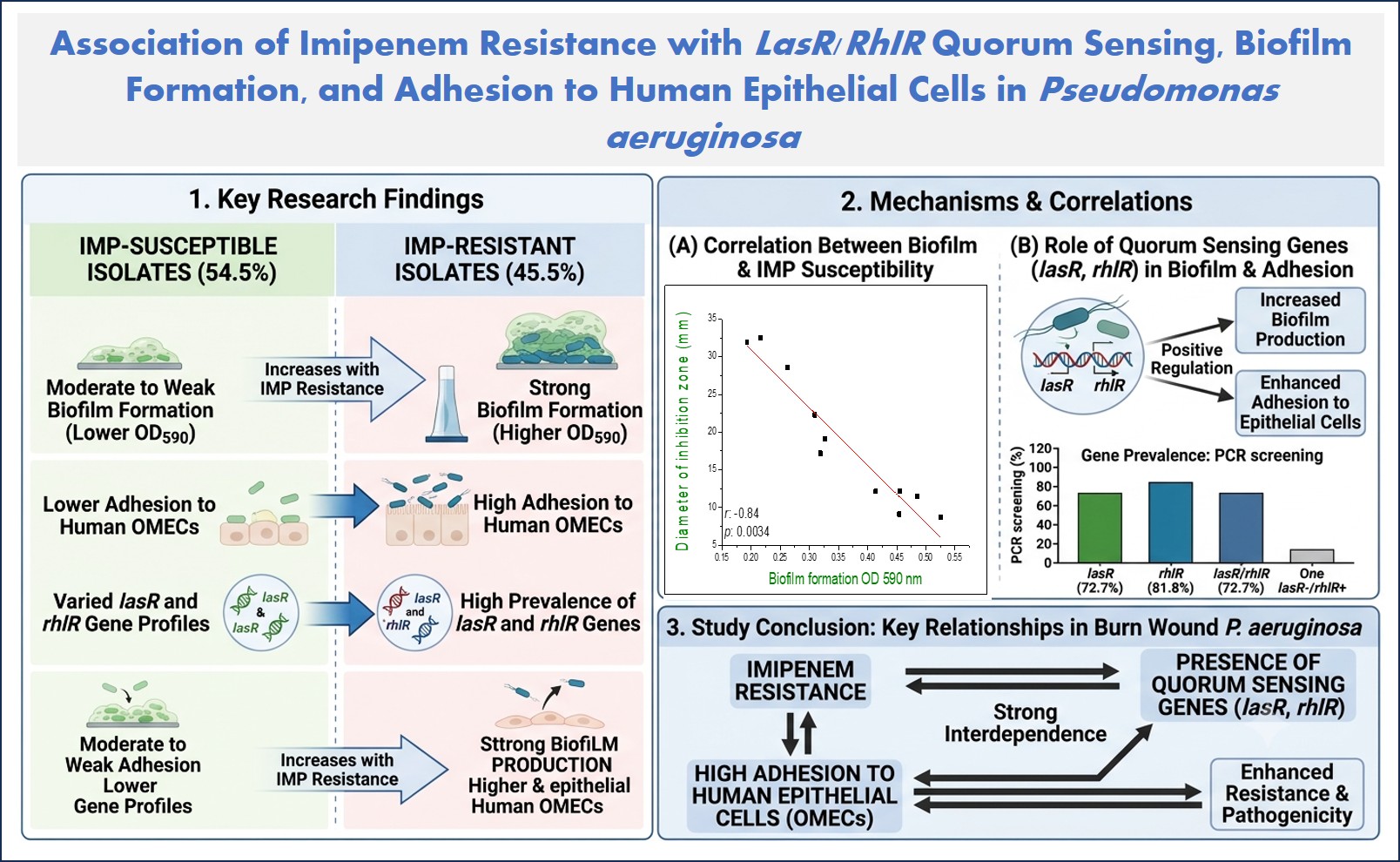
Pseudomonas aeruginosa is responsible for a high rate of burn wound infection. Biofilm formation enhances this pathogen's resistance to antibiotics. Quorum-sensing (QS) genes regulate biofilm production. Carbapenem resistance, particularly to imipenem (IMP), is a major challenge for physicians. The study aims to investigate the relationships among IMP resistance, lasR/rhlR QS genes, biofilm formation, and adhesion of P. aeruginosa to human oral mucosal epithelial cells (OMECs). Eleven P. aeruginosa isolates were obtained from burn wound infections; 45.5% were IMP-resistant. All IMP-resistant isolates were strong biofilm producers. A significant negative correlation was observed between IMP susceptibility, measured as the diameter of the inhibition zone (r = - 0.84, P < 0.005), and biofilm formation, measured as optical density at 590 nm. This finding indicates that biofilm formation in P. aeruginosa decreases IMP susceptibility. The current study also revealed that strong biofilm producers showed high adhesion to human OMECs. Polymerase chain reaction (PCR) screening detected lasR in 72.7% of P. aeruginosa isolates and rhIR in 81.8%, with both genes co-occurring in 72.7% and absent in 18.2%. The study revealed that one isolate had a lasR-negative/rhIR-positive profile. The study concluded that there is a strong relationship among QS gene carriage, biofilm production, adhesion to epithelial cells, and IMP resistance in P. aeruginosa.
Article History:
Received May 02, 2026
Revised June 12, 2026
Accepted: June 22, 2026
Published: June 28, 2026
Downloads
References
1. Hemmati J, Nazari M, Abolhasani FS, Ahmadi A, Asghari B. (2024) In vitro investigation of relationship between quorum-sensing system genes, biofilm forming ability, and drug resistance in clinical isolates of Pseudomonas aeruginosa. BMC Microbiol 24:99. doi: https://doi.org/10.1186/s12866-024-03249-w . PMCID: PMC10962089 .
2. Pang Z, Raudonis R, Glick BR, Lin TJ, Cheng Z. (2019) Antibiotic resistance in Pseudomonas aeruginosa: mechanisms and alternative therapeutic strategies. Biotechnol Adv 37(1):177–192. doi: https://doi.org/10.1016/j.biotechadv.2018.11.013. PMID: 30500353
3. Sati H, Carrara E, Savoldi A, Hansen P, Garlasco J, et al. (2025) The WHO Bacterial Priority Pathogens List Advisory Group (2025). The WHO Bacterial Priority Pathogens List 2024: a prioritisation study to guide research, development, and public health strategies against antimicrobial resistance. Lancet Infect Dis 25(9):1033–1043. doi: https://doi.org/10.1016/S1473-3099(25)00118-5. PMCID: PMC12367593. DOI: https://doi.org/10.1016/S1473-3099(25)00118-5
4. Montaner M, Lopez-Argüello S, Oliver A, Moya B. (2023) PBP Target Profiling by β-Lactam and β-Lactamase Inhibitors in Intact Pseudomonas aeruginosa: Effects of the Intrinsic and Acquired Resistance Determinants on the Periplasmic Drug Availability. Microbiol Spectr 11(1): e0303822. doi: https://doi.org/10.1128/spectrum.03038-22. PMCID: PMC9927461 DOI: https://doi.org/10.1128/spectrum.03038-22
5. Breidenstein EBM, de la Fuente-Núñez C, Hancock REW. (2011) Pseudomonas aeruginosa: all roads lead to resistance. Trends Microbiol 19(8):419–426. doi: https://doi.org/10.1016/j.tim.2011.04.005. PMID: 21664819.
6. Wilder CN, Diggle SP, Schuster M. (2011) Cooperation and cheating in Pseudomonas aeruginosa: the roles of the las, rhl and pqs quorum-sensing systems. ISME J 5(8):1332–1343. doi: https://doi.org/10.1038/ismej.2011.13. PMCID: PMC3146268. DOI: https://doi.org/10.1038/ismej.2011.13
7. O'Loughlin CT, Miller LC, Siryaporn A, Drescher K, Semmelhack MF, Bassler BL. (2013) A quorum-sensing inhibitor blocks Pseudomonas aeruginosa virulence and biofilm formation. Proc Natl Acad Sci U S A 110(44):17981–17986. doi: https://doi.org/10.1073/pnas.1316981110. PMCID: PMC3816427. DOI: https://doi.org/10.1073/pnas.1316981110
8. Behzadi P, Gajdács M, Pallós P, Ónodi B, Stájer A, et al. (2022) Relationship between biofilm-formation, phenotypic virulence factors and antibiotic resistance in environmental Pseudomonas aeruginosa. Pathogens 11(9):1015. doi: https://doi.org/10.3390/pathogens11091015. PMCID: PMC9503712. DOI: https://doi.org/10.3390/pathogens11091015
9. Wei Q, Ma LZ. (2013) Biofilm matrix and its regulation in Pseudomonas aeruginosa. Int J Mol Sci 14(10):20983–21005. doi: https://doi.org/10.3390/ijms141020983. PMCID: PMC3821654. DOI: https://doi.org/10.3390/ijms141020983
10. Lima JLC, Alves LR, Jacomé PRLA, Bezerra Neto JP, Maciel MAV, Morais MMC. (2018) Biofilm production by clinical isolates of Pseudomonas aeruginosa and structural changes in LasR protein of isolates non biofilm-producing. Braz J Infect Dis 22:129–136. doi: https://doi.org/10.1016/j.bjid.2018.03.003. PMCID: PMC9428190. DOI: https://doi.org/10.1016/j.bjid.2018.03.003
11. Fattouh M, Nasr El-din A, Ahmed N, Saleh AS. (2018) Inhibition of quorum sensing character in Pseudomonas aeruginosa isolates and its effect on biofilm formation and antimicrobial susceptibility profile. Egypt J Med Microbiol 27(1):25–33. doi: https://doi.org/10.21608/ejmm.2018.285134. DOI: https://doi.org/10.21608/ejmm.2018.285134
12. Ibrahim B, Ghafil JA, Abdullah ZA, Kınaytürk NK, Alshahrani SM, et al. (2026) Molecular insights into the oxidative perturbation of VIM-2 metallo-β-lactamase: Active site remodeling restores imipenem susceptibility in Pseudomonas aeruginosa. Microb Pathog 214: 108411. doi: https://doi.org/10.1016/j.micpath.2026.108411. PMID: 41771381. DOI: https://doi.org/10.1016/j.micpath.2026.108411
13. CLSI, Performance Standards for Antimicrobial Disk Susceptibility Tests, Clinical and Laboratory Standards Institute, 2018.
14. Al-Mutalib LAA, Zgair AK. (2023) Effect of subinhibitory doses of rifaximin on in vitro Pseudomonas aeruginosa adherence and biofilm formation to biotic and abiotic surface models. Polim Med 53:97–103. doi: https://doi.org/10.17219/pim/166584. PMID: 37470308. DOI: https://doi.org/10.17219/pim/166584
15. Hemmati J, Nazari M, Abolhasani FS, Ahmadi A, Asghari B. (2024) In vitro investigation of relationship between quorum-sensing system genes, biofilm forming ability, and drug resistance in clinical isolates of Pseudomonas aeruginosa. BMC Microbiol 24:99. doi: https://doi.org/10.1186/s12866-024-03249-w. PMCID: PMC10962089. DOI: https://doi.org/10.1186/s12866-024-03249-w
16. Pang Z, Raudonis R, Glick BR, Lin TJ, Cheng Z. (2019) Antibiotic resistance in Pseudomonas aeruginosa: Mechanisms and alternative therapeutic strategies. Biotechnol Adv 37(1):177–192. doi: https://doi.org/10.1016/j.biotechadv.2018.11.013. PMID: 30500353. DOI: https://doi.org/10.1016/j.biotechadv.2018.11.013
17. Breidenstein EBM, de la Fuente-Núñez C, Hancock REW. (2011) Pseudomonas aeruginosa: All roads lead to resistance. Trends Microbiol 19(8):419–426. doi: https://doi.org/10.1016/j.tim.2011.04.005. PMID: 21664819. DOI: https://doi.org/10.1016/j.tim.2011.04.005
18. Meng X, Ning C, Lu X, Kang M, Yang Y, et al. (2026) The Effects of Baicalin in Combination with Cefotaxime on the Biofilm and Metabolic Reprogramming of Multidrug-Resistant Pseudomonas aeruginosa. Biomolecules 16(4): 598. doi: https://doi.org/10.3390/biom16040598. PMCID: PMC13113927. DOI: https://doi.org/10.3390/biom16040598
Additional Files
Published
Issue
Section
License
Copyright (c) 2026 Marwa Mohammed Talib, Mansour Salem Attia, Ahmed Amrajaa Abdulrraziq (Author)

This work is licensed under a Creative Commons Attribution 4.0 International License.
All articles in the World Journal of Experimental Biosciences are published under the terms of the Creative Commons Attribution 4.0 International License (CC BY 4.0) ( (http://creativecommons.org/licenses/by/4.0/), which permits unrestricted use, distribution, and reproduction in any medium, provided the original work is properly cited.