Integrated Low-DMSO Cryopreservation and Expansion Strategies Enhance Cord Blood CD34⁺ Stem Cell Recovery and Function
DOI:
https://doi.org/10.65329/wjeb.v14.01.04Keywords:
Cord blood bank; CD34+, cryopreservation, hematopoietic stem cells, plant hormones.Abstract
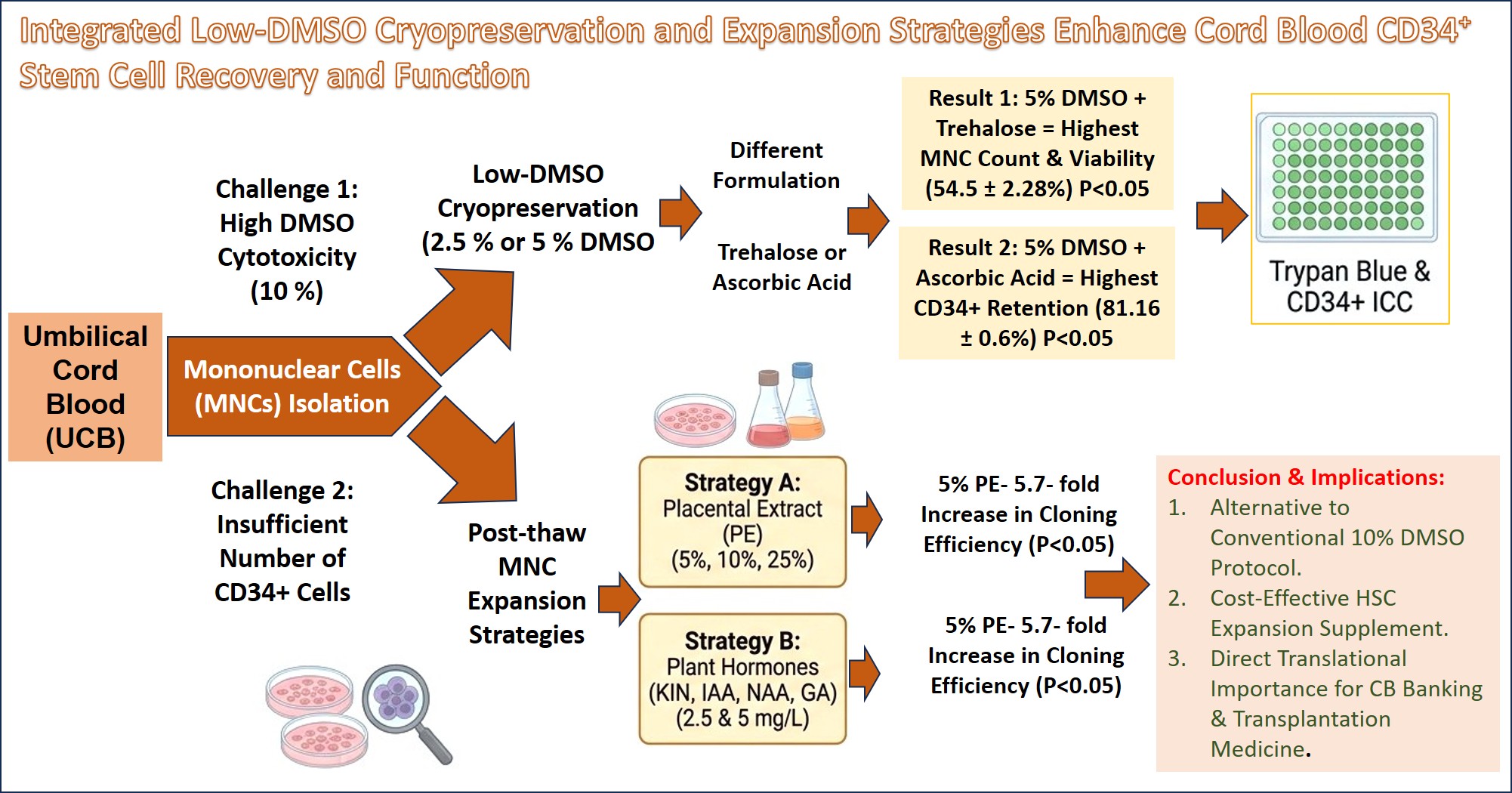
Umbilical cord blood (UCB) is a source of CD34+ hematopoietic stem cells (HSCs). The main challenges in handling them are the cytotoxicity of 10% dimethyl sulfoxide (DMSO) cryoprotection and insufficient cell number from a single cord blood unit. To address them, UCB-derived mononuclear cells (MNCs) were isolated by Ficoll density gradient centrifugation and cryopreserved in different formulations: 2.5% or 5% DMSO, each alone or supplemented with trehalose (25 µg/mL) or ascorbic acid (80 µg/mL). Post-thaw, viable MNC counts were assessed using trypan blue viability, and CD34+ immunocytochemistry was performed. To overcome the second challenge, MNCs were cultured for 7 days with 5%, 10%, or 25% placental extract, or for 4 days with 4 plant hormones, including kinetin, indole-3-acetic acid, naphthaleneacetic acid, and gibberellic acid at 2.5 and 5 mg/L. The MTT assay was used to evaluate the cytotoxicity. The results showed that 5% DMSO with trehalose yielded the highest post-thaw MNC count (4.70 ± 0.10 × 10⁶ cells/mL) and viability of 54.50 ± 0.28%, whereas 5% DMSO with ascorbic acid produced the highest CD34+ retention (81.16 ± 0.60%), both significantly higher than in 2.5% DMSO formulations (P < 0.05). 5% placental extract increased cloning efficiency 5.7-fold compared with the control (P < 0.05). The hormones used depleted differentiated MNCs while preserving CD34+ content at 89-96%. These findings establish 5% DMSO with trehalose or ascorbic acid as an alternative to conventional 10% DMSO protocols, and 5% placental extract as a cost-effective HSC expansion supplement with direct translational importance for cord blood banking and transplantation medicine.
References
[1] Mayani H, Lansdorp PM. (1998) Biology of human umbilical cord blood-derived hematopoietic stem/progenitor cells. Stem Cells 16(3): 153–165. doi: https://doi.org/10.1002/stem.160153 , PMID: 9617891.
[2] Rubinstein P, Carrier C, Scaradavou A, Kurtzberg J, Adamson J, et al. (1998) Outcomes among 562 recipients of placental-blood transplants from unrelated donors. N Engl J Med 339(22):1565–1577. doi: https://doi.org/10.1056/NEJM199811263392201, PMID: 9828244
[3] Mayani H. (2024) Umbilical Cord Blood Hematopoietic Cells: From Biology to Hematopoietic Transplants and Cellular Therapies. Arch Med Res 55(6): 103042. doi: https://doi.org/10.1016/j.arcmed.2024.103042 , PMID: 39003965.
[4] Zenhäusern R, Tobler A, Leoncini L, Hess OM, Ferrari P. (2000) Fatal cardiac arrhythmia after infusion of dimethyl sulfoxide-cryopreserved hematopoietic stem cells in a patient with severe primary cardiac amyloidosis and end-stage renal failure. Ann Hematol 79(9): 523–526. doi: https://doi.org/10.1007/s002770000186, PMID: 11043425 .
[5] Zambelli A, Poggi G, Da Prada G, Pedrazzoli P, Cuomo A, et al. (1998). Clinical toxicity of cryopreserved circulating progenitor cells infusion. Anticancer Res 18(6B):4705–4708. PMID: 9891544.
[6] Taherian MM, Abdoos P, Taherian MH, Ghorbanian F, Saltanatpour Z, Alizadeh A. (2024) Cryopreservation of Stem Cells in Tissue Engineering and Regenerative Medicine. J Appl Biotechnol Rep 11(3):1359-1370. doi: https://doi.org/10.30491/jabr.2022.331200.1501
[7] Sun WQ, Davidson P. (1998) Protein inactivation in amorphous sucrose and trehalose matrices: effects of phase separation and crystallization. Biochim Biophys Acta 1425(1):235–244. https://doi.org/10.1016/s0304-4165(98)00076-2 , PMID: 9813347
[8] Sabbah MA, Shamkhi NF, Alwachi SN. (2011) Trehalose and ascorbic acid improves the Cryopreservation of umbilical Cord Blood hematopoietic stem Cells (CD34+) with low Concentrations of Dimethylsulfoxide. Iraqi J Cancer Med Genet 4(1):57-62. https://doi.org/10.29409/ijcmg.v4i1.58
[9] Motta JP, Paraguassú-Braga FH, Bouzas LF, Porto LC. (2014) Evaluation of intracellular and extracellular trehalose as a cryoprotectant of stem cells obtained from umbilical cord blood. Cryobiology 68(3): 343–348. https://doi.org/10.1016/j.cryobiol.2014.04.007 , PMID: 24769312.
[10] Mantri S, Satpathy AK, Mohapatra PC. (2021) Trehalose: effect on cryopreservation of umbilical cord blood-derived hematopoietic stem cells. Acta Haematol Pol 52(2):121–126. https://doi.org/10.5603/AHP.2021.0018.
[11] Buettner GR. (1993) The pecking order of free radicals and antioxidants: lipid peroxidation, alpha-tocopherol, and ascorbate. Arch Biochem Biophys 300(2):535–543. https://doi.org/10.1006/abbi.1993.1074 ,PMID: 8434935.
[12] Limaye LS, Kale VP. (2001) Cryopreservation of human hematopoietic cells with membrane stabilizers and bioantioxidants as additives in the conventional freezing medium. J Hematother Stem Cell Res 10(5):709–718. https://doi.org/10.1089/152581601753193931, PMID: 11672518
[13] Mantri S, Kanungo S, Mohapatra PC. (2015) Cryoprotective Effect of Disaccharides on Cord Blood Stem Cells with Minimal Use of DMSO. Indian J Hematol Blood Transfus 31(2):206–212. https://doi.org/10.1007/s12288-014-0352-x, PMID: 25825559
[14] Liu B, Tao C, Wu Z, Yao H, Wang DA. (2022) Engineering strategies to achieve efficient in vitro expansion of haematopoietic stem cells: development and improvement. J Mater Chem B 10(11): 1734–1753. https://doi.org/10.1039/d1tb02706a , PMID: 35191442
[15] Kadekar D, Kale V, Limaye L. (2015) Differential ability of MSCs isolated from placenta and cord as feeders for supporting ex vivo expansion of umbilical cord blood derived CD34(+) cells. Stem Cell Res Ther 6: 201. https://doi.org/10.1186/s13287-015-0194-y, PMCID: PMC4617445
[16] Teleb RS, Abdul-Hafez A, Othman A, Ahmed AE, Elsaid AA, et al. (2023) Cord Blood Plasma and Placental Mesenchymal Stem Cells-Derived Exosomes Increase Ex Vivo Expansion of Human Cord Blood Hematopoietic Stem Cells While Maintaining Their Stemness. Cells 12(2), 250. https://doi.org/10.3390/cells12020250, PMCID: PMC9857343
[17] Wang L, Cheng J, Lin F, Liu S, Pan H, et al. (2019) Ortho-Topolin Riboside Induced Differentiation through Inhibition of STAT3 Signaling in Acute Myeloid Leukemia HL-60 Cells. Turk J Haematol 36(3):162–168. https://doi.org/10.4274/tjh.galenos.2019.2019.0020, PMCID: PMC6682775
[18] Park E, Ciofani M (2025) Th17 cell pathogenicity in autoimmune disease. Exp Mol Med 57(9):1913–1927. https://doi.org/10.1038/s12276-025-01535-9, PMCID: PMC12508148
[19] Surbek DV, Schönfeld B, Tichelli A, Gratwohl A, Holzgreve W. (1998) Optimizing cord blood mononuclear cell yield: a randomized comparison of collection before vs after placenta delivery. Bone Marrow Transplant 22(3):311–312. https://doi.org/10.1038/sj.bmt.1701315, PMID: 9720751.
[20] Solves P, Moraga R, Saucedo E, Perales A, Soler MA, et al. (2003) Comparison between two strategies for umbilical cord blood collection. Bone Marrow Transplant 31(4):269–273. https://doi.org/10.1038/sj.bmt.1703809, PMID: 12621461.
[21] Sutherland DR, Keating A. (1992) The CD34 antigen: structure, biology, and potential clinical applications. J Hematother 1(2):115–129. https://doi.org/10.1089/scd.1.1992.1.115, PMID: 1285404
[22] Scott KL, William N, Acker JP. (2022) The response of a human haematopoietic cell line to trehalose-loaded liposomes and their effect on post-thaw membrane integrity. Cryobiology 106:160–163. https://doi.org/10.1016/j.cryobiol.2022.03.005, PMID: 35413361
[23] Jafar H, Abuarqoub D, Ababneh N, Hasan M, Al-Sotari S, et al. (2019) hPL promotes osteogenic differentiation of stem cells in 3D scaffolds. PloS one 14(5): e0215667. https://doi.org/10.1371/journal.pone.0215667, PMCID: PMC6504042
[24] Sakurai M, Ishitsuka K, Becker HJ, Yamazaki S. (2024) Ex vivo expansion of human hematopoietic stem cells and clinical applications. Cancer Sci 115(3):698–705. https://doi.org/10.1111/cas.16066, PMCID: PMC10921004.
[25] Meaker GA, Wilkinson AC. (2024) Ex vivo hematopoietic stem cell expansion technologies: recent progress, applications, and open questions. Exp Hematol 130:104136. https://doi.org/10.1016/j.exphem.2023.12.001, PMCID: PMC11511678
[26] Cilloni D, Garau D, Regazzi E, Sammarelli G, Savoldo B, et al. (1999) Primitive hematopoietic progenitors within mobilized blood are spared by uncontrolled rate freezing. Bone Marrow Transplant 23(5):497–503. https://doi.org/10.1038/sj.bmt.1701601, PMID: 10100565.
[27] Yang H, Acker JP, Cabuhat M, Letcher B, Larratt L, McGann LE. (2005) Association of post-thaw viable CD34+ cells and CFU-GM with time to hematopoietic engraftment. Bone marrow transplant 35(9):881–887. https://doi.org/10.1038/sj.bmt.1704926, PMID: 15778729.
[28] Maas RGC, Lee S, Harakalova M, Snijders Blok CJB, Goodyer WR, et al. (2021) Massive expansion and cryopreservation of functional human induced pluripotent stem cell-derived cardiomyocytes. STAR Protoc 2(1):100334. https://doi.org/10.1016/j.xpro.2021.100334, PMCID: PMC7881265
[29] Zhang XB, Li K, Yau KH, Tsang KS, Fok TF, et al. (2003) Trehalose ameliorates the cryopreservation of cord blood in a preclinical system and increases the recovery of CFUs, long-term culture-initiating cells, and nonobese diabetic-SCID repopulating cells. Transfusion 43(2):265–272. https://doi.org/10.1046/j.1537-2995.2003.00301.x, PMID: 12559024.
[30] Mondal B. (2009). A simple method for cryopreservation of MDBK cells using trehalose and storage at -80 degrees C. Cell Tissue Bank 10(4): 341–344. https://doi.org/10.1007/s10561-009-9130-7, PMID: 19381873.
Downloads
Additional Files
Published
Issue
Section
License

This work is licensed under a Creative Commons Attribution 4.0 International License.
All articles in the World Journal of Experimental Biosciences are published under the terms of the Creative Commons Attribution 4.0 International License (CC BY 4.0) ( (http://creativecommons.org/licenses/by/4.0/), which permits unrestricted use, distribution, and reproduction in any medium, provided the original work is properly cited.