Pathogenicity and Efficacy of Beauveria bassiana against the Larval and Adult Stages of Culex pipiens.
DOI:
https://doi.org/10.65329/wjeb.v14.01.05Keywords:
Beauveria bassiana, biological control, Culex pipiens, Entomopathogenic fungi.Abstract
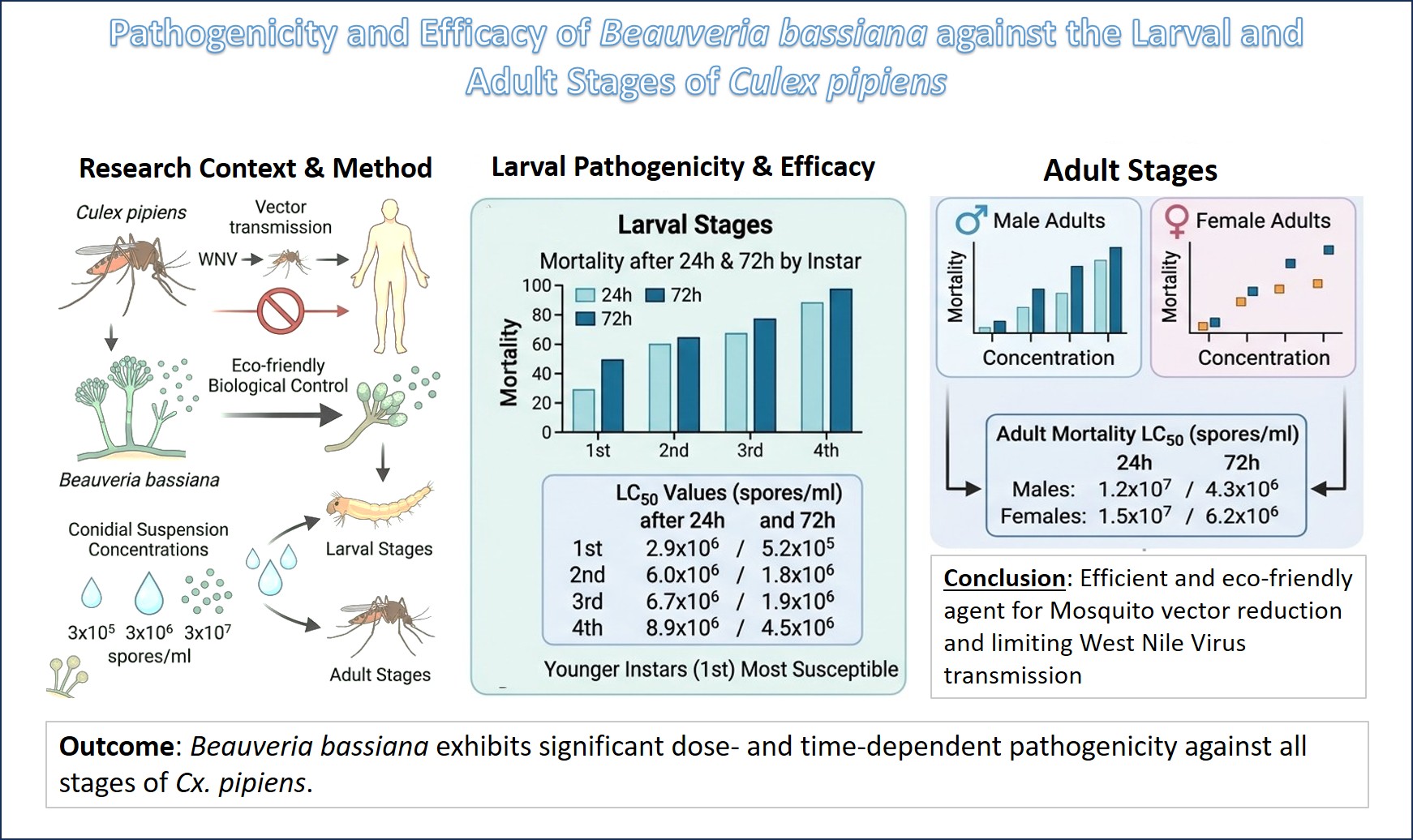
Diseases transmitted by mosquitoes pose a threat to global public health. Culex pipiens transmits West Nile virus. The eco-friendly biological control, recruited by Beauveria bassiana, is a promising strategy. The current study aims to employ entomopathogenic fungi (B. bassiana) against the larval and adult stages of Cx. pipiens as an alternative method to chemical pesticides. The study investigated the effects of conidial suspension concentrations (3 x 10⁵, 3 x 10⁶, and 3 x 10⁷ spores/ml) on four larval stages of Cx pipiens. The first instar was the most susceptible and showed significantly higher mortality at higher concentrations. The LC50 values for the first larval instar were 2.935 x 10⁶ and 5.241 x 10⁵ spores/ml after exposing for 24 and 72 h, respectively. For the second instar, the values were 5.988 x 10⁶ and 1.845 x 10⁶ spores/ml; for the third instar, 6.696 x 10⁶ and 1.868 x 10⁶ spores/ml; and for the fourth instar, 8.913 x 10⁶ and 4.45 x 10⁶ spores/ml, in the same intervals of time. Furthermore, mortality percentages for adults were 1.245 x 10⁷ and 4.314 x 10⁶ spores/ml for males, and 1.456 x 10⁷ and 6.159 x 10⁶ spores/ml for females after 24 and 72 h of treatment, respectively. The findings demonstrate that B. bassiana exhibits significant pathogenicity against both larval and adult stages of Cx. pipiens, with efficacy increasing at higher concentrations and longer exposure times. These results support its role as an eco-friendly biological control agent in reducing mosquito populations and limiting the transmission of West Nile virus.
References
[1] Aliota MT, Peinado SA, Osorio JE, Bartholomay LC. (2016) Culex pipiens and Aedes triseriatus mosquito susceptibility to Zika virus. Emerg Infect Dis 22(10):1857–1859. doi: https://doi.org/10.3201/eid2210.161082.
[2] World Health Organization (WHO). (2018). Malaria Programs Iraq.
[3] Ishak IH, Kamgang B, Ibrahim SS, Riveron JM, Irving H, Wondji CS. (2017) Pyrethroid resistance in Malaysian populations of dengue vector Aedes aegypti is mediated by CYP9 family of cytochrome P450 genes. PLoS Negl Trop Dis 11(1): doi: https://doi.org/10.1371/journal.pntd.0005302
[4] Thongwat D, Chokchaisiri R, Ganranoo L, Bunchoo N. (2018) Larvicidal efficacy of crude and fractionated extracts of Dracaena loureiri against Aedes aegypti, Aedes albopictus, Culex quinquefasciatus and Anopheles minimus mosquito vectors. Asian Pac J Trop Biomed 8(5):247–254. doi: https://doi.org/10.4103/2221-1691.233009
[5] Ginting S, Djamilah, Sipriyadi, Sari SP. (2025) Morphological and molecular characterization of entomopathogenic fungi Beauveria spp. Bengkulu isolate. HAYATI J Biosci 32(4):1103–1108. doi: https://doi.org/10.4308/hjb.32.4.1103-1108
[6] Aboelhadid SA, Ibrahim SM, Arafa WM, Mahrous LN, Abdel–Baki AS, Wahba AA. (2018) In vitro efficacy of Verticillium lecanii and Beauveria bassiana of commercial source against cattle tick, Rhipicephalus (Boophilus) annulatus. Adv Anim Vet Sci 6(3):139–147. doi: https://doi.org/10.17582/journal.aavs/2018/6.3.139.147
[7] Apriyanto D, Nadrawati. (2019) Laboratory evaluation of Bengkulu isolates of Beauveria bassiana and Metarhizium anisopliae against coffee berry borer, Hypothenemus hampei, using the spraying method. J HPT Tropika 19(2):93–100. doi: https://doi.org/10.23960/j.hptt.21993-100
[8] Yasin M, Wakil W, Ghazanfar MU, Qayyum MA, Tahir M, Bedford GO. (2019) Virulence of entomopathogenic fungi Beauveria bassiana and Metarhizium anisopliae against red palm weevil, Rhynchophorus ferrugineus (Olivier). Entomol Res 49(1): 3–12. doi: https://doi.org/10.1111/1748-5967.12260
[9] Chen WH, Liu M, Huang ZX, Yang GM, Han YF, et al. (2018) Beauveria majiangensis, a new entomopathogenic fungus from Guizhou, China. Phytotaxa 333(2):243–250. doi: https://doi.org/10.11646/phytotaxa.333.2.8.
[10] Manjushree G, Chellappan M. (2019) Evaluation of entomopathogenic fungus for the management of pink mealybug, Dysmicoccus brevipes (Cockerell) (Hemiptera: Pseudococcidae) on pineapple in Kerala. J Entomol Zool Stud 7(1):1215–1222.
[11] Samson RA, Evans HC, Latge JP. (1988) Atlas of entomopathogenic fungi. Springer-Verlag.
[12] World Health Organization (WHO). (2005). Guidelines for laboratory and field testing of mosquito larvicides (WHO/CDS/WHOPES/GCDPP/13). Geneva, Switzerland.
[13] Gopal GS, Venkateshalu B, Nadaf AM, Guru PN, Pattepur S. (2021) Management of the grape mealy bug, Maconellicoccus hirsutus (Green), using entomopathogenic fungi and botanical oils: A laboratory study. Egypt J Biol Pest Control 31(1):1–8. doi: https://doi.org/10.1186/s41938-021-00444-z
[14] Pérez Panti O, García de la Cruz R, González Hernández H, Sánchez Soto S, Moscoso Ramírez PA, Izquierdo Reyes F. (2024) Bio-efficacy of entomopathogenic fungi and vegetable oils against the pink pineapple mealybug: Dysmicoccus brevipes (Cockerell). Rev Fac Cienc Agrar UNCuyo 56(1):83–93. doi: https://doi.org/10.48162/rev.39.125
[15] Qu Y, Tang R, Liu Y, Chen Y, Shen Y, et al. (2025) Field experiment reveals varied earthworm densities boost soil organic carbon more than they increase carbon dioxide emissions. Geoderma 456: 117251. doi: https://doi.org/10.1016/j.geoderma.2025.117251
[16] Abbott, W. S. (1925). A method of computing the effectiveness of an insecticide. Journal of Economic Entomology, 18(2), 265–267. https://doi.org/doi.org/10.1093/jee/18.2.265a
[17] Ullah S, Raza ABM, Alkafafy M, S Sayed, M I Hamid. (2022) Isolation, identification and virulence of indigenous entomopathogenic fungal strains against the peach-potato aphid, Myzus persicae Sulzer (Hemiptera: Aphididae), and the fall armyworm, Spodoptera frugiperda (J.E. Smith) (Lepidoptera: Noctuidae). Egypt J Biol Pest Control 32, 2. doi: https://doi.org/10.1186/s41938-021-00500-8
[18] Sevim A, Demir I, Demirbag Z (2010). Molecular characterization and virulence of Beauveria spp. from the pine processionary moth, Thaumetopoea pityocampa (Lepidoptera: Thaumetopoeidae). Mycopathologia, 170(4):269–277. doi: https://doi.org/10.1007/s11046-010-9321-6
[19] Kubota MS, Cseko YM, Oliveira JH, Traub-Cseko YM. (2022) Sexual dimorphism in immune responses and infection resistance in Aedes aegypti and other hematophagous insect vectors. Front Trop Dis 3:847109. doi: https://doi.org/10.3389/fitd.2022.847109
[20] Zamani Z, Aminaee MM, Khaniki GB. (2013) Introduction of Beauveria bassiana as a biological control agent for Tribolium castaneum in Kerman province. Arch Phytopathol Plant Prot 46(18):2235–2243. doi: https://doi.org/10.1080/03235408.2013.790650
[21] Micheline M, Manuel A, Lourdes M, Silva D, Antonio J. (2014) Influence of volumetric oxygen transfer coefficient (kLa) on xylanases batch production by Aspergillus niger van Tieghem in stirred tank and internal–loop airlift bioreactors. Biochem Eng J 80:19–26. doi: https://doi.org/10.1016/j.bej.2013.09.002
[22] Mastore M, Quadroni S, Toscano A, Mottadelli N, Brivio MF. (2019) Susceptibility to entomopathogens and modulation of basal immunity in two insect models at different temperatures. J Therm Biol 79:15–23. doi: https://doi.org/10.1016/j.jtherbio.2018.11.006
[23] Pelizza S, Mancini M, Russo L, Vianna F, Scorsetti AC. (2023) Control capacity of the LPSc 1067 strain of Beauveria bassiana (Ascomycota: Hypocreales) on different species of grasshoppers (Orthoptera: Acrididae: Melanoplinae), agricultural pests in Argentina. Rev Fac Cienc Agrar UNCUYO 55(1):98–103. doi: https://doi.org/10.48162/rev.39.099
[24] Oliveira MTD, Monteiro AC, Scala Júnior NL, Barbosa JC, Mochi DA. (2016) Sensibility of isolates of entomopathogenic fungi to solar radiation, ultraviolet rays and temperature. Arquivos do Instituto Biológico, 83, 1–7. doi: https://doi.org/10.1590/1808-1657000042014
[25] Ito ET, Varea PG, Dalva TM, Maria HPP, Pedro MOJ. (2007) Production of extracellular protease by Brazilian strain of Beauveria bassiana reactivated on coffee berry borer, Hypothenemus hampei. Braz Arch Biol Technol 50(2):217–223. doi: https://doi.org/10.1590/S1516-89132007000200006
[26] Chen WH, Han YF, Liang ZQ, Jin DC. (2017) A new araneogenous fungus in the genus Beauveria from Guizhou, China. Phytotaxa, 302(1): 57–64. doi: https://doi.org/10.11646/phytotaxa.302.1.5
[27] Lacey CM, Lacey LA, Roberts DW. (1988) Route of invasion and histopathology of Metarhizium anisopliae in Culex quinquefasciatus. J Invertebr Pathol 52(1):108–118. doi: https://doi.org/10.1016/0022-2011(88)90109-7. PMID: 3418133.
[28] Matsoukis S, Eliopoulos PA. (2020) Endophytic entomopathogenic fungi: A valuable biological control tool against plant pests. Appl Sci 10(1): 360. doi: https://doi.org/10.3390/app10010360
[29] Saleem U, Asrar M, Hussain D, Hafeez F, Qadir MS. (2025) Evaluation of entomopathogenic fungi and nematode species for eco-friendly management of fall armyworm, Spodoptera frugiperda (J. E. Smith) (Lepidoptera: Noctuidae). Int J Trop Insect Sci 45:1975–1984. doi: https://doi.org/10.1007/s42690-025-01559-8
[30] Abid Falhy MM, Azeez ZF. (2025) Effectiveness of entomopathogenic fungi against adult red flour beetles (Tribolium castaneum) (Coleoptera: Tenebrionidae). Indones J Health Sci Med 2(1):52. doi: https://doi.org/10.21070/ijhsm.v2i1.52
Downloads
Published
Issue
Section
License
Copyright (c) 2026 Majida Mohammad Abidfalhy Yaseen (Author)

This work is licensed under a Creative Commons Attribution 4.0 International License.
All articles in the World Journal of Experimental Biosciences are published under the terms of the Creative Commons Attribution 4.0 International License (CC BY 4.0) ( (http://creativecommons.org/licenses/by/4.0/), which permits unrestricted use, distribution, and reproduction in any medium, provided the original work is properly cited.