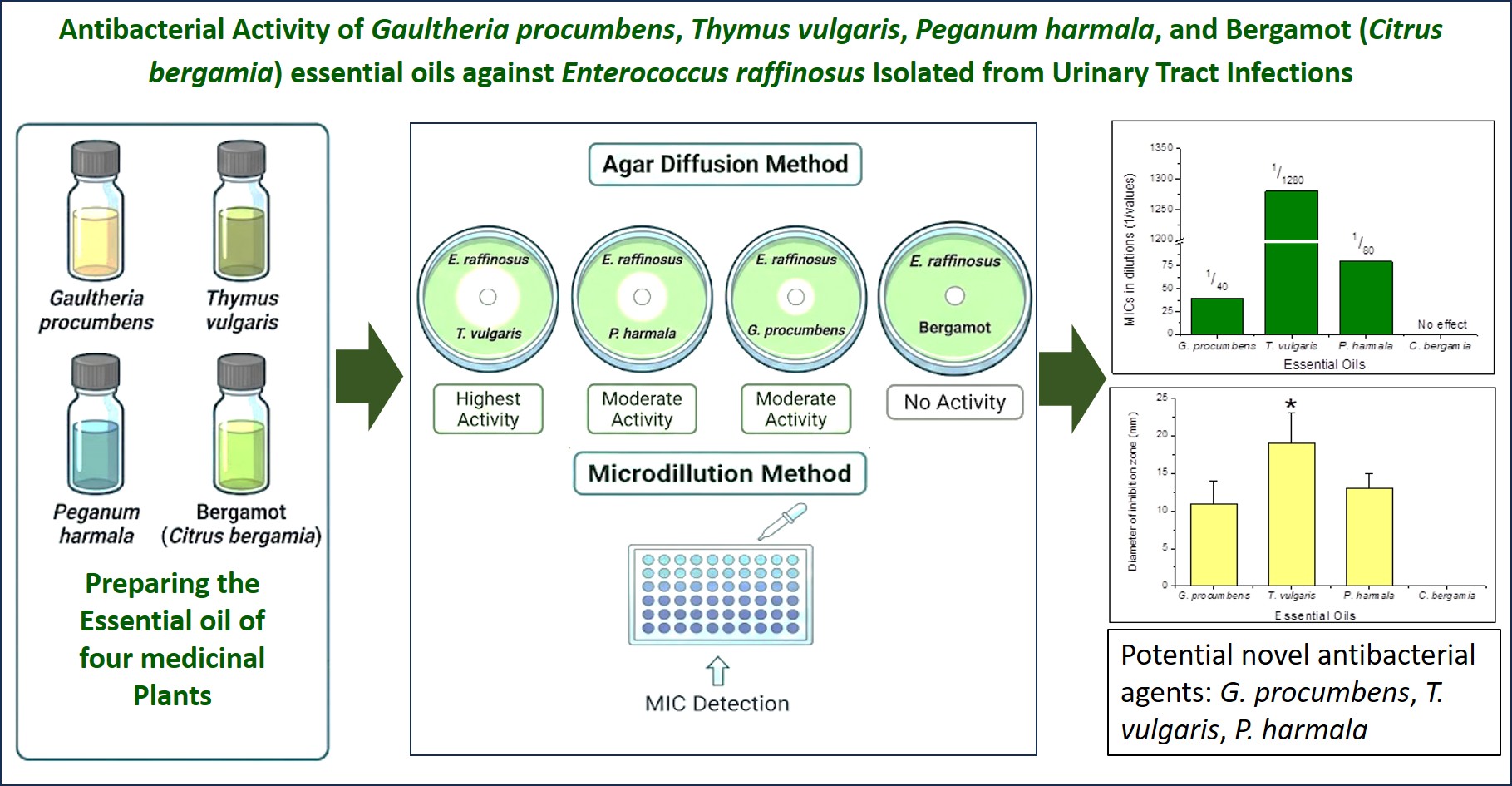
Antibacterial Activity of Gaultheria procumbens, Thymus vulgaris, Peganum harmala, and Bergamot (Citrus bergamia) Essential Oils against Enterococcus raffinosus Isolated from Urinary Tract Infections
DOI:
https://doi.org/10.65329/wjeb.v13.02.006Keywords:
Antibacterial effect, Enterococcus raffinosus, Essential oil, Urinary tract infections.Abstract
The discovery of alternative antimicrobial agents against resistant bacteria has been a major target for microbiologists and physicians, especially in recent years, because the resistance to antibiotics has increased. No previous study has investigated the antibacterial effects of essential oils prepared from Gaultheria procumbens, Thymus vulgaris, Peganum harmala, and Bergamot (Citrus bergamia) against Enterococcus raffinosus. The present study aims to investigate the antibacterial activity of the essential oils of the above medicinal plants against E. raffinosus in vitro. In the present study, essential oils were extracted from the above four medicinal plants. For evaluating the antibacterial effect of the essential oils, three isolates of E. raffinosus were isolated from 44 urine samples collected from patients with urinary tract infections (UTIs). Only one isolate was multidrug-resistant (MDR) to commonly used antibiotics. The microdilution method on microtiter plates and the agar diffusion method were used to check the susceptibility of E. raffinosus to the essential oils. The study showed that the essential oil of T. vulgaris showed the highest antibacterial activity against E. raffinosus, followed by P. harmala. The present study showed a moderate antibacterial effect of G. procumbens essential oil against E. raffinosus. The present study showed no antibacterial effect of the essential oil of Bergamot against E. raffinosus. It can be concluded from the study that the antibacterial effect of the essential oils prepared from G. procumbens, T. vulgaris, and P. harmala against MDR-E. raffinosus, that is why these oils can serve as a novel antibacterial agent against E. raffinosus infections.
References
[1] Salam MA, Al-Amin MY, Salam MT, Pawar JS, Akhter N, et al. (2023). Antimicrobial Resistance: A Growing Serious Threat for Global Public Health. Healthcare (Basel) 11(13):1946. https://doi.org/10.3390/healthcare11131946 PMID: 37444780; PMCID: PMC10340576.
[2] Al-Jumaili AA, Ahmed KK. (2024) A review of antibiotic misuse and bacterial resistance in Iraq. East Mediterr Health J 30(10):663-670. https://doi.org/10.26719/2024.30.10.663 .
[3] Miskeen PA, Deodhar L. (2002) Antimicrobial susceptibility pattern of Enterococcus species from urinary tract infections. J Assoc Physicians India 50:378-81. PMID: 11922226..
[4] Lapcharoen K, Bumrungpun C, Chumpol W, Lunha K, Yongkiettrakul S, et al. (2025) Investigation of Bacterial Species and Their Antimicrobial Drug Resistance Profile in Feline Urinary Tract Infection in Thailand. Animals (Basel) 15(15):2235. https://doi.org/10.3390/ani15152235 . PMID: 40805025; PMCID: PMC12345554 .
[5] Lee YW, Lim SY, Jung J, Kim MJ, Chong YP, et al. (2022) Enterococcus raffinosus bacteremia: clinical experience with 49 adult patients. Eur J Clin Microbiol Infect Dis 41(3):415-420. https://doi.org/10.1007/s10096-021-04389-x . PMID: 34977997.
[6] Fujii A, Kawada-Matsuo M, Nguyen-Tra Le M, Masuda K, Tadera K, et al. (2024) Antibiotic susceptibility and genome analysis of Enterococcus species isolated from inpatients in one hospital with no apparent outbreak of vancomycin-resistant Enterococcus in Japan. Microbiol Immunol 68(8):254-266. https://doi.org/10.1111/1348-0421.13155 . PMID: 38873884.
[7] Guimarães AC, Meireles LM, Lemos MF, Guimarães MCC, Endringer DC, et al. (2029) Antibacterial Activity of Terpenes and Terpenoids Present in Essential Oils. Molecules 24(13):2471. https://doi.org/10.3390/molecules24132471 . PMID: 31284397; PMCID: PMC6651100.
[8] Gago C, Serralheiro A, Miguel MDG. (2025) Anti-Inflammatory Activity of Thymol and Thymol-Rich Essential Oils: Mechanisms, Applications, and Recent Findings. Molecules 30(11):2450. https://doi.org/10.3390/molecules30112450 . PMID: 40509336; PMCID: PMC12155930.
[9] Jintanasirinurak S, Manichart N, Somala N, Laosinwattana C, Teerarak M. (2023) Chemical analysis and bioactivities of Gaultheria procumbens L. essential oil: Herbicidal, antioxidant and antibacterial activities. Curr Appl Sci Technol 23(5):10-55003. https://doi.org/10.55003/cast.2023.05.23.009
[10] Cebi N, Erarslan A. (2023) Determination of the Antifungal, Antibacterial Activity and Volatile Compound Composition of Citrus bergamia Peel Essential Oil. Foods 12(1):203. https://doi.org/10.3390/foods12010203 . PMID: 36613419; PMCID: PMC9818623.
[11] Toc DA, Pandrea SL, Botan A, Mihaila RM, Costache CA, et al. (2022) Enterococcus raffinosus, Enterococcus durans and Enterococcus avium Isolated from a Tertiary Care Hospital in Romania-Retrospective Study and Brief Review. Biology (Basel) 11(4):598. https://doi.org/10.3390/biology11040598 . PMID: 35453797; PMCID: PMC9030019 .
[12] Abed IJ, Hussein AR, Abdulhasan GA, Dubaish AN. (2022) Microbiological Effect of Lemongrass Cymbopogon Citratus and Spearmint Mentha Spicata Essential Oils as Preservatives and Flavor Additives in Yogurt, Iraqi J Sci 63(7):2839-2849. https://doi.org/10.24996/ijs.2022.63.7.8
[13] Khalaf AN, Abed IJ. (2021) Evaluating the in vitro Cytotoxicity of Thymus vulgaris Essential Oil on MCF-7 and HeLa Cancer Cell Lines. Iraqi J Sci 62(9):2862-2871. https://doi.org/10.24996/ijs.2021.62.9.3
[14] Yao H, Liu J, Jiang X, Chen F, Lu X, Zhang J. (2021) Analysis of the Clinical Effect of Combined Drug Susceptibility to Guide Medication for Carbapenem-Resistant Klebsiella pneumoniae Patients Based on the Kirby-Bauer Disk Diffusion Method. Infect Drug Resist 14:79-87. https://doi.org/10.2147/IDR.S282386. PMID:33469322; PMCID: PMC7812027 .
[15] CLSI. (2024) Performance standards for antimicrobial disk susceptibility tests, CLSI M02, 14th ed. Clinical and Laboratory Standards Institute, Wayne, PA. https://clsi.org/shop/standards/m02/ .
[16] Zhang M, Qin R, Zhang X, Ge L, Li G, et al. (2024) Spontaneous resolution or antibiotic effectiveness? Reflection on a case of pediatric urinary tract infections caused by Enterococcus raffinosus. FEMS Microbiol Lett 371:fnae030. https://doi.org/10.1093/femsle/fnae030 . PMID: 38740525.
[17] Bakó C, Balázs VL, Kerekes E, Kocsis B, Nagy DU, et al. (2023) Flowering phenophases influence the antibacterial and anti-biofilm effects of Thymus vulgaris L. essential oil. BMC Complement Med Ther 23(1):168. https://doi.org/10.1186/s12906-023-03966-1. PMID: 37226152; PMCID: PMC10207748.
[18] de Oliveira Nóbrega LMM, de Araújo FSM, Nóbrega HKDC, Ribeiro ABBG, Fernandes VDG, et al. (2023). Evaluation of the Antibacterial Activity of Gaultheria procumbens Essential Oil Against Klebsiella pneumoniae Strains. Eur J Med Health Sci 5(6):33-37. https://eu-opensci.org/index.php/ejmed/article/view/41930/9960
[19] Arif M, Wang X, Kazi MSK, Ullah Khan S, Saeed S, et al. (2022) Antimicrobial activities of different solvent extracts from stem and seeds of Peganum Harmala L. PLoS One 17(4):e0265206. https://doi.org/10.1371/journal.pone.0265206. PMID: 35482722; PMCID: PMC9049364.
[20] Quirino A, Giorgi V, Palma E, Marascio N, Morelli P, et al. (2022) Citrus bergamia: Kinetics of Antimicrobial Activity on Clinical Isolates. Antibiotics (Basel) 11(3):361. https://doi.org/10.3390/antibiotics11030361. PMID: 35326824; PMCID: PMC8944555 .
Downloads
Published
Issue
Section
License

This work is licensed under a Creative Commons Attribution 4.0 International License.
All articles in the World Journal of Experimental Biosciences are published under the terms of the Creative Commons Attribution 4.0 International License (CC BY 4.0) ( (http://creativecommons.org/licenses/by/4.0/), which permits unrestricted use, distribution, and reproduction in any medium, provided the original work is properly cited.