Study the level of microbial and chemical pollutants in the soil of some densely populated areas of Baghdad
DOI:
https://doi.org/10.65329/wjeb.v13.02.005Keywords:
Heavy metals, Microorganism, Pollution, Skin infectionAbstract
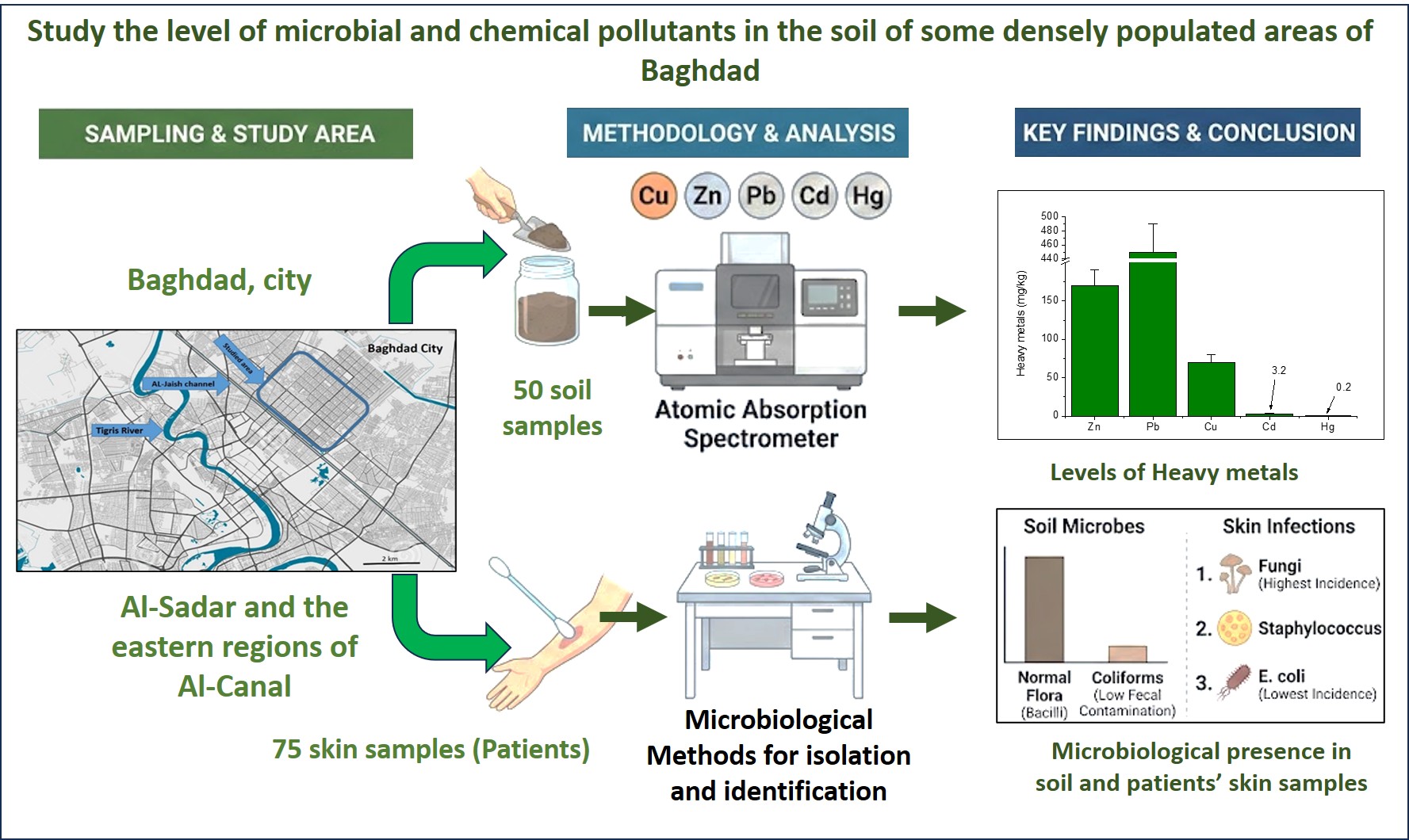
The problem of environmental pollution with heavy metals and pathogenic microorganisms, especially soil contamination, is considered one of the most important public health threats. The current study aims to evaluate the levels of soil contamination in densely populated areas of Baghdad with heavy metals and pathogenic microorganisms and evaluate the incidence of skin infection with different microorganisms in the study areas. Fifty soil samples were collected from different regions of Al-Sadr City and the areas east of the canal. The atomic absorption spectrometer was used to measure the level of heavy metals [Cooper (cu), Zinc (Zn), Lead (Pb), Cadmium (cd), and Mercury (Hg)]. Routine microbiological techniques were used to evaluate the levels of soil contamination with different microorganisms, and the same methods were used to isolate and identify the microorganism causing skin infection in 75 skin swabs collected from outdoor patients of the same study's area. The results of the current study showed that heavy metal levels in the soil samples were below the permissible limits by the United States Environmental Protection Agency (EPA) document. The study also showed that most soil samples were contaminated with microorganisms, particularly normal flora bacteria, at high levels, followed by actinomycetes, whereas contamination with coliform bacteria was very low. The results of microbial examination of the skin showed that the fungal infection was followed by a bacterial infection (Staphylococcal infection), whereas infection with Escherichia coli was the lowest. The current study concludes that soil contamination levels in densely populated areas of Baghdad are within acceptable limits. The study also showed that microbial contamination with fecal microorganisms was low.
References
[1] Lillini R, Tittarelli A, Bertoldi M, Ritchie D, Katalinic A, et al. (2021) Water and Soil Pollution: Ecological Environmental Study Methodologies Useful for Public Health Projects. A Literature Review. Rev Environ Contam Toxicol. 256:179-214. https://doi.org/10.1007/398_2020_58. PMID: 33866420.
[2] Mhammedsharif RM, Kolo KY. (2023) A case study of environmental pollution by pathogenic bacteria and metal(oid)s at Soran Landfill Site, Erbil, Iraqi Kurdistan Region. Environ Monit Assess 195:811. https://doi.org/10.1007/s10661-023-11352-0 .
[3] Perković S, Paul C, Vasić F, Helming K. (2022) Human Health and Soil Health Risks from Heavy Metals, Micro(nano)plastics, and Antibiotic Resistant Bacteria in Agricultural Soils. Agronomy 12(12):2945. https://doi.org/10.3390/agronomy12122945
[4] Yang Q, Li Z, Lu X, Duan Q, Huang L, Bi J. (2018) A review of soil heavy metal pollution from industrial and agricultural regions in China: Pollution and risk assessment. Sci Total Environ 642:690-700. https://doi.org/10.1016/j.scitotenv.2018.06.068 . PMID: 29909337.
[5] Chang L, Shen S, Zhang Z, Song X, Jiang Q. (2018) Study on the relationship between age and the concentrations of heavy metal elements in human bone. Ann Transl Med 6(16):320. https://doi.org/10.21037/atm.2018.08.09 . PMID: 30363972; PMCID: PMC6186975.
[6] Ahmed,YS, Al-Shandah BT. (2024) Evaluating Water Quality of the Tigris River in the Qayyarah District/Nineveh/Iraq Through the Concentrations of Some Heavy metals and Some Limnological Parameters. Egypt J Aquat Biol Fish 28(4):23-39. https://doi.org/10.21608/ejabf.2024.365576
[7] Mouhamad RS, Hussein AA, Alsaedi SA, Nasif NS, Joda SO. (2017) Detect of human fecal contamination in water and soil of multiple sanitary landfills in Baghdad city. Microbiol Res Int 5(4):43-50. https://www.netjournals.org/z_MRI_17_021.html
[8] Ohya H, Fujiwara S, Komai Y. Yamaguchi M. (1988) Microbial biomass and activity in urban soils contaminated with Zn and Pb. Biol Fert Soils 6:9–13 (1988). https://doi.org/10.1007/BF00257913 .
[9] Khudhair SA, Ismael HA, Rashak NA, Mallooki AM, Ghafil JA, Zgair AK. (2023) Antimicrobial effect of soil microorganisms’ products against different clinical bacterial isolates. World J Exp Biosci 11: 41- 45. https://doi.org/10.65329/wjeb.v11.02.004
[10] Aly R, Maibach HI, Shinefield HR, Strauss WG. (1972) Survival of pathogenic microorganisms on human skin. J Invest Dermatol 58(4):205-10. https://doi.org/10.1111/1523-1747.ep12539912. PMID: 4623202.
[11] Al-Dulaimi GA, Younes MK. (2017) Assessment of potable water quality in Baghdad City, Iraq. Air Soil Water Res 10: https://doi.org/10.1177/1178622117733441
[12] Yang J, Sun Y, Wang Z, Gong J, Gao J, et al. (2022) Heavy metal pollution in agricultural soils of a typical volcanic area: Risk assessment and source appointment. Chemosphere 304:135340. https://doi.org/10.1016/j.chemosphere.2022.135340. PMID: 35709847.
[13] Balali-Mood M, Naseri K, Tahergorabi Z, Khazdair MR, Sadeghi M. (2021) Toxic mechanisms of five heavy metals: mercury, lead, chromium, cadmium, and arsenic. Frontiers in pharmacology, 12, 643972. https://doi.org/10.3389/fphar.2021.643972 .
[14] Hartmann M, Six J. (2023) Soil structure and microbiome functions in agroecosystems. Nat Rev Earth Environ 4:4–18 (2023). https://doi.org/10.1038/s43017-022-00366-w .
[15] Daunoras J, Kačergius A, Gudiukaitė R. (2024) Role of soil microbiota enzymes in soil health and activity changes depending on climate change and the type of soil ecosystem Biology 13(2): 85. https://doi.org/10.3390/biology13020085.
[16] Zheng F, Guo X, Tang M, Zhu D, Wang H, et al. (2023) Variation in pollution status, sources, and risks of soil heavy metals in regions with different levels of urbanization. Sci Total Environ 866:161355. https://doi.org/10.1016/j.scitotenv.2022.161355 . PMID: 36610633.
[17] Yin F, Meng W, Liu L, Feng K, Yin C. (2023) Spatial Distribution and Associated Risk Assessment of Heavy Metal Pollution in Farmland Soil Surrounding the Ganhe Industrial Park in Qinghai Province, China. Land 12(6):1172. https://doi.org/10.3390/land12061172 .
[18] Yuan C-Z, Wang X-R. (2023) Source Apportionment and Health Risk Assessment of Heavy Metals in Soils of Old Industrial Areas—A Case Study of Shanghai, China. Int J Environ Res Public Health. 20(3):2395. https://doi.org/10.3390/ijerph20032395 . PMID: 36767761; PMCID: PMC9915166.
[19] Mao X, Sun J, Shaghaleh H, Jiang X, Yu H, et al. (2023) Environmental Assessment of Soils and Crops Based on Heavy Metal Risk Analysis in Southeastern China. Agronomy 13(4):1107. https://doi.org/10.3390/agronomy13041107
[20] Hadi MS, Abadi AL, Himawan T, MASRURI M, Lestari SR, et ql. (2021) The role of bacterial symbionts in the biodegradation of chlorpyrifos in the digestive tract of Plutella xylostella larvae. J Biol Divers 22(2):702-712. https://doi.org/10.13057/biodiv/d220222
[21] Abed RM, Abbas RA, Al-Chalabi FA, Ahmed ZA. (2025) Assessment of Mycorrhizal Colonization and Heavy Metal Accumulation in Phragmites australis from the Euphrates River Banks, Iraq. Catrina (Int J Environ Sci) 34(1):11-17. doi.org/10.21608/cat.2025.267844.1253
[22] Li H, Yao J, Liu J, Min N, Sunahara G, et al. (2023) Effects of soil metal(loid)s pollution on microbial activities and environmental risks in an abandoned chemical smelting site. J Environ Sci (China) 143:60-70. https://doi.org/10.1016/j.jes.2023.08.011. PMID: 38644024.
[23] Fadhil Alsaffar, M., Hufdhy Ajam, W., & Abdelsalam, A. (2024). Skin Conditions and Microbial Infections Among Iraqi Primary School Students in the Babil Governorate, Iraq. Iranian Journal of Medical Microbiology, 18(5), 337-342. https://doi.org/10.30699/ijmm.18.5.337
Downloads
Published
Issue
Section
License

This work is licensed under a Creative Commons Attribution 4.0 International License.
All articles in the World Journal of Experimental Biosciences are published under the terms of the Creative Commons Attribution 4.0 International License (CC BY 4.0) ( (http://creativecommons.org/licenses/by/4.0/), which permits unrestricted use, distribution, and reproduction in any medium, provided the original work is properly cited.