Bacteriocin Produced by Lactobacillus acidophilus Exhibits Antagonistic Activity Against Uropathogenic Klebsiella pneumoniae
DOI:
https://doi.org/10.65329/wjeb.v13.02.004Keywords:
Antibiofilm, Antagonism, Bacteriocin, Klebsiella pneumoniae, UTI.Abstract
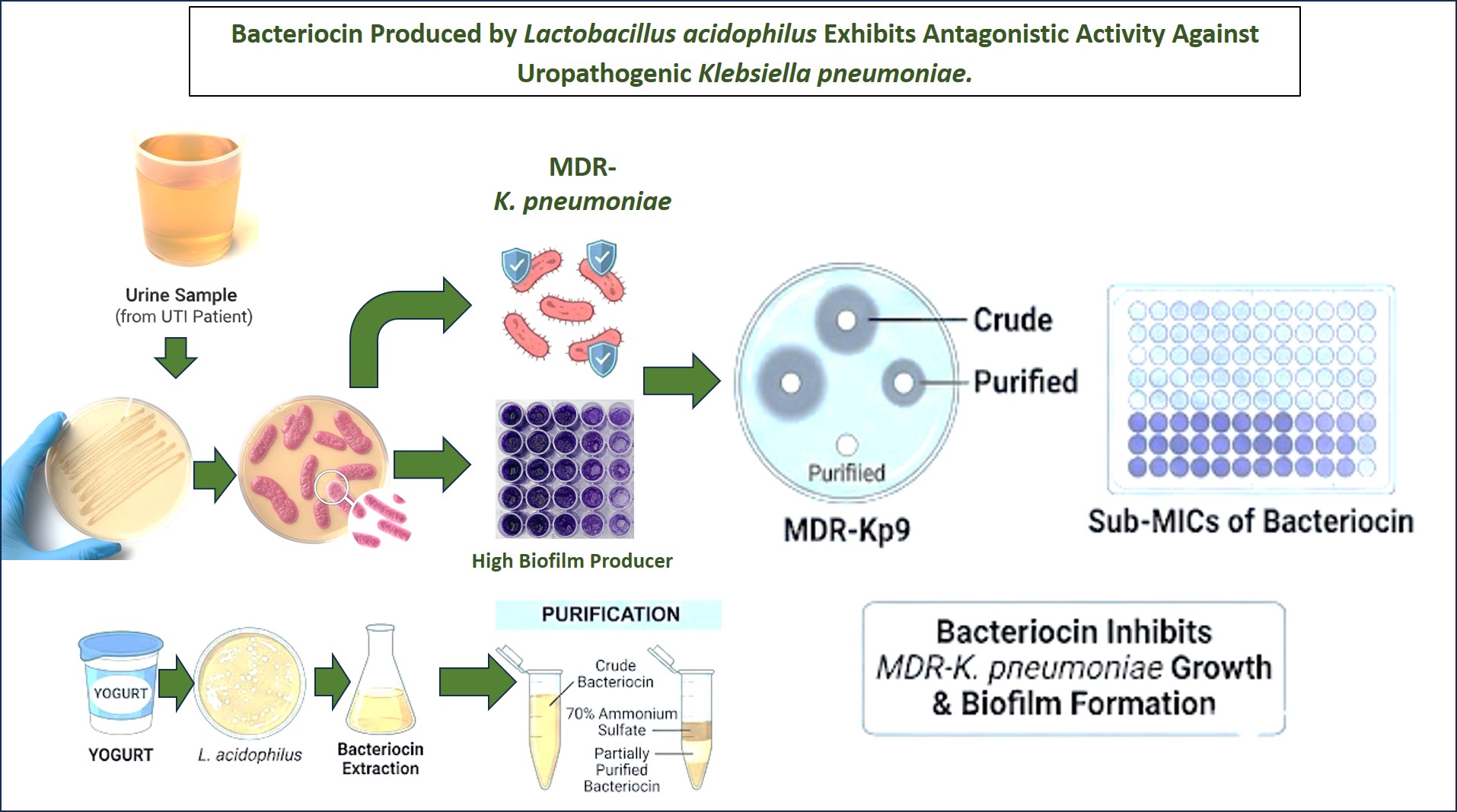
Antibiotic resistance in bacteria is a major problem facing the health system worldwide. The ability of bacteria to form biofilms enhances their resistance to antibiotics. Finding alternative antimicrobial agents is a crucial approach in the global fight against infectious diseases caused by multidrug-resistant bacteria. In this study, yogurt samples were cultured on Man–Rogosa–Sharpe agar (MRS) to isolate Lactobacillus acidophilus. Fifty urine samples were collected from patients with urinary tract infections (UTI). Eleven isolates of Klebsiella pneumoniae were obtained from these samples. The bacteriocin was extracted from L. acidophilus grown in MRS broth. Ammonium sulfate at 70% saturation was used for the partial purification of the bacteriocin. The gel diffusion method evaluated the antibacterial effect of both crude and partially purified bacteriocin on MDR-K. pneumoniae, which produced the highest level of biofilm. The ability of the 11 isolates of K. pneumoniae to produce biofilm was assessed using the microdilution method in a polystyrene microtiter plate. The results showed that out of eleven isolates, eight were MDR. All isolates produced biofilm at different levels. Both crude and partially purified bacteriocin (at dilutions 1/2, 1/4, 1/8, 1/16, and 1/32) inhibited the growth of Kp9. The partially purified bacteriocin was more effective than the crude form in inhibiting Kp9 growth. Sub-MICs (1/2, 1/4, 1/8, and 1/16 MICs) of both crude and partially purified bacteriocin inhibited biofilm formation of Kp9. The bacteriocin from L. acidophilus has the ability to inhibit MDR-K. pneumoniae and its capacity to prevent biofilm formation in vitro.
References
[1] Thompson D, Xu J, Ischia J, Bolton D. (2023) Fluoroquinolone resistance in urinary tract infections: Epidemiology, mechanisms of action and management strategies. BJUI Compass 5(1):5-11. https://doi.org/10.1002/bco2.286 . PMID: 38179021 ; PMCID: PMC10764174.
[2] Ghafil JA, İbrahim BMS, Zgair AK. (2022) Coating indwelling urinary catheters with moxifloxacin prevents biofilm formation by Burkholderia cepacia. Polim Med 52(1):7-11. https://doi.org/10.17219/pim/149986 . PMID: 35754328.
[3] De Rosa FG, Corcione S, Cavallo R, Di Perri G, Bassetti M. (2015) Critical issues for Klebsiella pneumoniae KPC-carbapenemase producing K. pneumoniae infections: a critical agenda. Future Microbiol 10(2):283-94. https://doi.org/10.2217/fmb.14.121. PMID: 25689539.
[4] Mohammed MT, Zgair AK. (2025) Multidrug-resistant Klebsiella pneumoniae isolated from an infected wound in Iraq. World J Exp Biosci 13:11-14. https://doi.org/10.65329/wjeb.v13.01.001
[5] Sakkas H, Bozidis P, Ilia A, Mpekoulis G, Papadopoulou C. (2019) Antimicrobial Resistance in Bacterial Pathogens and Detection of Carbapenemases in Klebsiella pneumoniae Isolates from Hospital Wastewater. Antibiotics (Basel) 8(3):85. https://doi.org/10.3390/antibiotics8030085 PMID: 31252510; PMCID: PMC6783922.
[6] Ming L, Zhang Q, Yang L, Huang JA. (2015) Comparison of antibacterial effects between antimicrobial peptide and bacteriocins isolated from Lactobacillus plantarum on three common pathogenic bacteria. Int J Clin Exp Med 8(4):5806-11. PMID: 26131169; PMCID: PMC4483923.
[7] Icer MA, Özbay S, Ağagündüz D, Kelle B, Bartkiene E, Rocha JMF, Ozogul F. (2023) The Impacts of Acidophilic Lactic Acid Bacteria on Food and Human Health: A Review of the Current Knowledge. Foods 12(15):2965. https://doi.org/10.3390/foods12152965 . PMID: 37569234; PMCID: PMC10418883.
[8] Zhydzetski A, Głowacka-Grzyb Z, Bukowski M, Żądło T, Bonar E, Władyka B. (2024) Agents Targeting the Bacterial Cell Wall as Tools to Combat Gram-Positive Pathogens. Molecules 29(17):4065. https://doi.org/10.3390/molecules29174065 . PMID: 39274911; PMCID: PMC11396672.
[9] Javadi K, Emadzadeh MR, Mohammadzadeh Hosseini Moghri SAH, Halaji M, Parsian H, et al. (2025) Anti-biofilm and antibacterial effect of bacteriocin derived from Lactobacillus plantarum on the multidrug-resistant Acinetobacter baumannii. Protein Expr Purif 226:106610. https://doi.org/10.1016/j.pep.2024.106610 . Epub 2024 Sep 19. PMID: 39306312.
[10] Al-Mathkhury HJ, Ali AS, Ghafil JA. (2011) Antagonistic effect of bacteriocin against urinary catheter associated Pseudomonas aeruginosa biofilm. N Am J Med Sci 3(8):367-70. https://doi.org/10.4297/najms.2011.3367 . PMID: 22171244; PMCID: PMC3234144
[11] Lowry O, Rosebrouch N, Frra A, Randall RJ. (1951) Protein measurement with the Folin phenol reagent. J Biol Chem 193: 267-275. PMID: 14907713
[12] Al-Mutalib LAA, Zgair AK. (2023) Effect of subinhibitory doses of rifaximin on in vitro Pseudomonas aeruginosa adherence and biofilm formation to biotic and abiotic surface models. Polim Med 53(2):97-103. https://doi.org/10.17219/pim/166584 . PMID: 37470308.
[13] Zgair AK, Chhibber S. (2013) Stenotrophomonas maltophilia flagellin is involved in bacterial adhesion and biofilm formation. Microbiol 82(5): 647-651. https://doi.org/10.1134/S0026261713050172
[14] Ghafil JA, Al-Sudani SFK, Ibrahim SBM, Alshahrani AM, Zgair AK. (2024) Relationship between biofilm formation of Pseudomonas aeruginosa and susceptibility to rifaximin and ofloxacin. Pak J Pharm Sci 37(6):1609-1614. PMID: 39923153.
[15] López Romo A, Quirós R. (2019) Appropriate use of antibiotics: an unmet need. Ther Adv Urol 11:1756287219832174. https://doi.org/10.1177/1756287219832174 . PMID: 31105775; PMCID: PMC6502979.
[16] Montanari E, Bernardo G, Le Noci V, Anselmi M, Pupa SM, et al. (2025) Biofilm formation by the host microbiota: a protective shield against immunity and its implication in cancer. Mol Cancer 24(1):148. https://doi.org/10.1186/s12943-025-02348-0 . PMID: 40399923; PMCID: PMC12093748.
[17] Lila ASA, Rajab AAH, Abdallah MH, Rizvi SMD, Moin A, et al. (2023) Biofilm Lifestyle in Recurrent Urinary Tract Infections. Life (Basel) 13(1):148. https://doi.org/10.3390/life13010148 . PMID: 36676100; PMCID: PMC9865985 .
[18] Wu S, Liu G, Jin W, Xiu P, Sun C. (2016) Antibiofilm and Anti-Infection of a Marine Bacterial Exopolysaccharide Against Pseudomonas aeruginosa. Front Microbiol 7:102. https://doi.org/10.3389/fmicb.2016.00102 . PMID: 26903981; PMCID: PMC4744842
Downloads
Published
Issue
Section
License

This work is licensed under a Creative Commons Attribution 4.0 International License.
All articles in the World Journal of Experimental Biosciences are published under the terms of the Creative Commons Attribution 4.0 International License (CC BY 4.0) ( (http://creativecommons.org/licenses/by/4.0/), which permits unrestricted use, distribution, and reproduction in any medium, provided the original work is properly cited.